Were Smoky Mountain Grist Mills a Tech Thing?

Making the Most of the Daily Grind

by Ria Nicholas
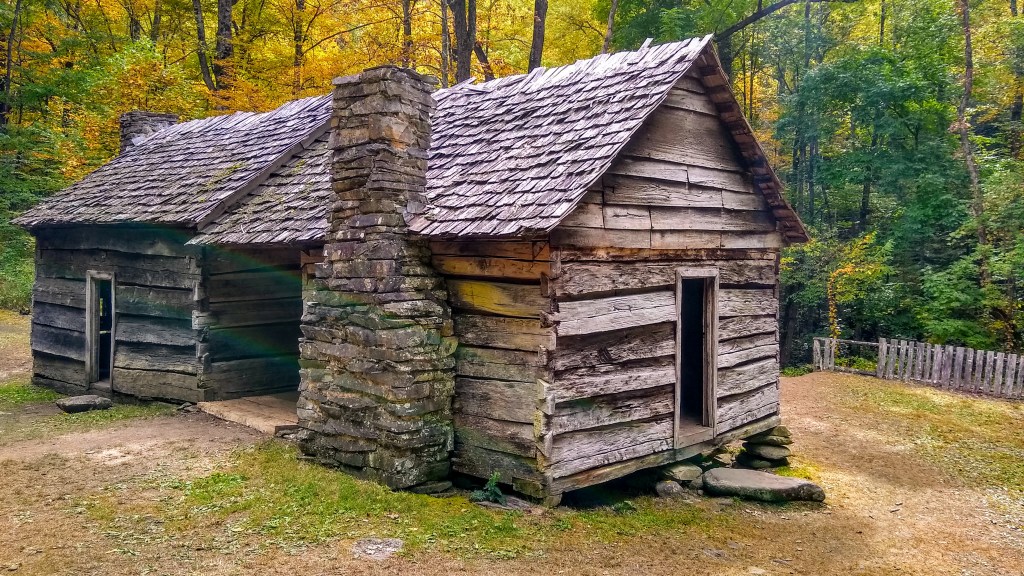
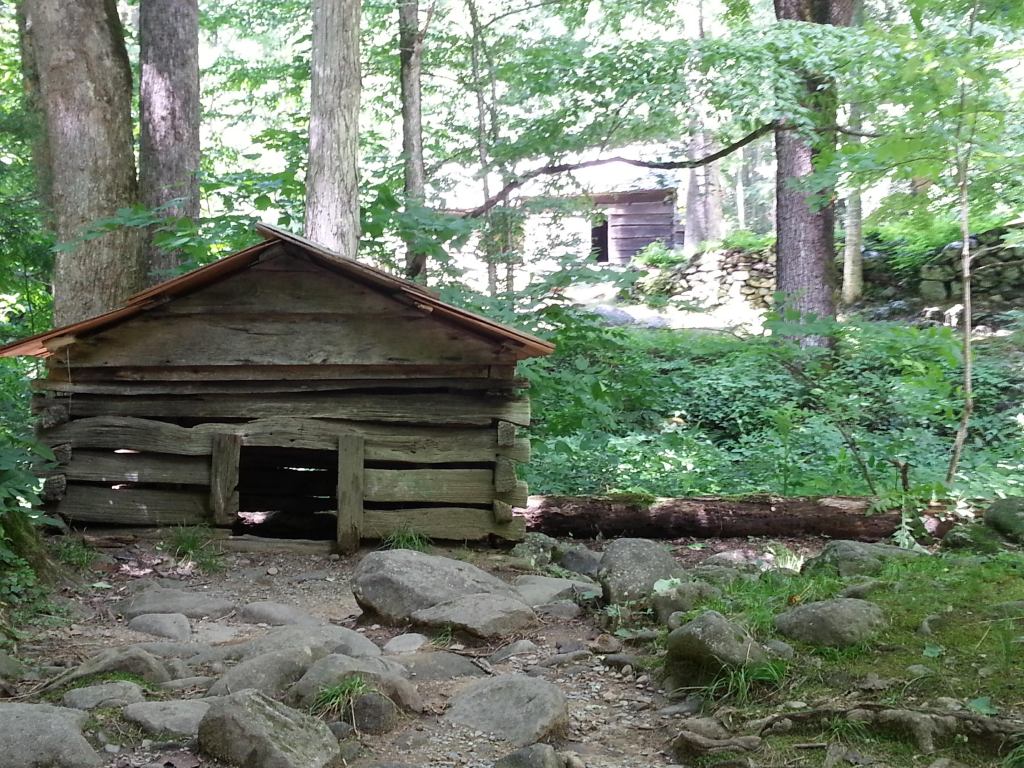
We were surprised to learn that Ephraim and Minerva Bales
raised NINE children in this tiny cabin!

In the late 1800s, scattered Appalachian [apple-AT-ch’n] farm communities consisted of independent, resourceful, God-fearing people, scrappy enough to wrest a living from the hardscrabble soil under their feet. If the Church acted as the spiritual head of the community, and the family epitomized its heart, then the grist mill constituted its secular stomach. Not much of anything could happen without a grist mill, but engineering one from scant frontier resources often meant having to ‘MacGyver‘ the technology on the spot.

“You didn’t make it without corn. Wheat bread may have been for special occasions, but everyone ate cornmeal, sometimes two and three times a day.”

— George Moore, Smoky Mountain resident

(Click on the link to view the video:)


This area of the country was less about amber waves of grain and more about sturdy stalks of corn. Although mountain farms produced wheat, rye, barley, and oats, it was corn that grew here in abundance and supplied the staff of life. It provided grits, spoonbread, hoecakes, mush, cornbread and more – often several times a day – but only if you had access to a mill.
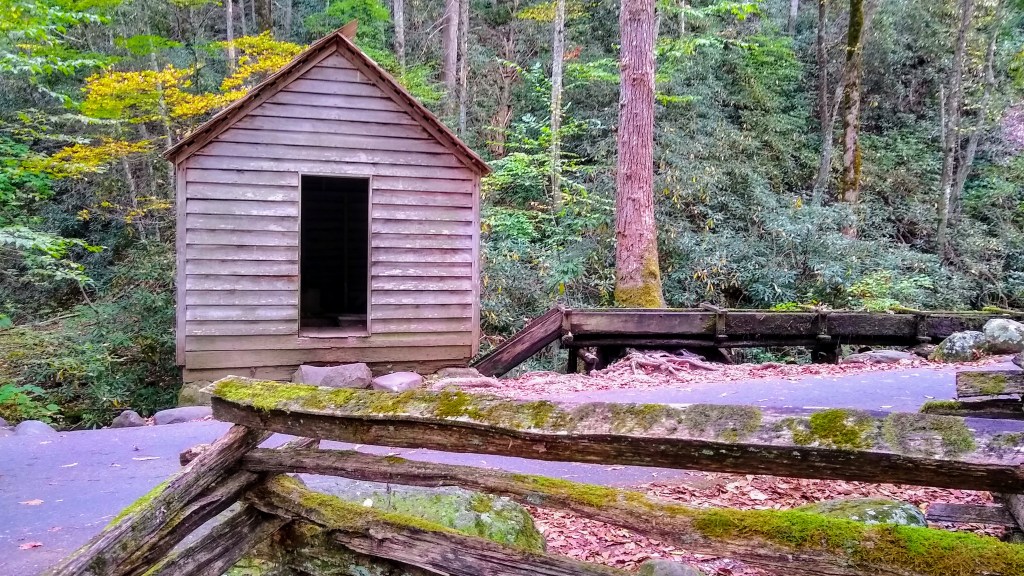
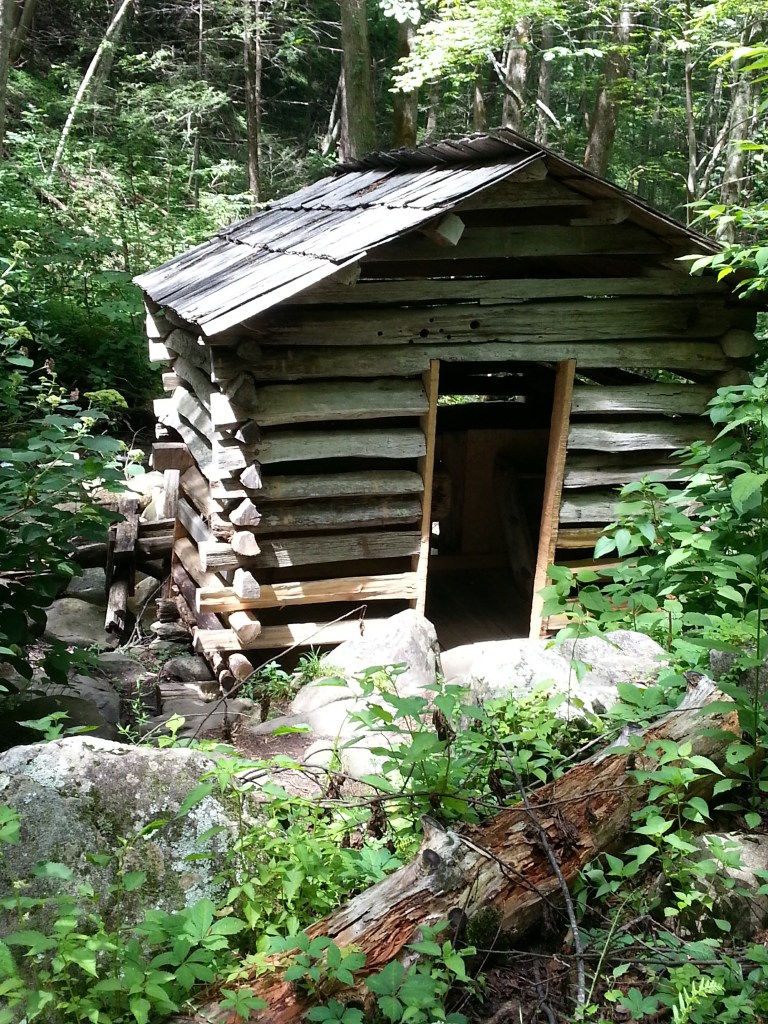
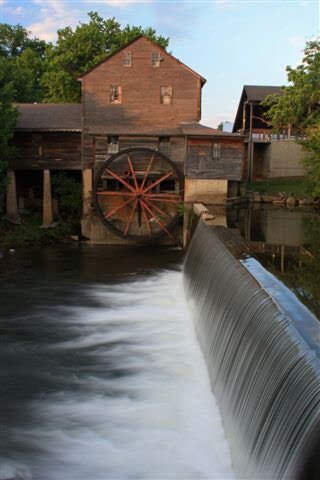
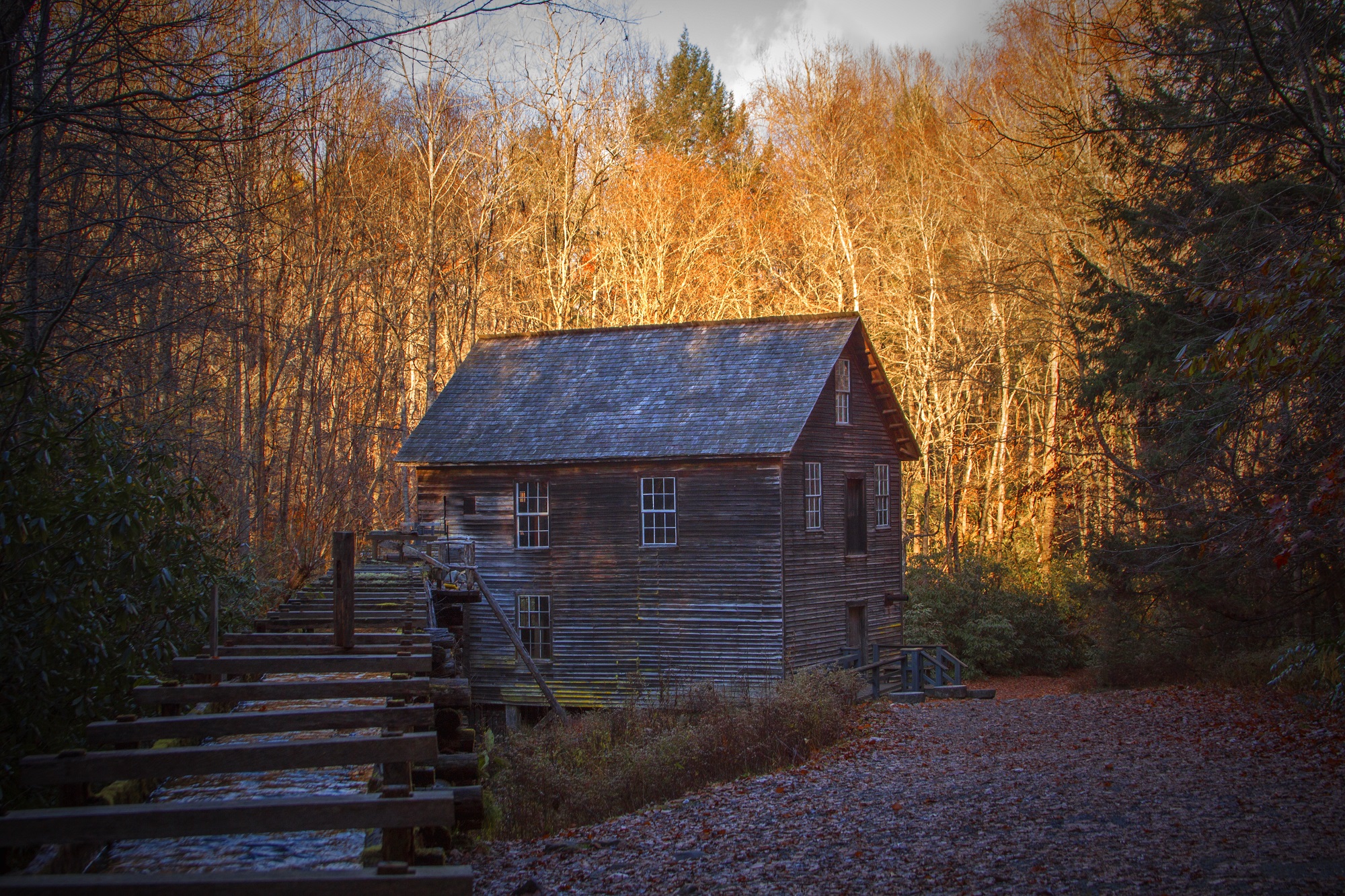
The Reagan Mill sits beside a stream, with its flume to the right; photo by Ria Nicholas

Sign up for more articles. It’s free:
We discovered that Great Smoky Mountains National Park preserves four historic grist mills. Two of them, the Ogle Mill and the Reagan Mill, sit along the Roaring Fork Motor Nature Trail, just outside Gatlinburg in Tennessee.

In Cades Cove, toward the western end of the park, the Cable Mill, with its iconic mill wheel, churns away.

And on U.S. Highway 441, about a mile from the Oconaluftee Visitor Center, not far from Cherokee and Bryson City, in North Carolina, Mingus Mill, the grandest of the grist mills, runs an efficient turbine. All four mills are easily accessible.
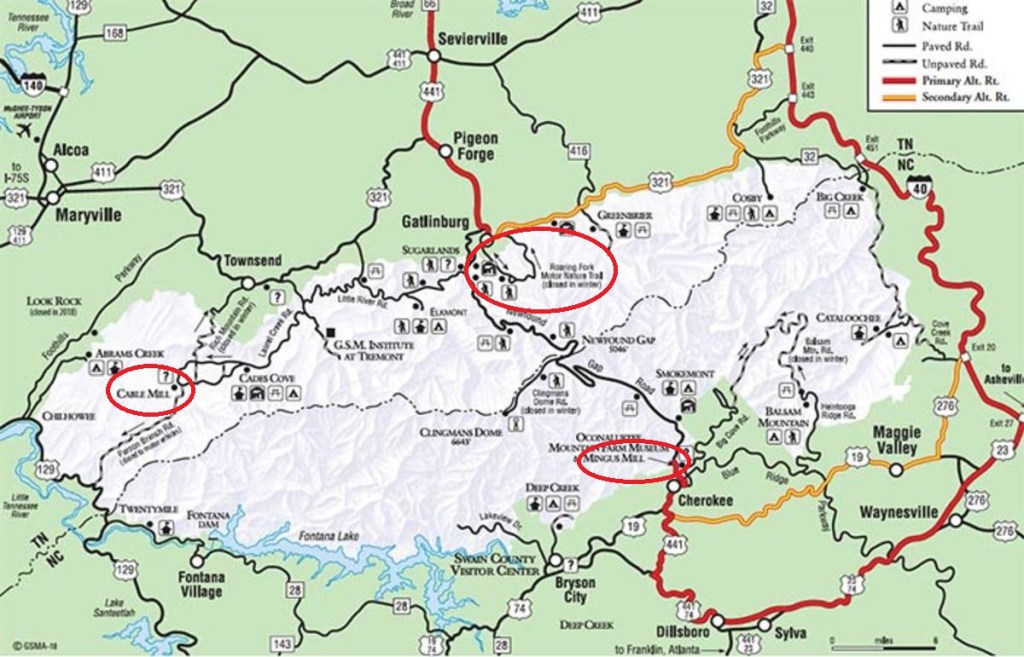
Map of Great Smoky Mountains National Park. Roaring Fork Motor Nature Trail (Ogle & Reagan Mills),
Cades Cove (Cable Mill) and Mingus Mill (near the Oconaluftee Visitor Center) shown with red circles.

Outside of the Park, two further mills, The Old Mill and the Dollywood Mill, both in Pigeon Forge, Tennessee (near Sevierville), invite further exploration.

Simply put, water and gravity power grist mills. But the technology harnessing that energy actually varies a good bit. In any case, the force of moving water, through a series of mechanisms, turns the “runner stone” against a stationary mill stone, called the “bed.”
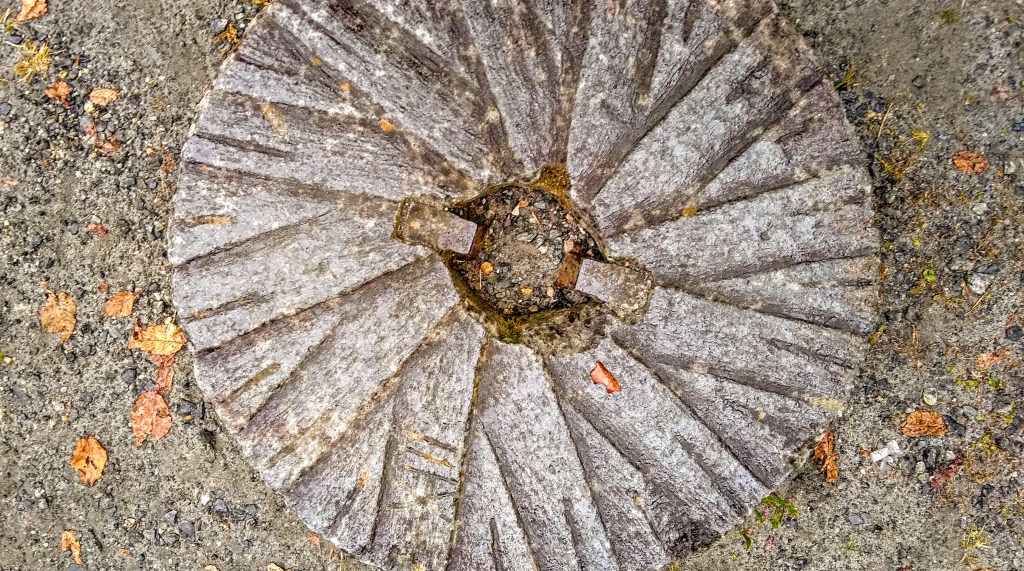
Mill stones -they cut rather than grind the grain. Photo by Ria Nicholas

The miller loaded dried grain into a hopper, which fed the grain into the space between the mill stones. The size of that space could be adjusted by the miller and determined the coarseness of the flour or cornmeal.

Grist Mill 1G – Basic Service

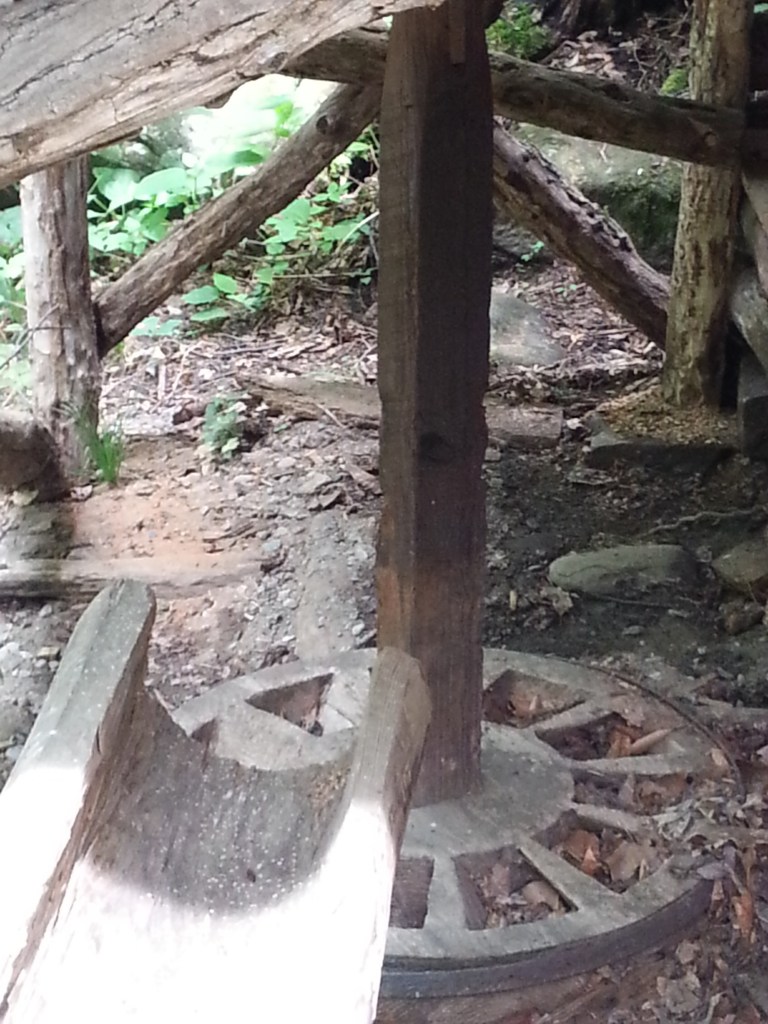
Tub mills, which originated in ancient times, were fitted with small, horizontal wooden wheels with angled paddles – a primitive kind of turbine. (These originally sat in a wooden frame or ‘tub,’ though these ‘tubs’ have since fallen out of use.) Sometimes these simple wooden turbines were placed directly on the edge of a stream to capture the power of the passing water.

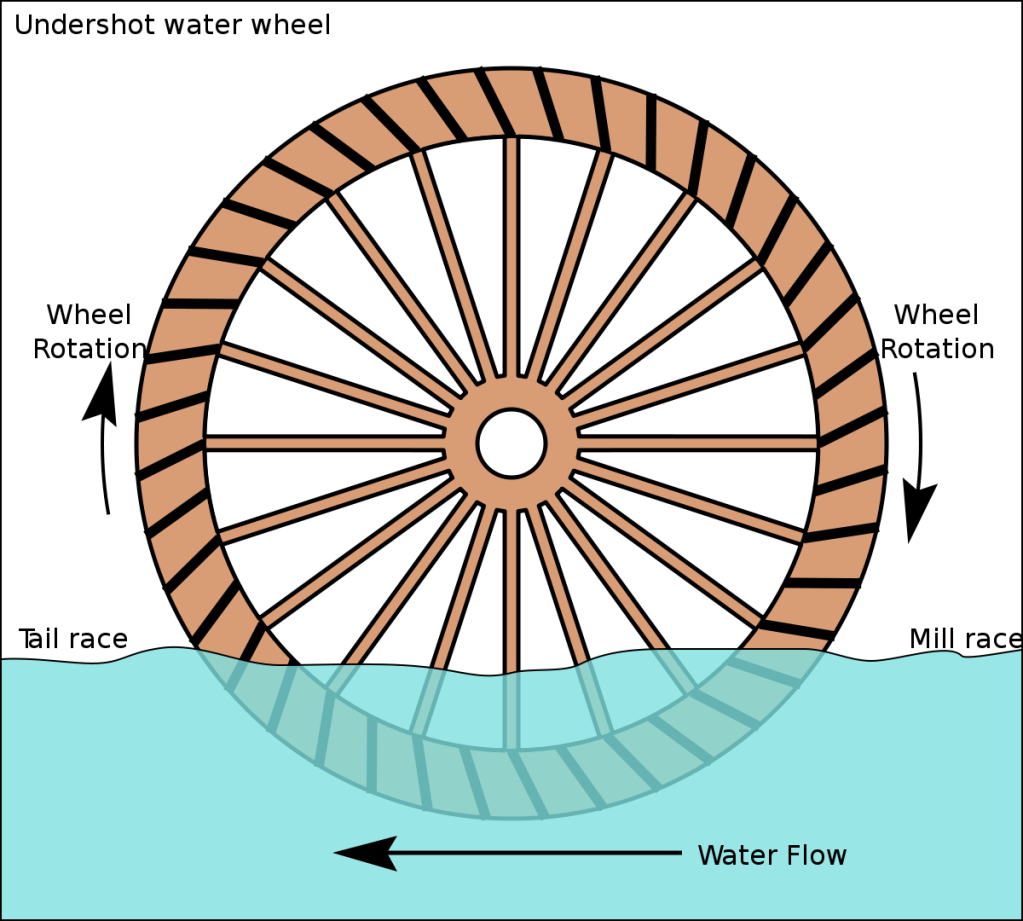
Similarly, some mills with classic vertical water wheels were “undershot,” meaning the wheel sat directly in the creek, taking advantage of the flowing water to turn it.
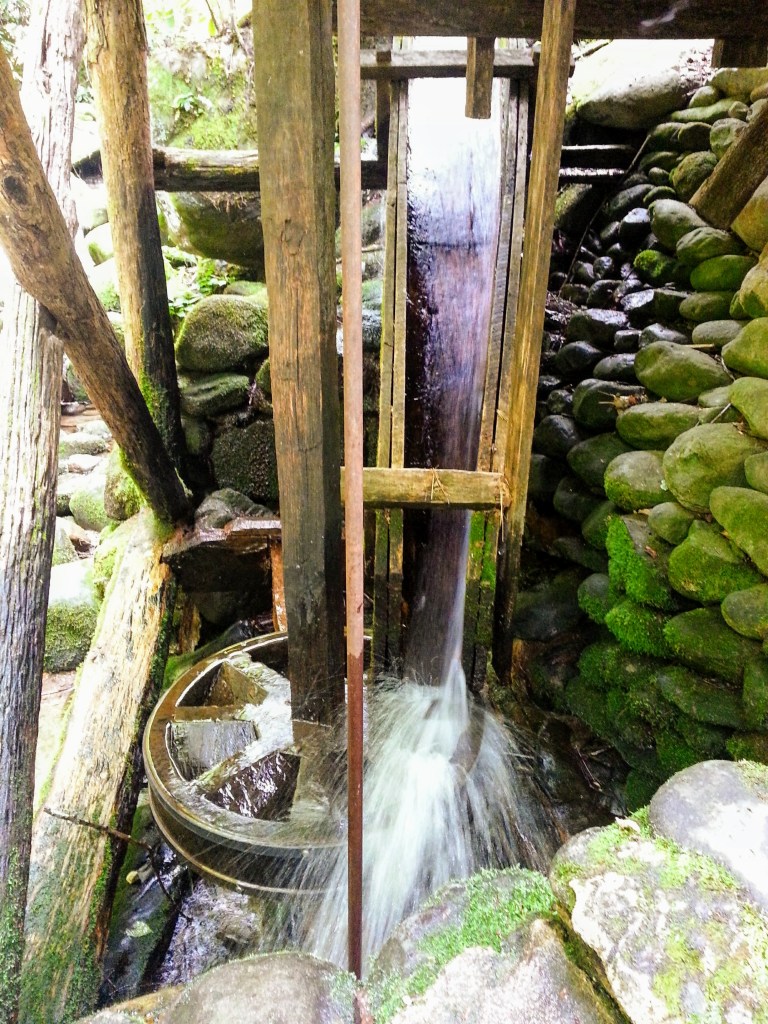
Water falling from flume onto ‘turbine’ at the Reagan Mill

Grist Mill 2GAn Upgrade: The Ogle and Reagan Mills

Both the Ogle Mill and the Reagan Mill were tub mills, but they both made use of flumes, a kind of wooden ‘aqueduct’ that carried the water from a creek downstream to the mill.

These flumes permitted the miller greater control over the flow of water reaching the mill. Additionally, flumes were elevated. Tub mills that used a flume, increased the force on the ‘turbine’ by dropping water from a height at the end of the flume onto the angled paddles.
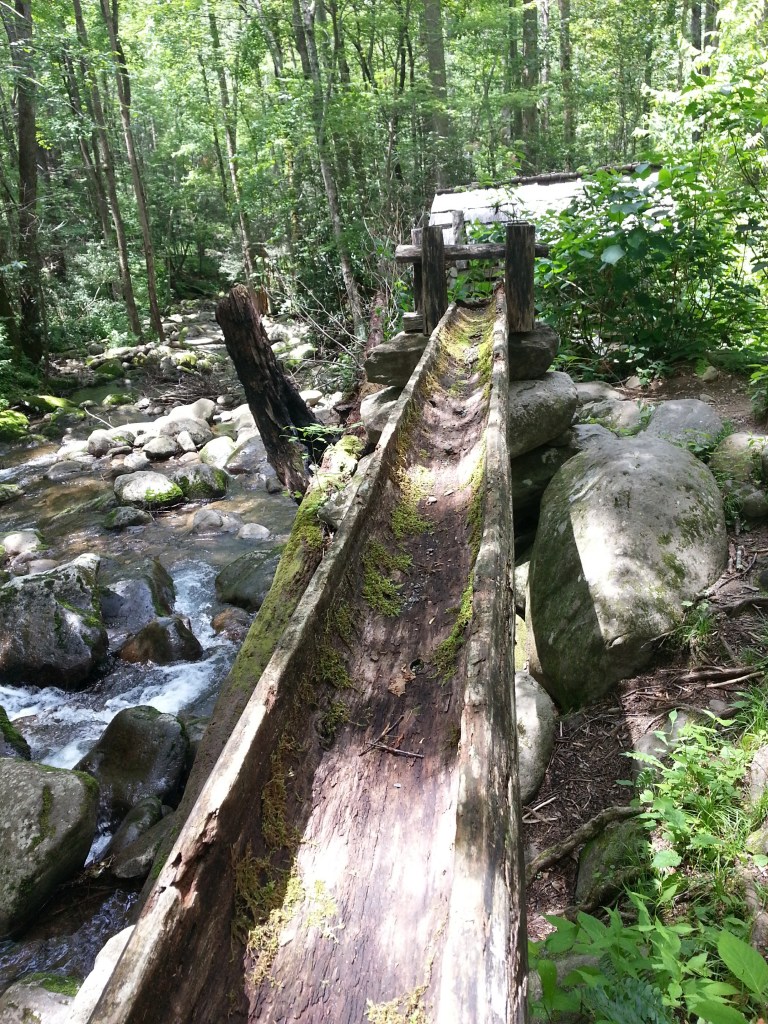
Note: The flume at the Ogle Mill (above, right) consisted of just a hollowed-out log.

Jim Zura and Ria Nicholas at Le Conte Creek

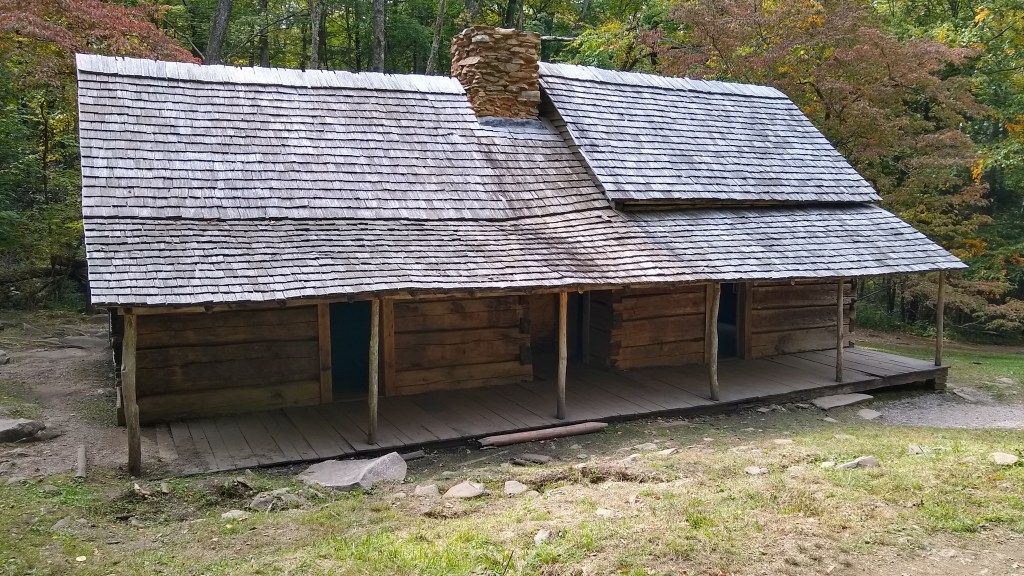
The Noah “Bud” Ogle Place, an excellent example of a mountain farmstead, lies on Cherokee Orchard Road, just outside Gatlinburg, Tennessee, near the entrance to the Roaring Fork Motor Nature Trail. After touring the homestead, we took the short, wooded walk from the main cabin to Le Conte Creek to see the primitive 1885 tub mill. Its flume consists of a simple hollowed-out log.

The Reagan Mill, built in 1895 by the multi-talented Alfred Reagan, is crafted from sawn lumber with a hand-split oak shingle roof. It sits directly on the Roaring Fork Motor Nature Trail, across the road from his homestead. Like the Ogle Mill, it was able to produce enough meal for his family and a few neighbors.
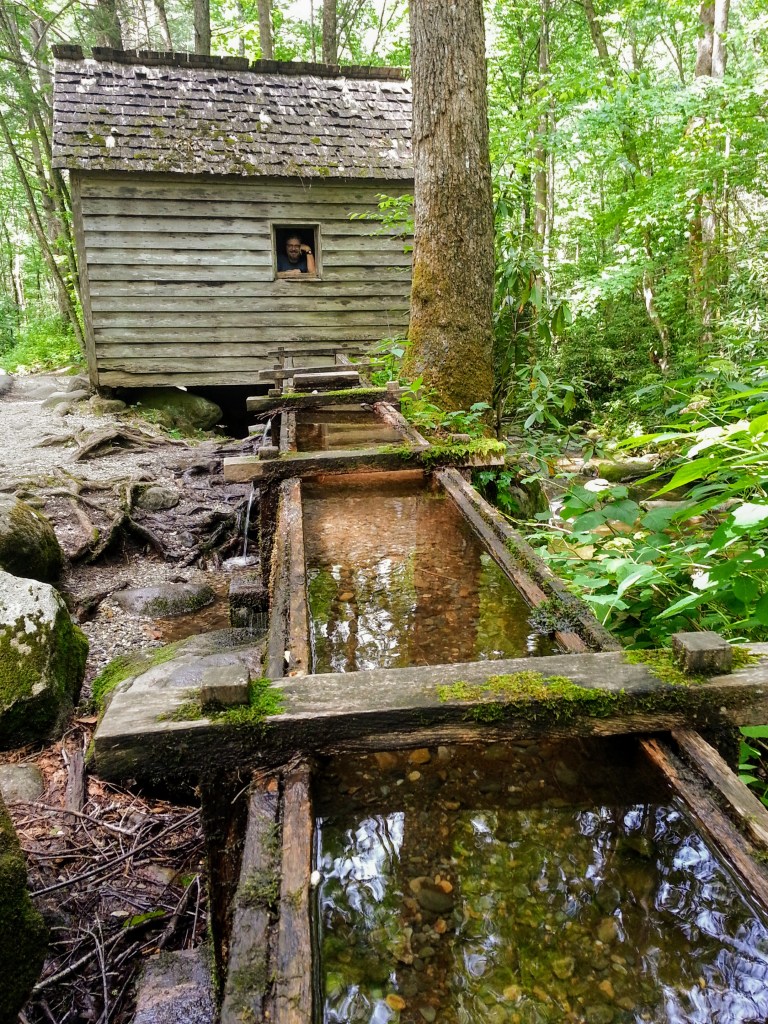
We grabbed one of the parking spots on the left side of the little one-lane road. From there we toured the Reagan home and the Reagan Mill just across the street.
Notice the flume carrying water to the mill.
Photo by Ria Nicholas

Grist Mill 3G – A Refresh: The Cable Mill

The Cable Mill sits alongside the Cades Cove loop in the western part of Great Smoky Mountains National Park. Built by John Cable in 1867, it made use of dams and millraces to channel water from Mill Creek and Forge Creek to the flume serving the mill. Watergates along the flume regulated the amount of water channeled to the mill, and a chunk rack (a giant wooden ‘comb’) filtered out debris.
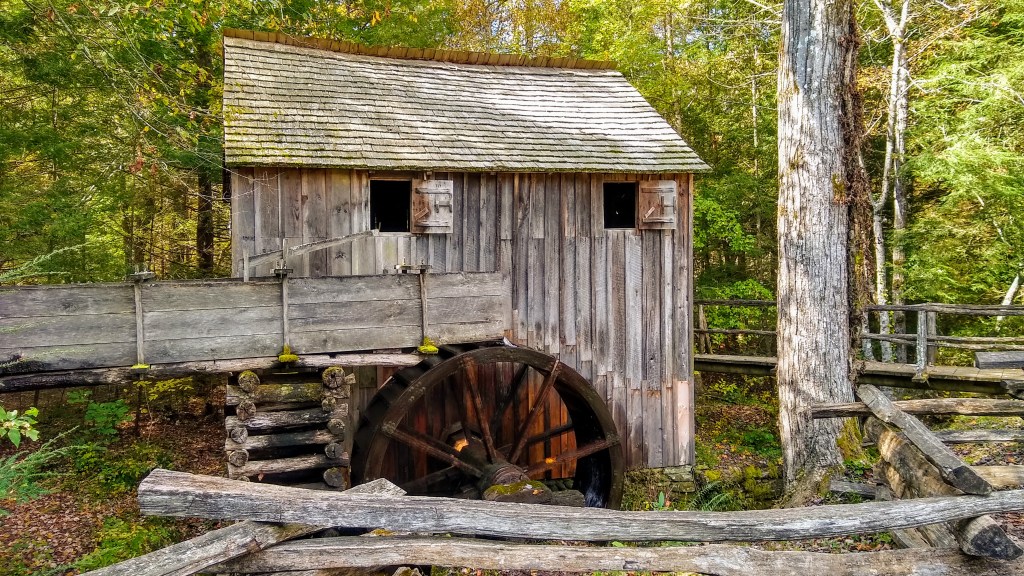
Water from the flume is dropped at the top of the wheel. Cable Mill is an example of an “overshot” waterwheel. Photo by Ria Nicholas

Cable Mill is an “overshot” mill. That means its flume directs water to the top of the water wheel, rather than the bottom of the wheel sitting in moving water. The heavy mill wheel, mounted vertically to the side of the building, lends a ‘gravity assist’ to the falling water, acting like a flywheel. The whole process produces substantially more power than that achieved with an undershot wheel. This energy, passing through a series of gears, turns the runner stone. Cable Mill is capable of producing roughly 150 pounds of meal per hour.
Grist Mill 4G – State of the Art: Mingus Mill
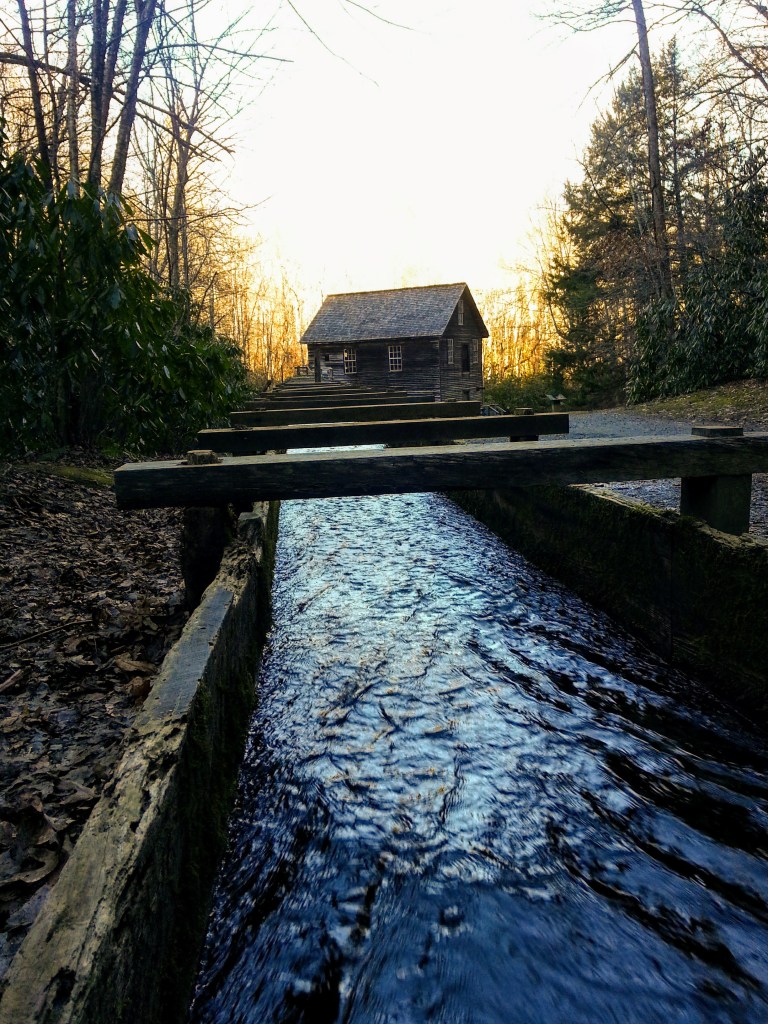
The flume carries water from the mill race
downhill toward Mingus Mill. Photo by Ria Nicholas

In 1886, the Mingus family contracted Sion Thomas Early to build this top-of-the-line grist mill for $600. As with the Cable Mill, a millrace and flume direct water from a nearby creek toward the mill, and a chunk rack filters out debris. But whereas the flume at Cable Mill dumps water at the top of a vertical waterwheel, the flume at Mingus Mill dumps the water into a 22-foot high, four-foot-square wooden tower, called a ‘penstock.’

Water weighs a lot! One cubic foot of water weighs in excess of 60 lbs. As you can imagine, this ‘tower’ of water is extremely heavy. Twelve thousand pounds of accumulated water weight pushes the water down through a 15” pipe at the bottom of the tower with tremendous force.

Diagram by Ria Nicholas

The principle behind building up pressure in the penstock resembles the use of a boiler in a steam engine. The miller at Mingus Mill explained it to us by using the example of turning on your garden hose and holding your thumb over the opening. The gushing water from the 15″ pipe spins a relatively small iron turbine with many times the energy of water running over a mill wheel. Mingus Mill is capable of grinding in excess of 300 lbs. of meal per hour – double that of the Cable Mill.
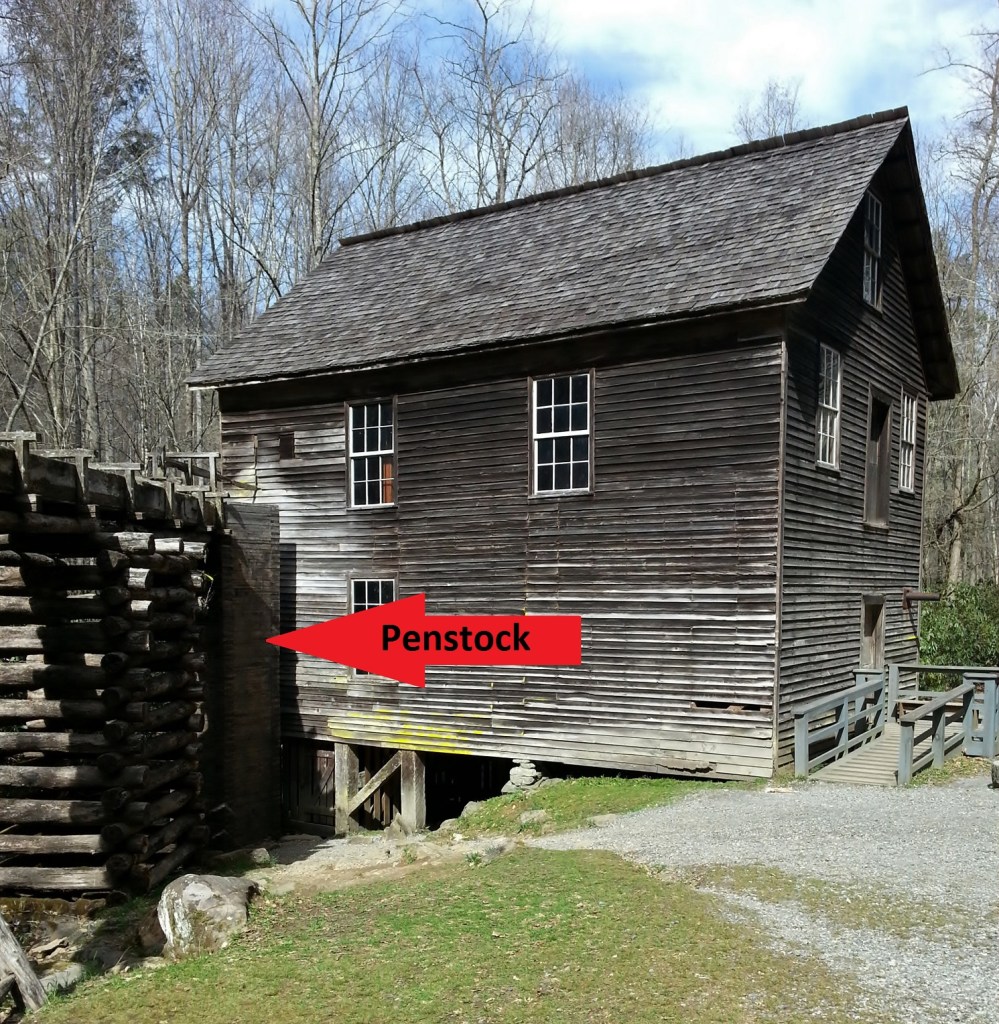
We can see the penstock, which holds the “tower” of water, between
the flume cribbing, on the left, and the mill building, on the right. The turbine sits underneath the mill building.

Mingus Mill is located in the southern portion of Great Smoky Mountains National Park, a short, easy walk from the parking lot off U.S. Highway 441, just north of the Oconaluftee Visitor Center and near the Oconaluftee Indian Village.

Competing Technologies: Mill Wheel vs. Turbine
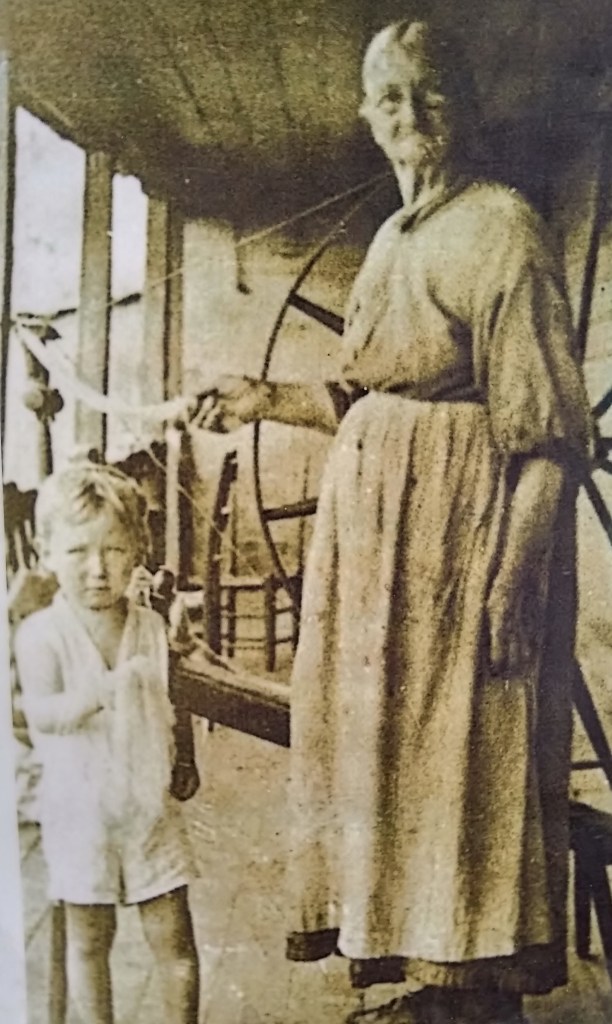
Rebecca Cable (“Aunt Becky”) –
daughter of John Cable; image courtesy the National Park Service.

Of course upgraded technology has its price. A mill wheel could be built by local blacksmiths and carpenters for a reasonable sum. But it had to be replaced relatively often. The heavy wheel had to be mounted vertically to the side of the mill building, and it turned in one direction, while the runner stone, sitting horizontally, turned in another. In the process, the mill building itself suffered from continuous jostling.

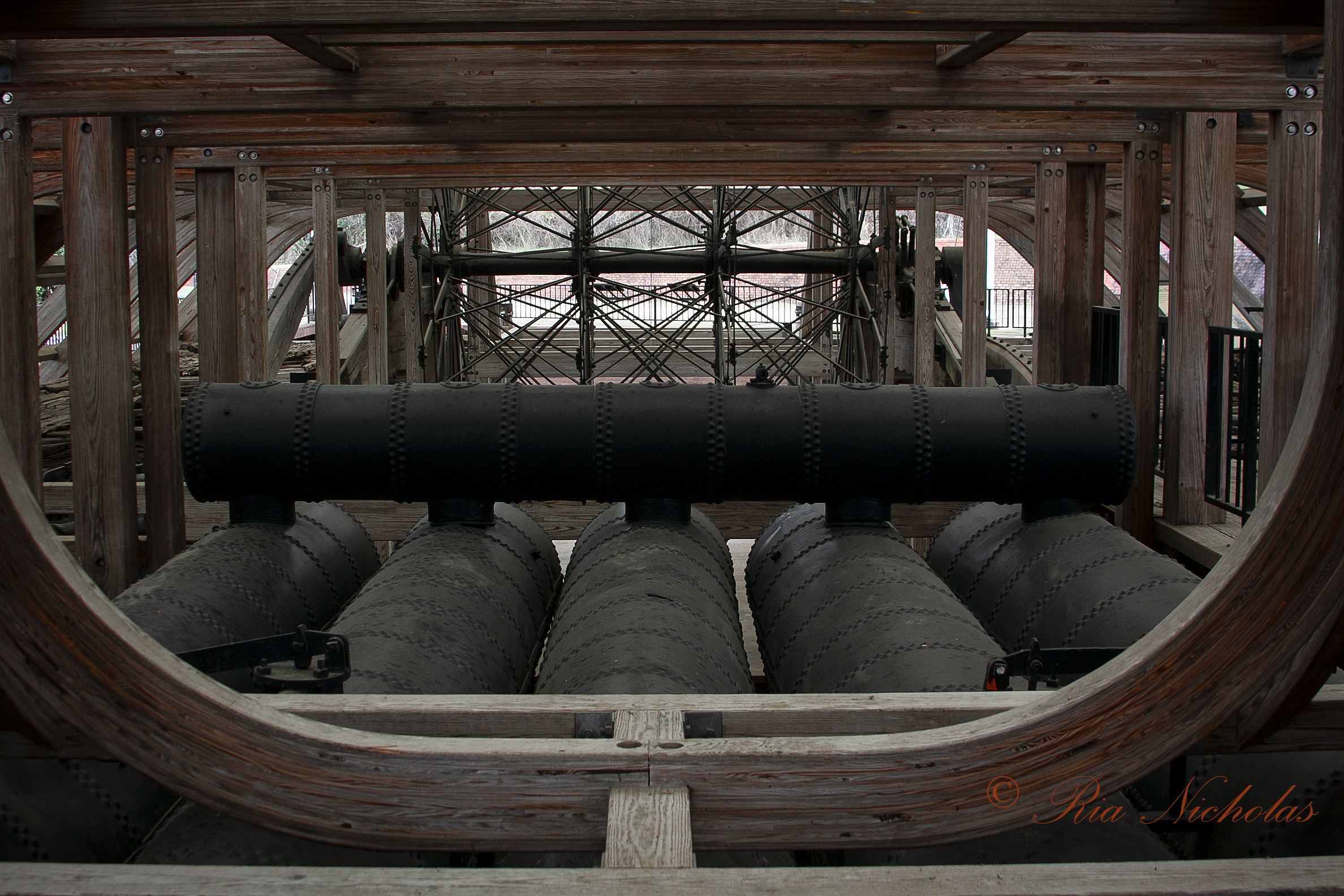
Water pressure shooting from the bottom of a penstock was strong enough to require an iron turbine. And an iron turbine had to be fabricated at a foundry or machine shop. The one at Mingus Mill was imported all the way from Ohio – at much greater expense. However, the turbine lasted a long time; the original one at Mingus Mill is still in use to this day. Additionally, since the turbine and the runner stone turn in the same direction, the stress produced on the mill building is negligible.

For families who didn’t own their own tub mill, grist mills served as gathering places – usually on Saturdays – where folks could exchange their latest gossip and barter for other commodities. They brought their grain, and for a “miller’s portion,” a fee of one-eighth of what they brought (approximately one gallon per bushel), the miller would grind and sift it, and they would leave with cornmeal or flour – and the stories shared by their neighbors.

The mills and other projects in Great Smoky Mountains National Park are generously supported by Great Smoky Mountains Association and Friends of the Smokies.

The Old Mill In Pigeon Forge – A Restaurant ‘Plug-In’

Another grist mill in the area (but outside of the Park) worthy of mention, the Old Mill in Pigeon Forge, Tennessee, has served as the town’s premier landmark since 1830. It was built by Isaac Love, who also built the forge that lent the community its name.
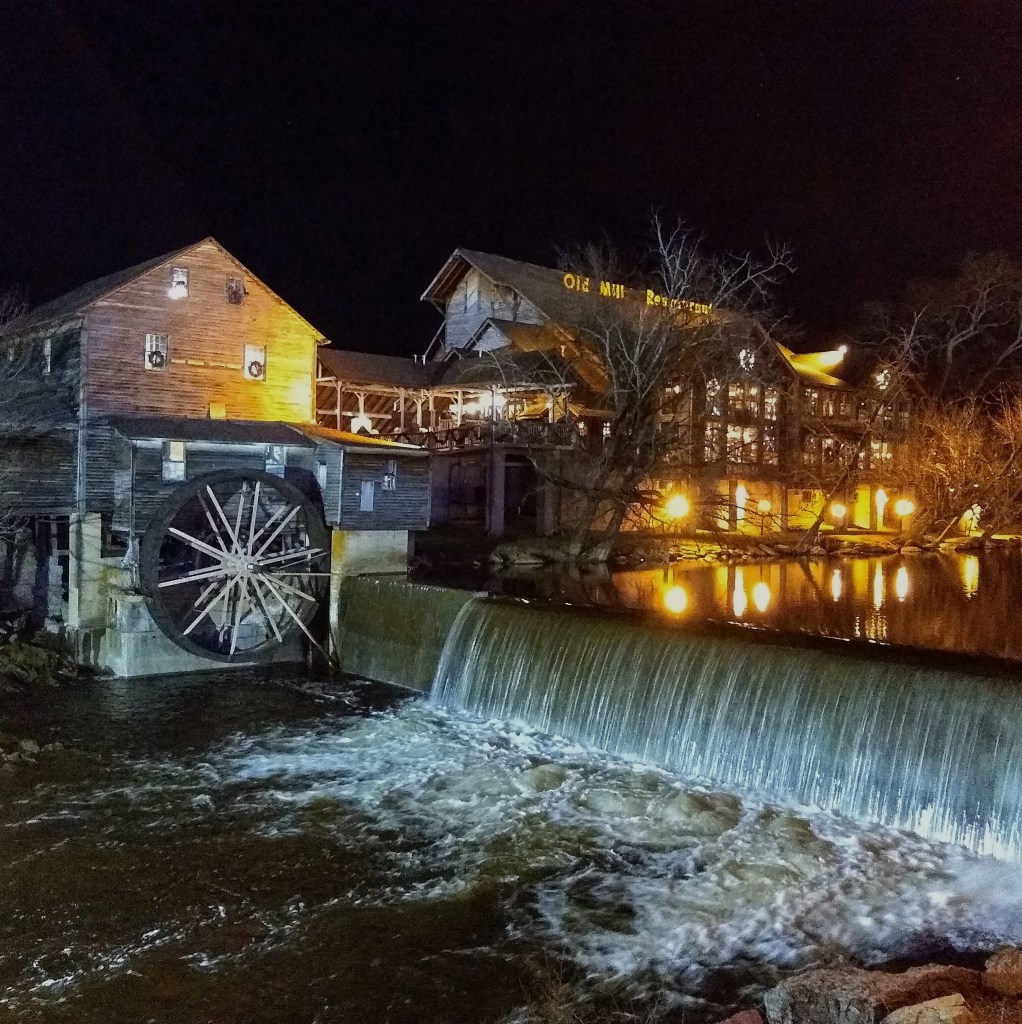
The Old Mill in Pigeon Forge is lighted at night. We try to make a point of dining at the restaurant here (building to right of mill) at least once every time we visit the area. Photo by Ria Nicholas

The mill, which has operated as a grist mill from the beginning, has simultaneously served in other capacities. Subsequent owner and Union sympathizer*, John Sevier Trotter, also utilized The Old Mill to power looms to produce cloth for the uniforms of the Army of the Potomac. After the Civil War, Trotter further employed the building as a sawmill, before ownership passed to A.T. Householder. Householder added the mill dam we see today and installed a generator to bring electric lights to the town. All the while, the mill continued to function as a grist mill.

Old Mill historian, Jimmy Proffitt, shared the following information with us:
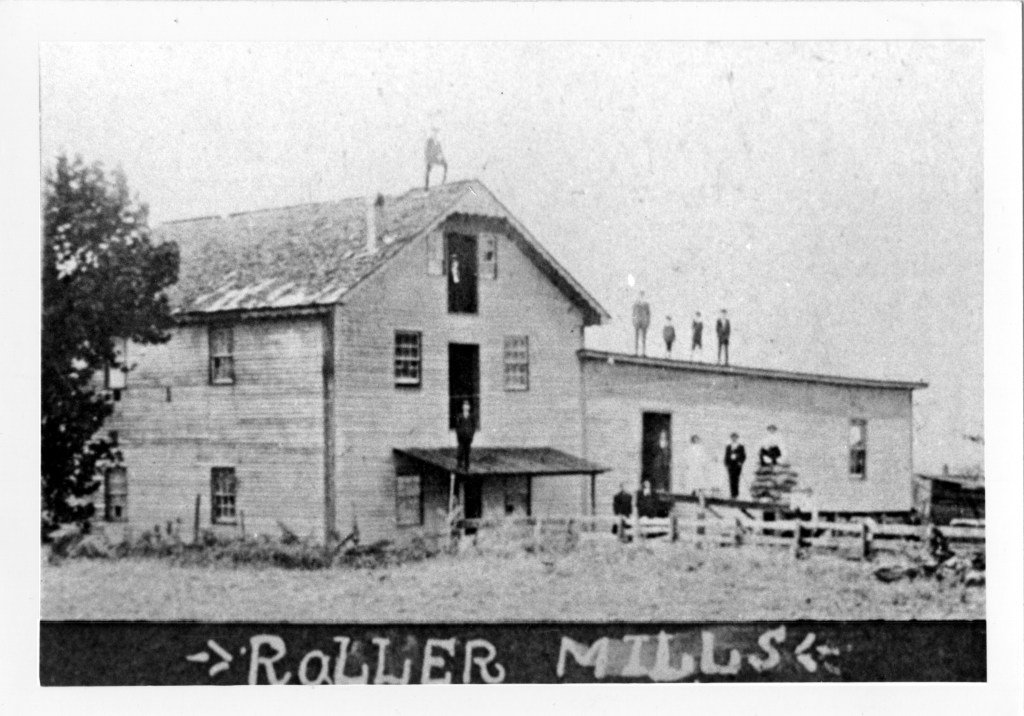
Historic photo courtesy The Old Mill
Photo courtesy The Old Mill

“[The grist mill] is still in full operation. The Old Mill Restaurant is located next to the mill and was built in 1995. The Mill still grinds primarily corn, and we grind over 400,000 pounds of it each year. We also grind wheat in-house, and [we] mix and bag a total of 700,000 pounds of mill product a year. We grind both white and yellow corn into corn meals and grits. We also provide the grains needed for our two restaurants for freshly baked bread at our Pottery House Café and for breading and recipes at both restaurants. We sell it online and in 2 locations on [our] property. . . Ours started out as a tub, then added a turbine in the late 1880’s when the mill was expanded and the large breast wheel (midway between undershot & overshot) was added. In 1920/21 a 2nd turbine was installed in the [penstock], which is the one we continue to use today. Our stones are still completely water powered and are the 2nd set of stones to be used in the mill; the first set is on display in our General Store. Not only did the water power the stones and the knitting mills on the 2nd floor during the Civil War, it also powered the saw mill, all the while the grist mill was still operating. It has been in continual operation since being built in 1830, with the exception of transfer of ownership a couple of times (It’s only changed hands 7 times), and for a few months during the depression. The previous owners had it for 67 years, converting the grain room and storage addition to the General Store in the 1950’s.”

*Even though Tennessee and North Carolina seceded from the Union, the majority of East Tennessee and Western North Carolina mountain folk weren’t slave holders, were rugged individualists and were distrustful of wealthy secessionist landowners. Most were loyal to the Union – so much so, that some communities made serious proposals to secede from the Confederacy and rejoin the Union. They viewed the conflict as a “rich man’s war but a poor man’s fight.” Redford Gatlin, for whom Gatlinburg was named, was the town’s only Confederate sympathizer. He was run out of town!

The Grist Mill at Dollywood – The Next Generation

Dollywood, nestled into a valley of the foothills at Pigeon Forge, Tennessee, serves as the premier theme park in the region and draws visitors from all over the country. Owned by music icon, Dolly Parton, it offers many unique thrill rides and attractions and is built on the values and heritage of the Smoky Mountains.

One of the many sights, sounds – and aromas – of the Park, the Dollywood Grist Mill is located in a section called Craftsman’s Valley. The mill was constructed in 1982, but is patterned after the historical mills of the area and utilizes traditional crafts and crafts people. It is the first fully functioning grist mill built in over 100 years.
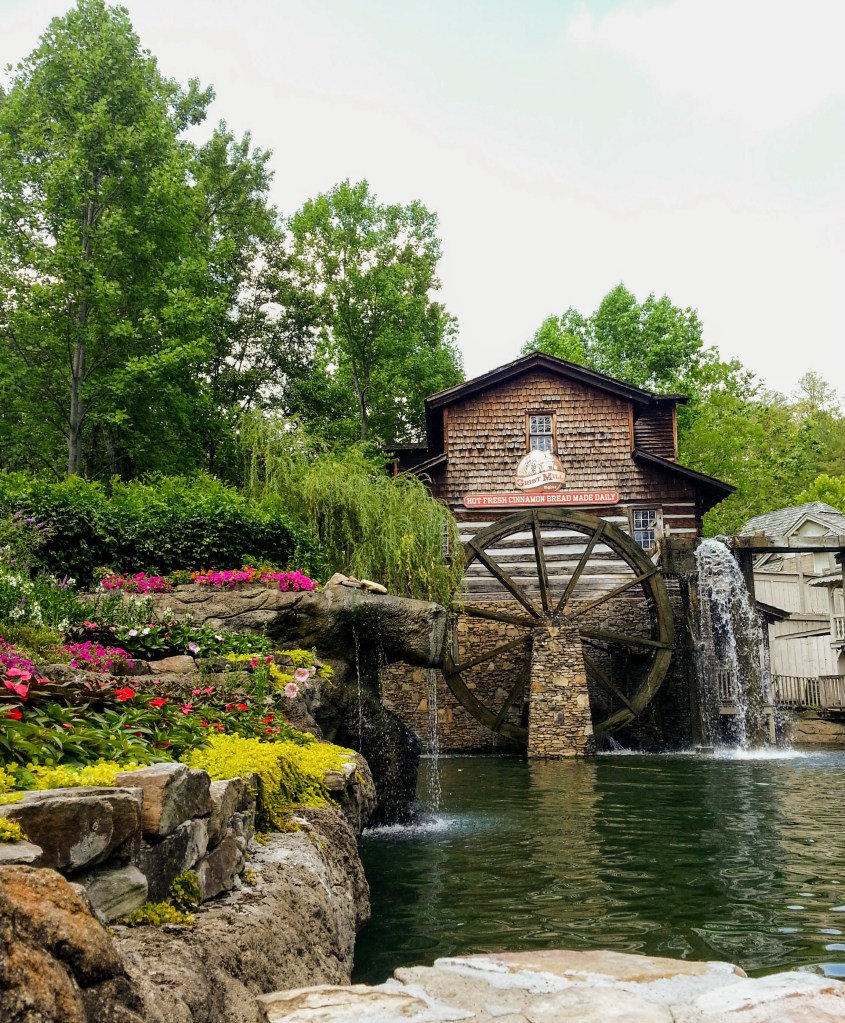
The Dollywood Grist Mill is very photogenic. We loved Dollywood, not only for its various rides, shops and shows, but also for its Eagle Mountain Sanctuary, the country’s largest population of non-releasable Bald Eagles. These and other birds of prey are housed in a 30,000 square-foot aviary under the care of the American Eagle Foundation and with permits from the U.S. Fish & Wildlife Service and The Tennessee Wildlife Resources Agency. Photo by Ria Nicholas

The scent of freshly baked cinnamon bread, made from flour milled right on the premises, emanates from the mill and lures tourists from every direction. They are encouraged to explore the mill, and a miller stands ready to answer questions.

Today, if we want bread, we just run to the nearest grocery store. We don’t give much thought to where our bread comes from, how it was made, or the history behind bread-making. But maybe we should. I know the next time I pop a slice in the toaster, I’ll pause for a moment of appreciation.

Sign up for more articles. It’s free:

Travel Tips:
Two Feathers Cabin in Pigeon Forge, TN is located just 1 mile behind Dollywood. The cabin features 2 bedrooms, 2 bathrooms, a fully equipped kitchen, jetted tub, hot tub, and air hockey table. Book your stay with us!

Roaring Fork Motor Nature Trail

Roaring Fork Motor Nature Trail is a leisurely 5.5 mile one-way driving loop accessible from Cherokee Orchard Road in Gatlinburg, Tennessee. Please note that RFMNT closes during the winter months. Aside from the historical buildings mentioned in this article, you can experience babbling brooks, rushing streams and a number of waterfalls, as well as excellent hiking trails there.

Cades Cove

Cades Cove is a leisurely, scenic, 11 mile, one-way driving loop that can experience heavy traffic during peak tourist times: in summer, during autumn (the colors are spectacular) and on weekends. Allow for at least two hours to drive the loop, more if you stop to walk the trails. Note that the loop is closed to motor vehicles but accessible by bike or on foot each Wednesday, from June 17th through September 30th. The loop can close at times due to heavy snowfall.

Mingus Mill

Mingus Mill is located one-half mile north of the Oconaluftee Visitors Center in Cherokee, North Carolina on US 441. A miller is on site to demonstrate from 9:00 am – 5:00 pm daily mid-March through mid-November and on Thanksgiving weekend.

Weather and Clothing

Although the climate in eastern Tennessee is mild, the area does experience four seasons (an occasional blizzard is possible), so be sure to dress accordingly. We also recommend comfortable walking shoes or hiking boots. Temperatures always run colder at higher elevations, and U.S. Highway 441 between Tennessee and North Carolina can close due to inclement weather during the winter.

Animal Encounters
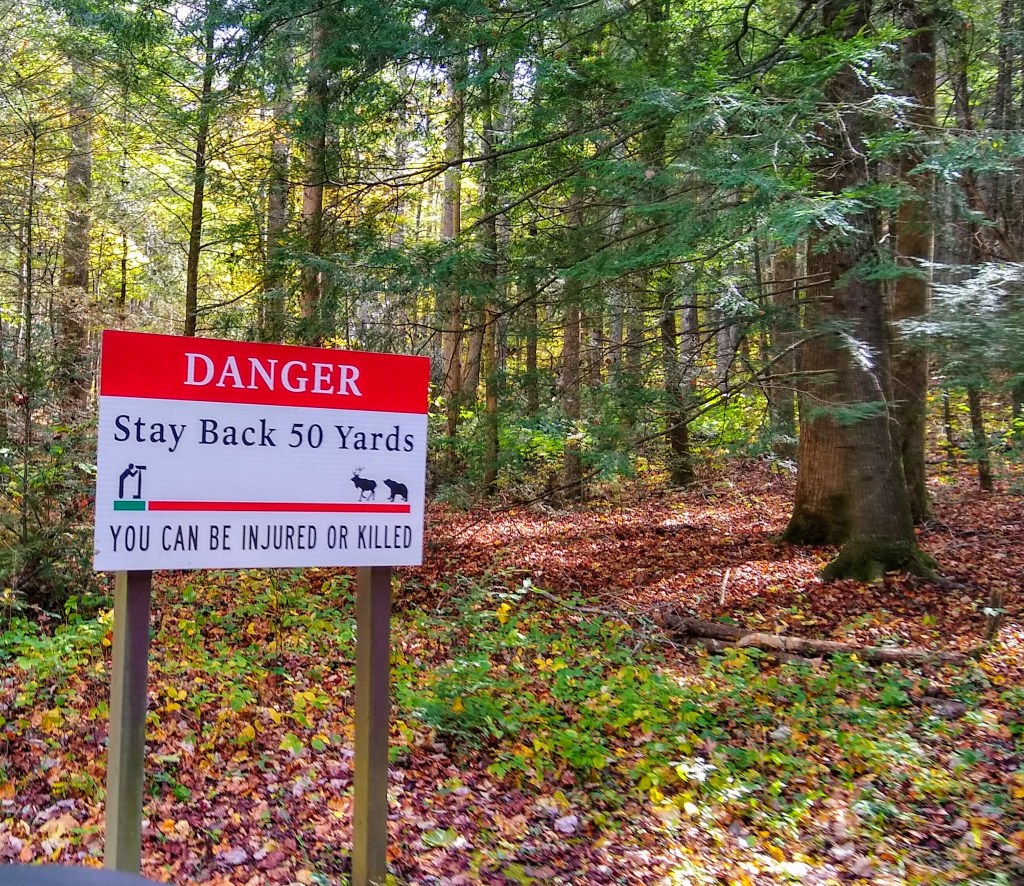
Wildlife experts estimate that about 1,500 black bears inhabit Great Smoky Mountains National Park. Additionally, elk (which grow to 650 pounds and sprout impressive racks!) have been reintroduced into the Park. That means that an animal encounter is a real possibility. Both black bears and elk can inflict serious, possibly fatal, injuries and should be viewed from a respectful distance of at least 50 yards (150 feet)!

And, of course, never feed a bear! Feeding bears is not only illegal, it causes them to lose their fear of humans and to associate people with food. This can lead to aggressive behavior toward humans, which means that Rangers have no choice but to euthanize them. Ergo the saying, “A fed bear is a dead bear.”

Comment

Send us a comment or an email telling us about your favorite place in the Smokies.


Houston’s Puttin’ On the Ritz!

The Majestic Metro Theater Is the Bee’s Knees!

By Ria Nicholas

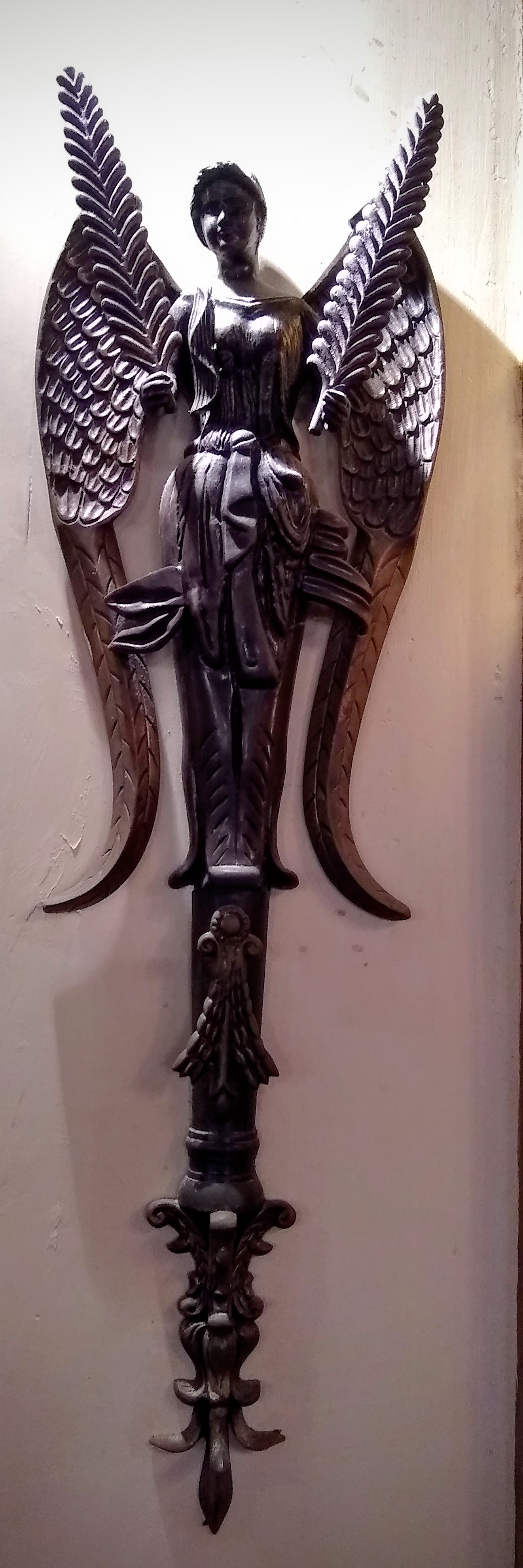
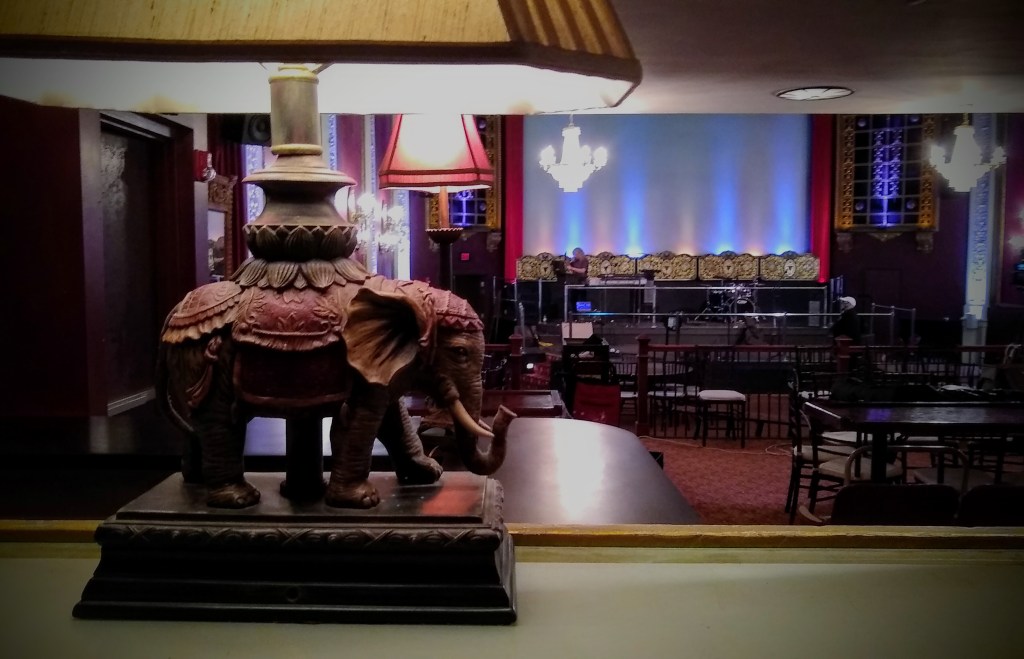
Just a few days ago I went with Jim Zura to help video a musical performance (without audience) at Houston’s Majestic Metro Theater at 911 Preston Street. I’d never heard of the place before, let alone been there. What an unexpected surprise! It was vintage, so needless to say, I fell completely in love with the venue.

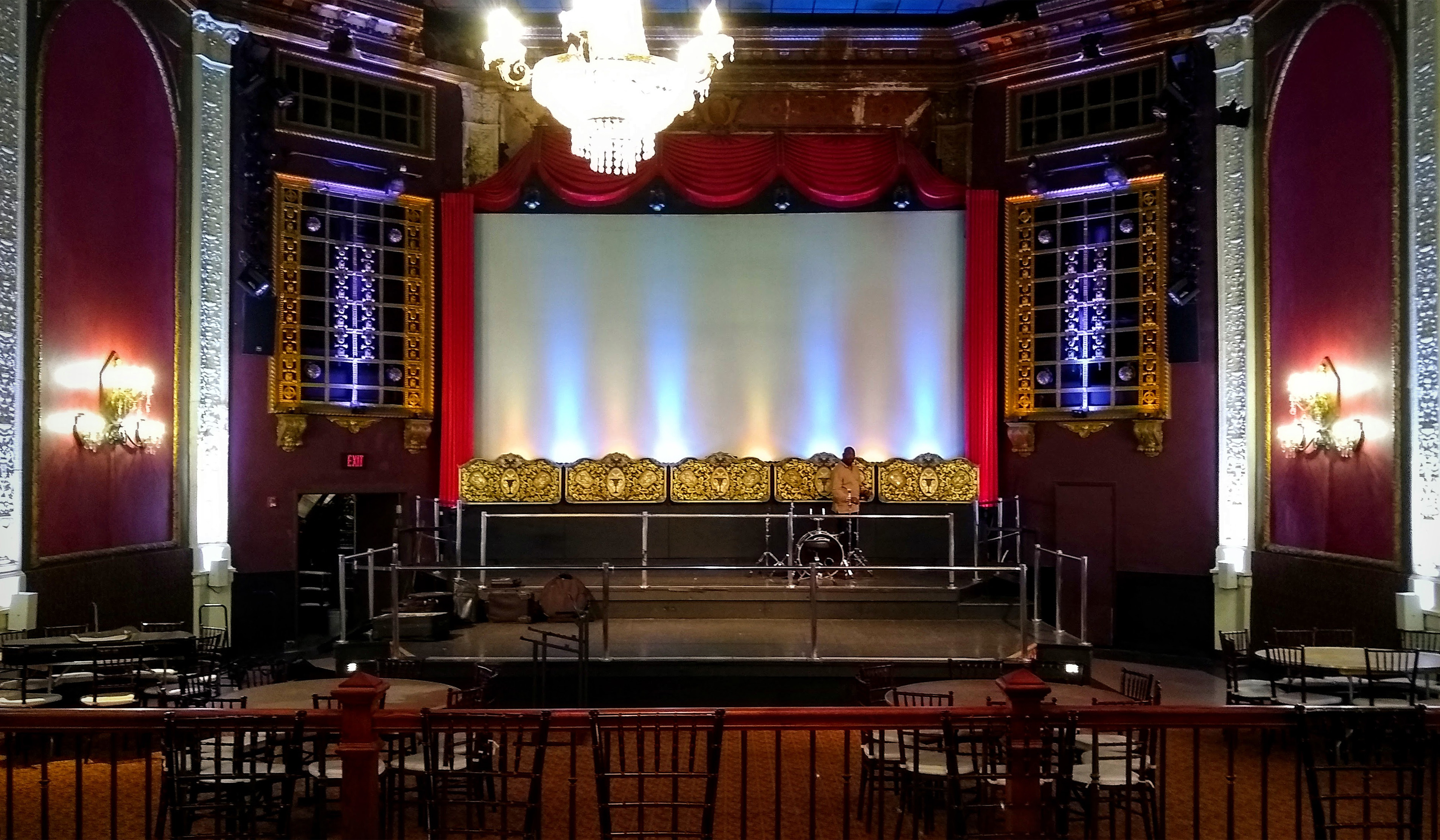
The Majestic Metro is Houston’s only theater, built before 1930, to survive to the present day. It opened as a movie theater under the name “the Ritz” on April 15, 1926 – the year my mother was born.


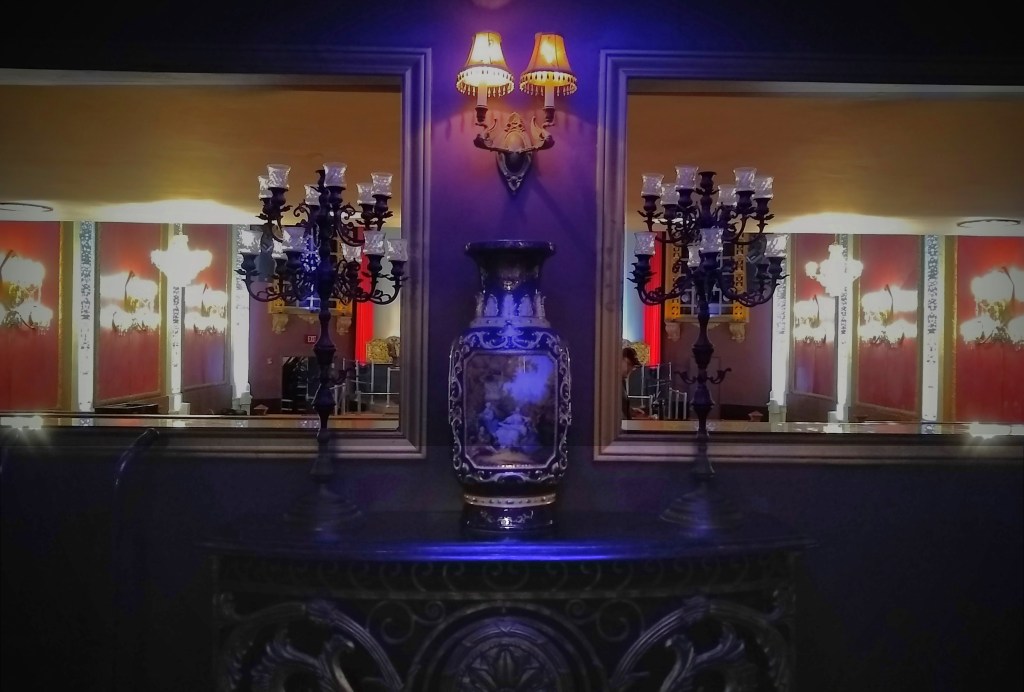
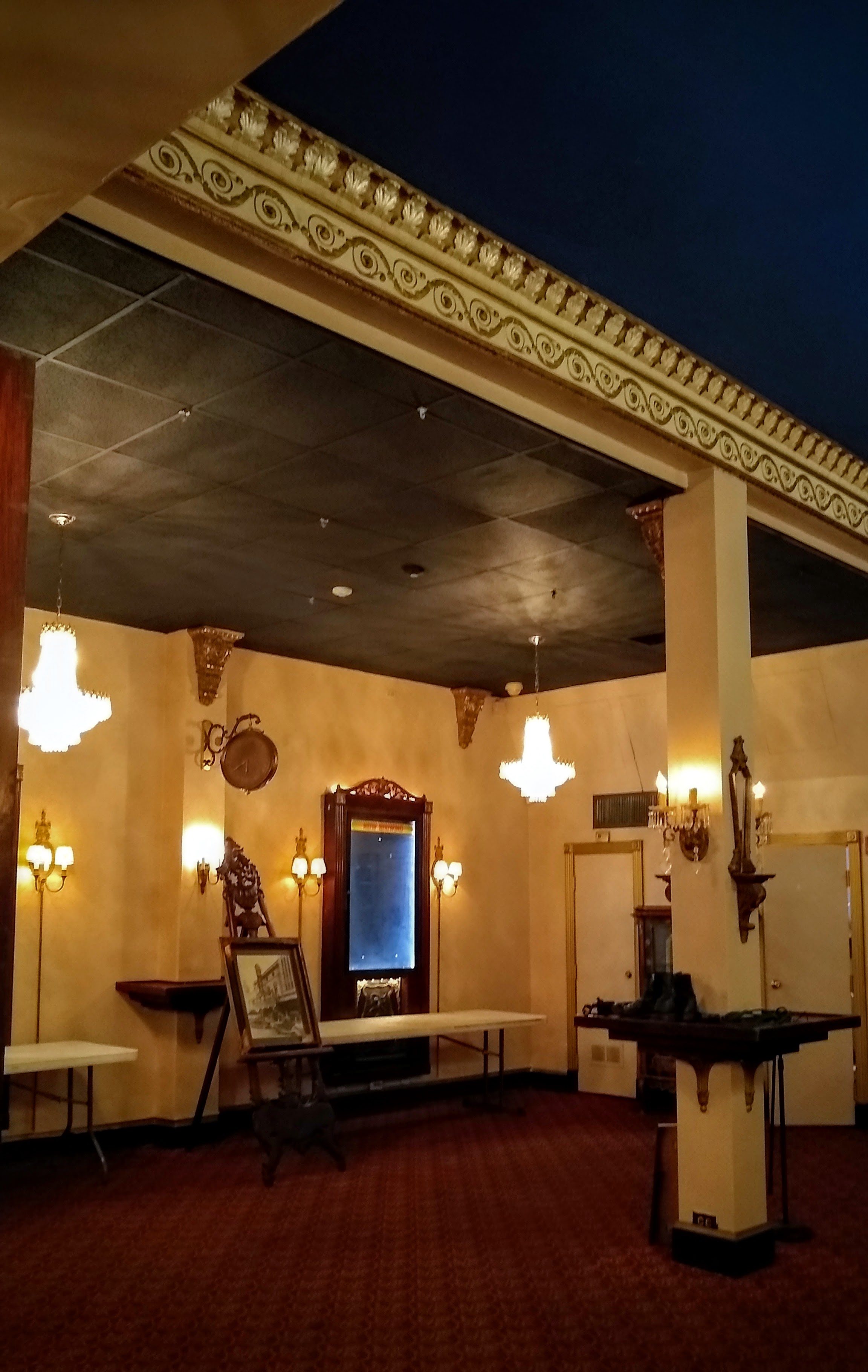
The Ritz / Majestic Metro: view from foyer toward the auditorium; photo by Ria Nicholas

Sign up for more articles. It’s free:

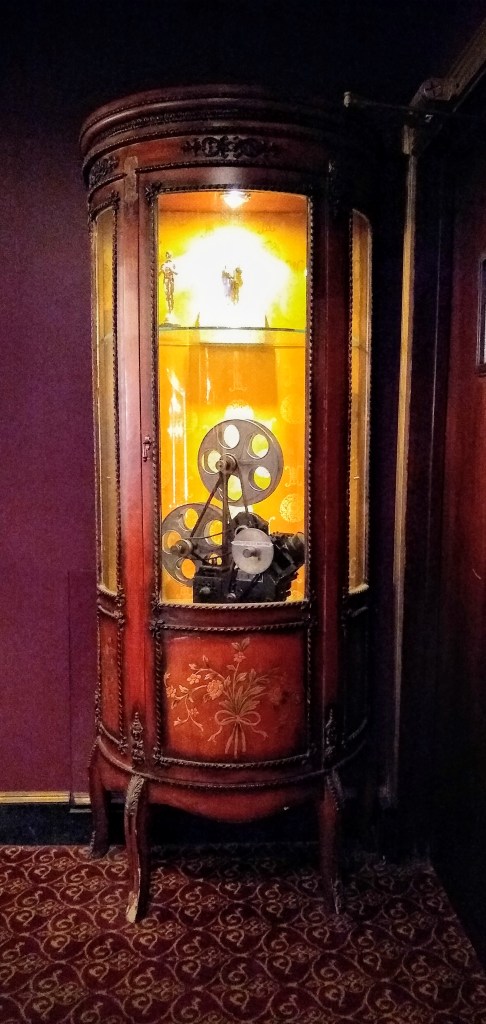
Curio cabinet with projector in foyer; photo by Ria Nicholas

By then people were beginning to relegate the horrors of WWI and the deadly Spanish flu pandemic to history, and no one had reason to anticipate the coming deprivations of the Great Depression. The Roaring Twenties was a decade of post-war euphoria, economic prosperity and general optimism. Consumers indulged in purchasing automobiles, electricity and radios.

On August 18, 1920, Congress had ratified the 19th Amendment, granting women the right to vote. ‘Flaming youth’ began testing sexual mores as they set out to live life to the fullest while they could.

“Tomorrow we may die, so let’s get drunk and make love.”

– Lois Long (a/k/a “Lipstick”), columnist for The New Yorker

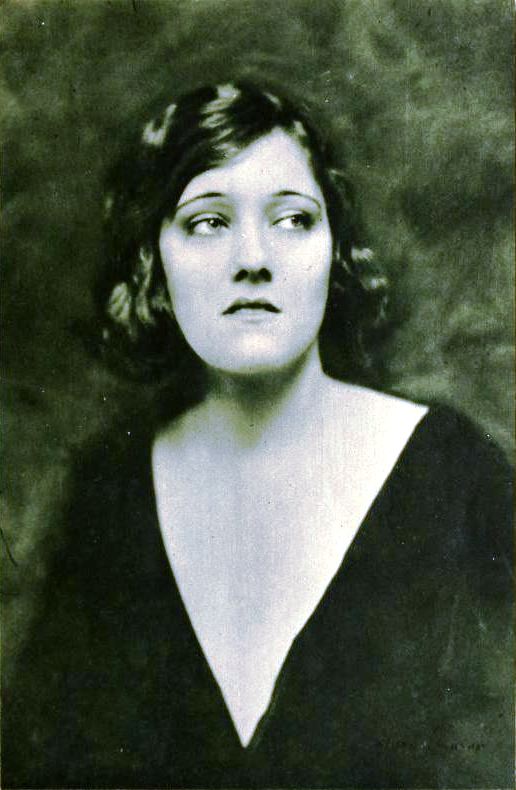
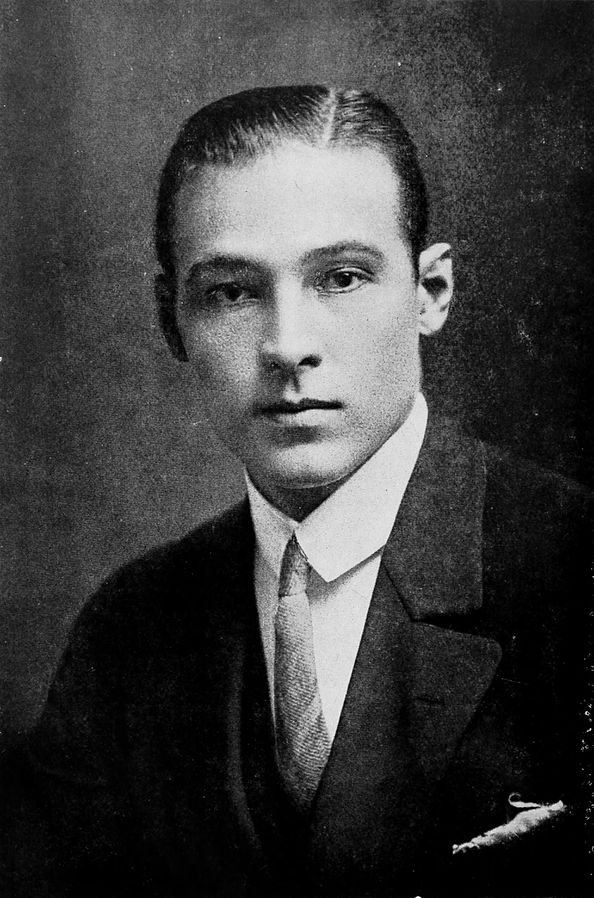
Movie stars Gloria Swanson and Rudolph Valentino were the heartthrobs of the day.

Sign up for more articles. It’s free:


The first Academy Awards were still three years away, but the top grossing movie in 1926 was Metro-Goldwyn-Mayer’s “Ben-Hur: A Tale of The Christ.” Perhaps it played at the Ritz.

(The movie title’s reference to Christ, so antithetical to the sensual graphics of the movie poster, aptly represents the moral tensions of the decade.)


According to Publisher’s Weekly, the number one best selling book was The Private Life of Helen of Troy by John Erskine. The number one song that year was Gene Austin’s “Bye Bye, Blackbird.”


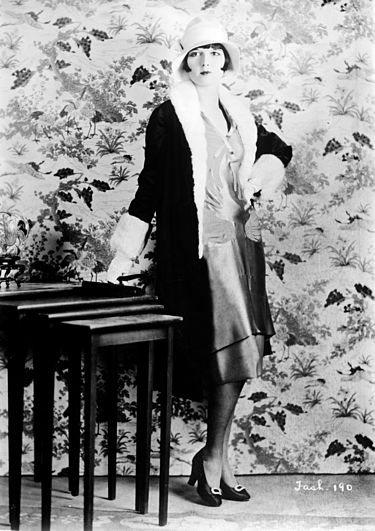
Louise Brooks, American film actress and dancer

Meanwhile, women were saying “bye bye corsets and crinoline.” Flappers raised eyebrows by raising hemlines, dropping waistlines and bobbing their hair. Coco Chanel infused a touch of masculinity into her feminine fashion designs; think Marlene Dietrich. For the modern woman, cloche hats and simple dresses with ornate jewelry were the style of the day.

Men wore three-piece suits – often pinstriped or plaid – with wide lapels and cuffed trousers. Oxford shoes were common and hats were a must.


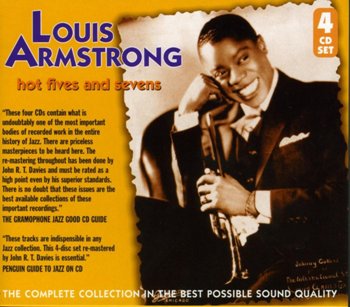
This was also the era of prohibition and bootlegging, of speakeasies and all that jazz! And, speaking of jazz, this was the decade when the young Louis Armstrong hit his stride, introducing a free form musical genre known as “scat.” The era was sensuous and raucous and socially experimental. It was an exciting time in America.


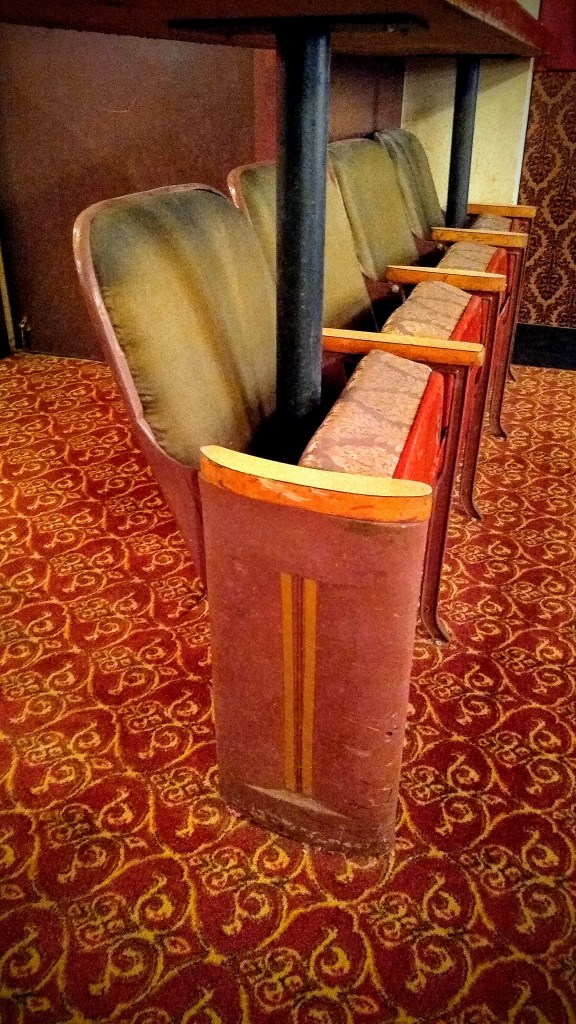
Unlike many other theaters of the time, the Ritz was a relatively intimate venue, with a seating capacity of only 1,260. You can see its affordable admission price (5 – 15¢) displayed above the entrance on the black and white photo near the top of this post.

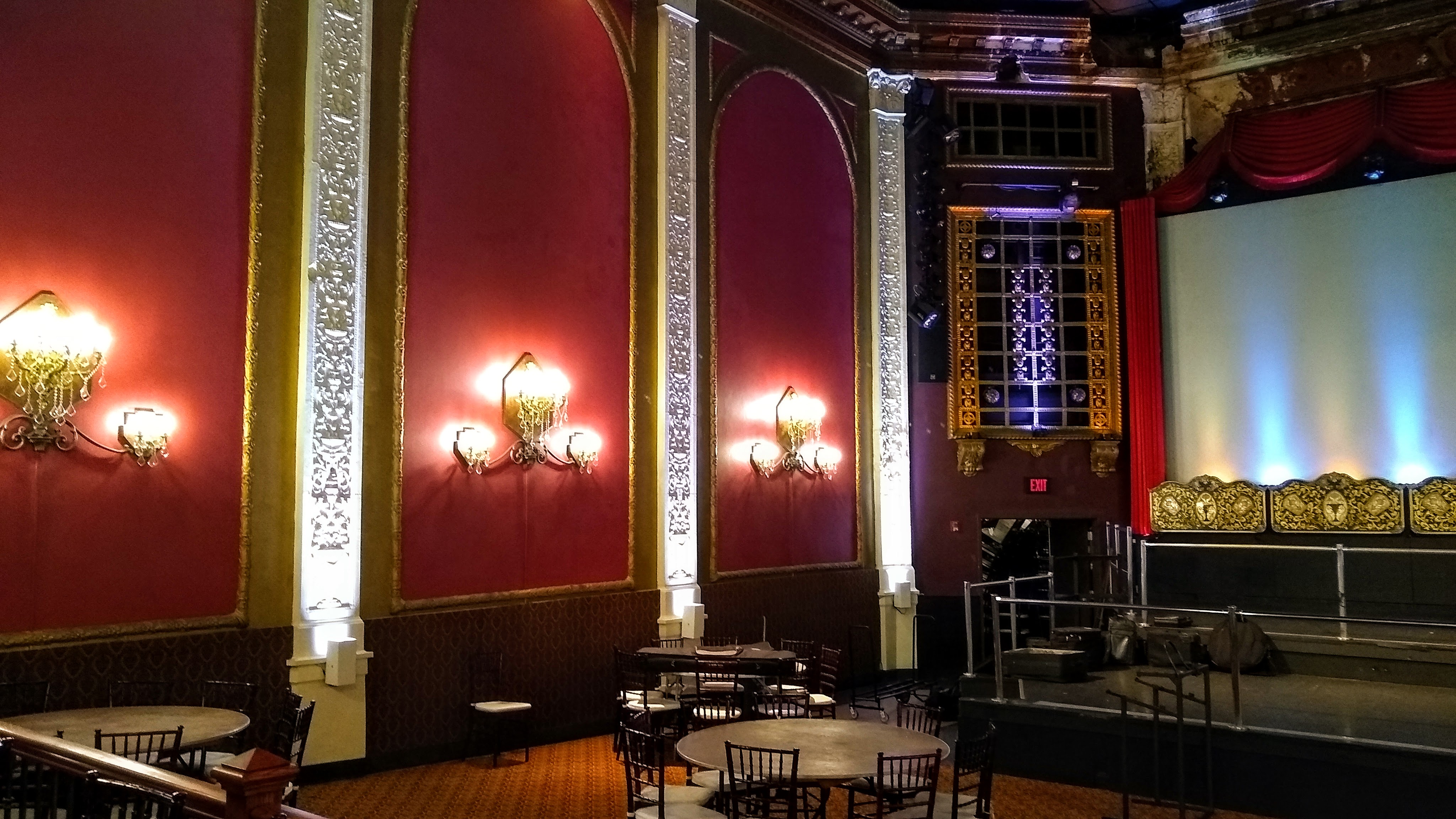
View into auditorium; photo by Ria Nicholas

Sign up for more articles. It’s free:

Photo by Ria Nicholas

In 1930, the Ritz changed ownership from Stella and Lillian Scanlan to local theater man, Will Horwitz and was entered into an alliance with the Interstate Theatre chain.

In the 1940s, the theater began running Spanish language films. Its name changed to Teatro Ritz and then Cine Ritz.

In the 70s, the Ritz, then owned by Alvin Guggenheim, switched to exploitation – low budget films that exploit current trends, niche genres, or lurid content. Guggenheim changed the name again, this time to Majestic Metro. The Ritz / Majestic Metro eventually closed its doors in 1984.

In 1985, businessman Gary Warwick purchased the building and put into motion its restoration. Today, this intimately elegant building in Houston’s downtown historic district serves as a special events venue. Its dance floor, banquet-style seating and state-of-the-art sound and light system make it ducky for receptions, parties and galas . . . or just hanging out to help with a video.

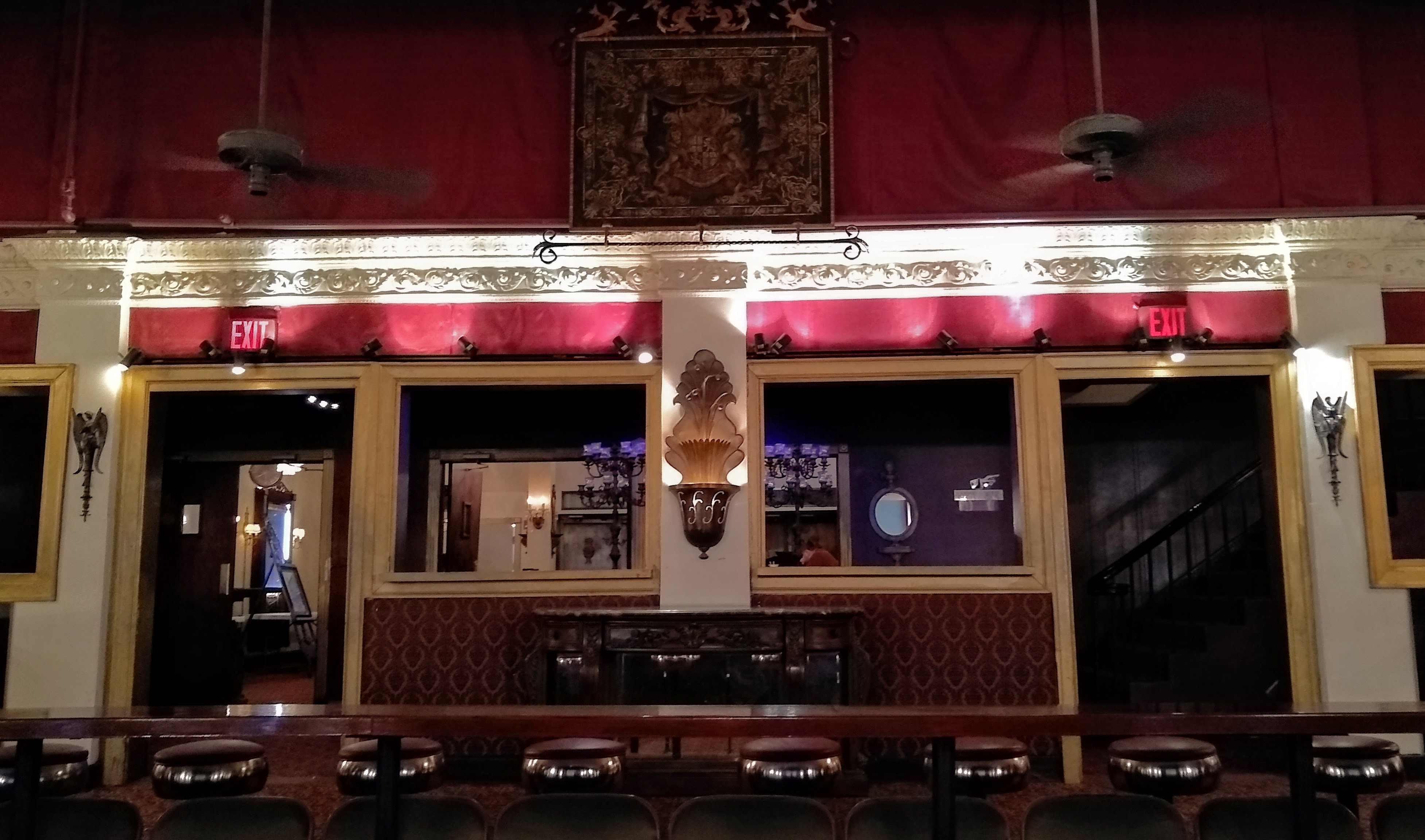
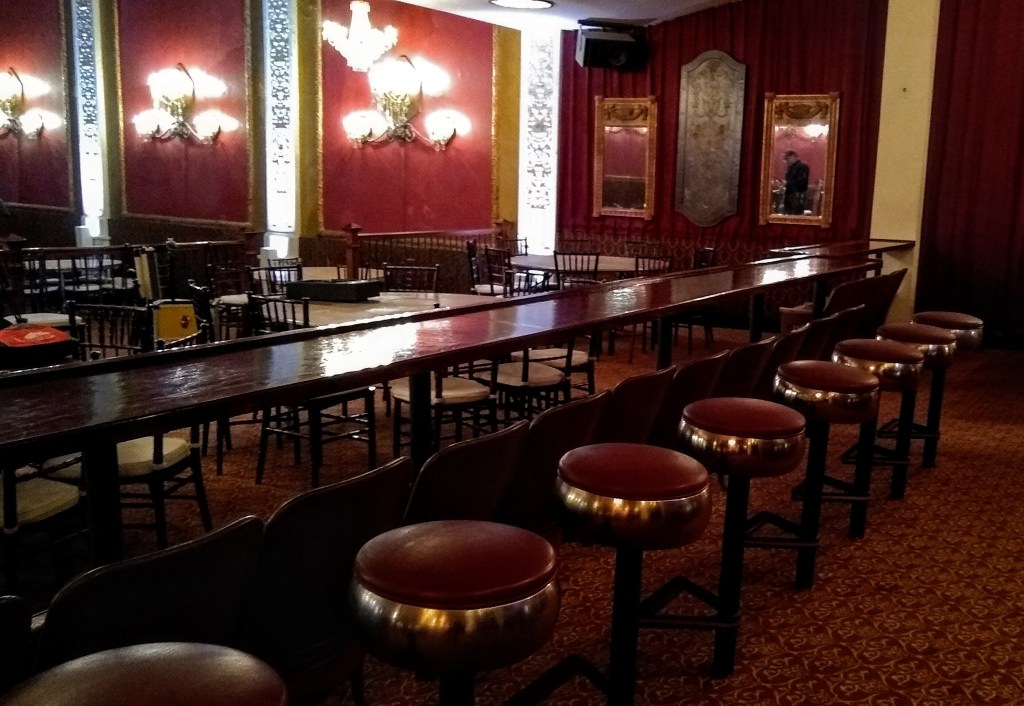
Bar stools in the back of the auditorium look out onto banquet-style tables. Photo by Ria Nicholas


12 Galveston Time Capsule Adventures

The Little Island That Could

by Ria Nicholas

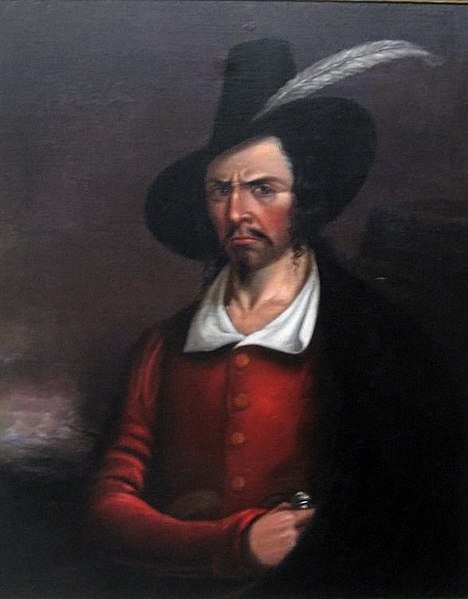
Anonymous portrait believed to be of pirate Jean Lafitte, courtesy Rosenberg Library, Galveston, Texas

Galveston, Texas is a microcosm of some of the greatest social upheavals in U.S. history.  In a sense, the narrative of an entire nation is distilled in the sands of this diminutive 200-square-mile barrier island. Tattooed Natives, shipwrecked explorers, determined slaves, brazen pirates, and barons of industry all contributed to the exploration, exploitation and exaltation that molded her.

Spanish explorer Cabeza de Vaca, who was shipwrecked here in 1528, found himself enslaved by local Karankawa Indians. He dubbed the island “Isla de Malhado” or “Isle of Doom.”  The cursed French explorer La Salle merely called her “San Louis.”  Jean Lafitte*, notorious smuggler and slave trader, organized a pirate camp on the island and named it “Campeche.” Ultimately, however, the island – and city – were named in honor of Count Bernardo de Gálvez, colonial governor of Spanish Louisiana and Cuba, who supported American patriots during the Revolutionary War.


* To learn more about the life of Pirate Jean Lafitte, see our article titled “Tour the French Quarter With NOLA’s Original Bad Boy!” You’ll also get some great ideas for places to visit!

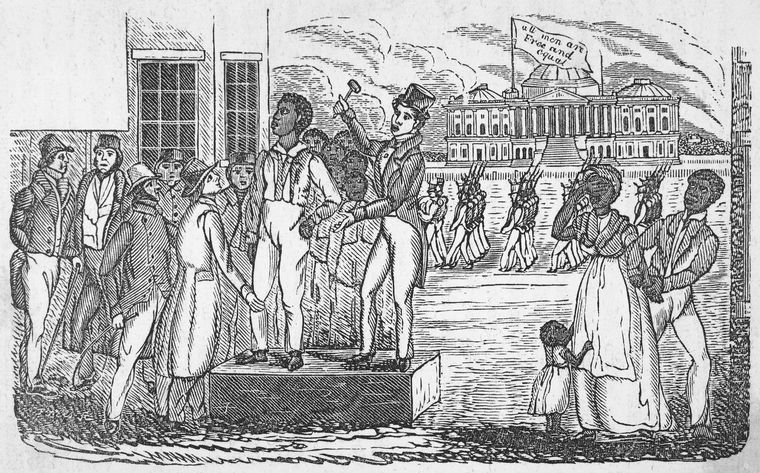
Geography played a pivotal role in the success, demise, and rebirth of Galveston. Following her official establishment as a port by the Congress of Mexico in 1825, Galveston quickly grew into a vibrant hub for commerce. Trade continued to flourish on the island after Texas gained its independence and later, while under the jurisdiction of the United States. The Island’s economy included, unfortunately, one of the largest slave markets in the South.

During the Civil War, the city was blockaded, captured, occupied and recaptured. Then, in June of 1865, its wharves and business district became the locus of a delayed announcement of the Emancipation Proclamation that gave rise to the Juneteenth Holiday. Over the ensuing years, Galveston’s trade expanded to rival that of the port of New York City, earning the city the nickname “Wall Street of the South.”

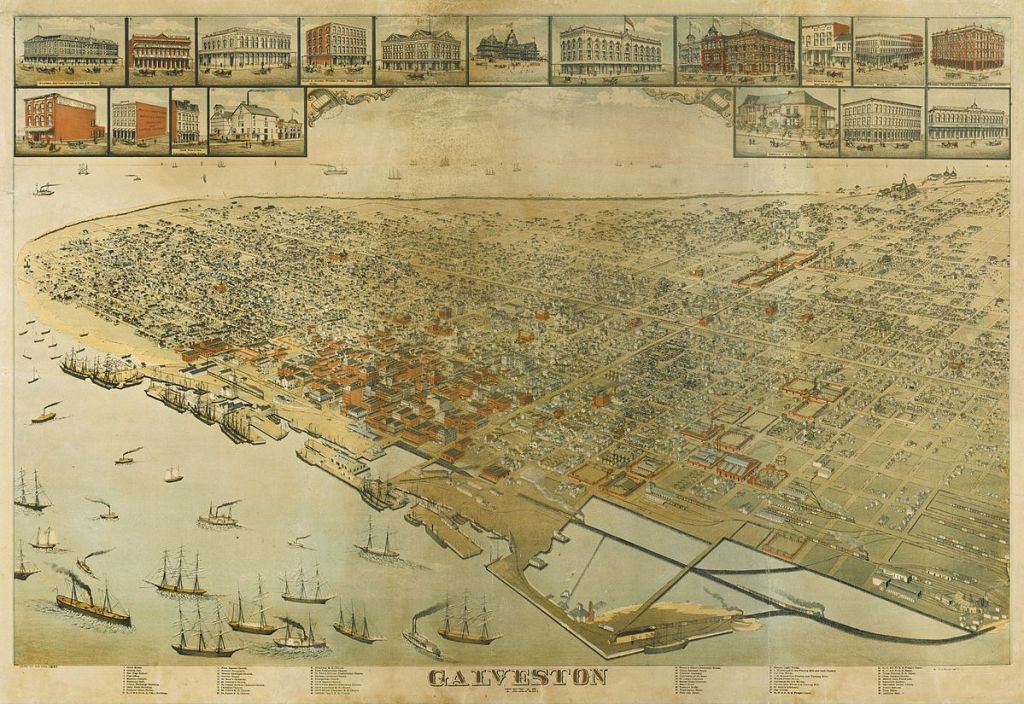
Galveston Texas, 1885. color lithograph – lithographer unknown. Courtesy Amon Carter Museum, Fort Worth, Texas. This work is in the public domain in its country of origin and other countries and areas where the copyright term is the author’s life plus 70 years or fewer.

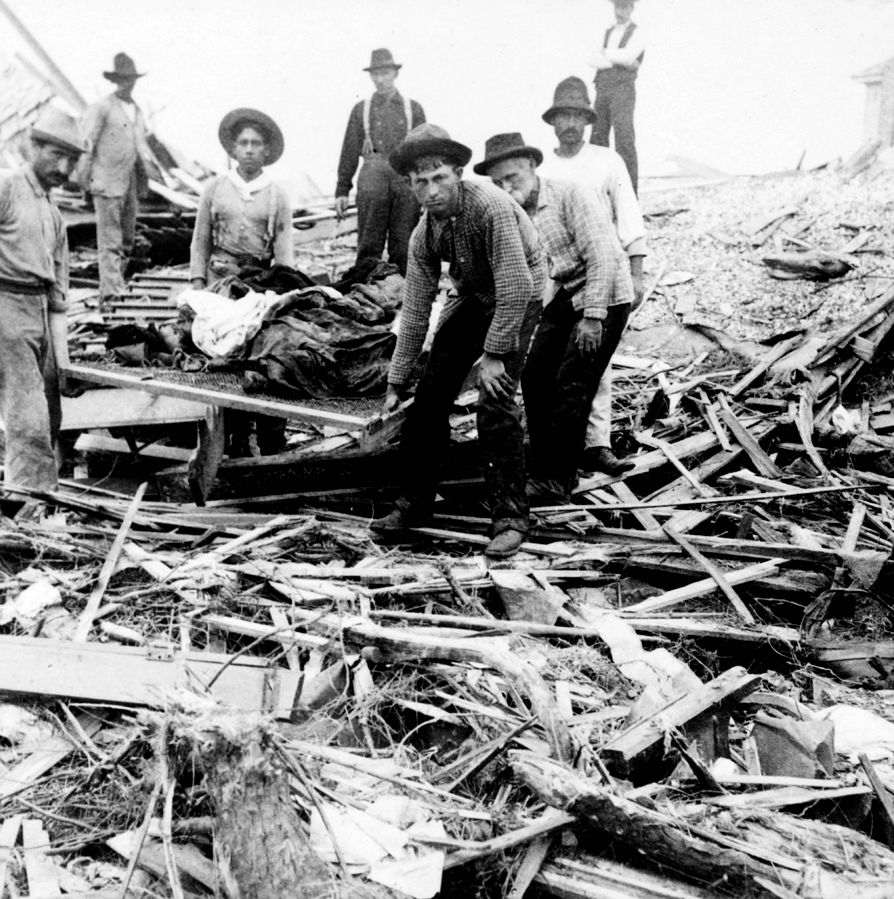
All the prosperity and jubilation, however, ended with the arrival of the Great Hurricane of 1900, which remains the worst natural disaster on record in U.S. history. With 130-mile-per-hour winds and a 15 ½ foot storm surge that swept over the entire sand-bank island, the hurricane claimed more than 6,000 lives and destroyed 3,600 buildings.

Carrying out bodies just removed from the wreckage – Galveston, Texas – 1900. Image is in the public domain.

Following the storm, resilient survivors buried their dead and set to work building a seawall along the beachfront. They raised the elevation of the entire city an astonishing 17 feet, lifting more than 2,100 buildings on jacks and pumping in tons of sand from the bay. 

Galveston’s come-back, rising from a maelstrom of despair to re-imagine herself a thriving tourist mecca, serves as a template for resilience in the face of present-day adversities.
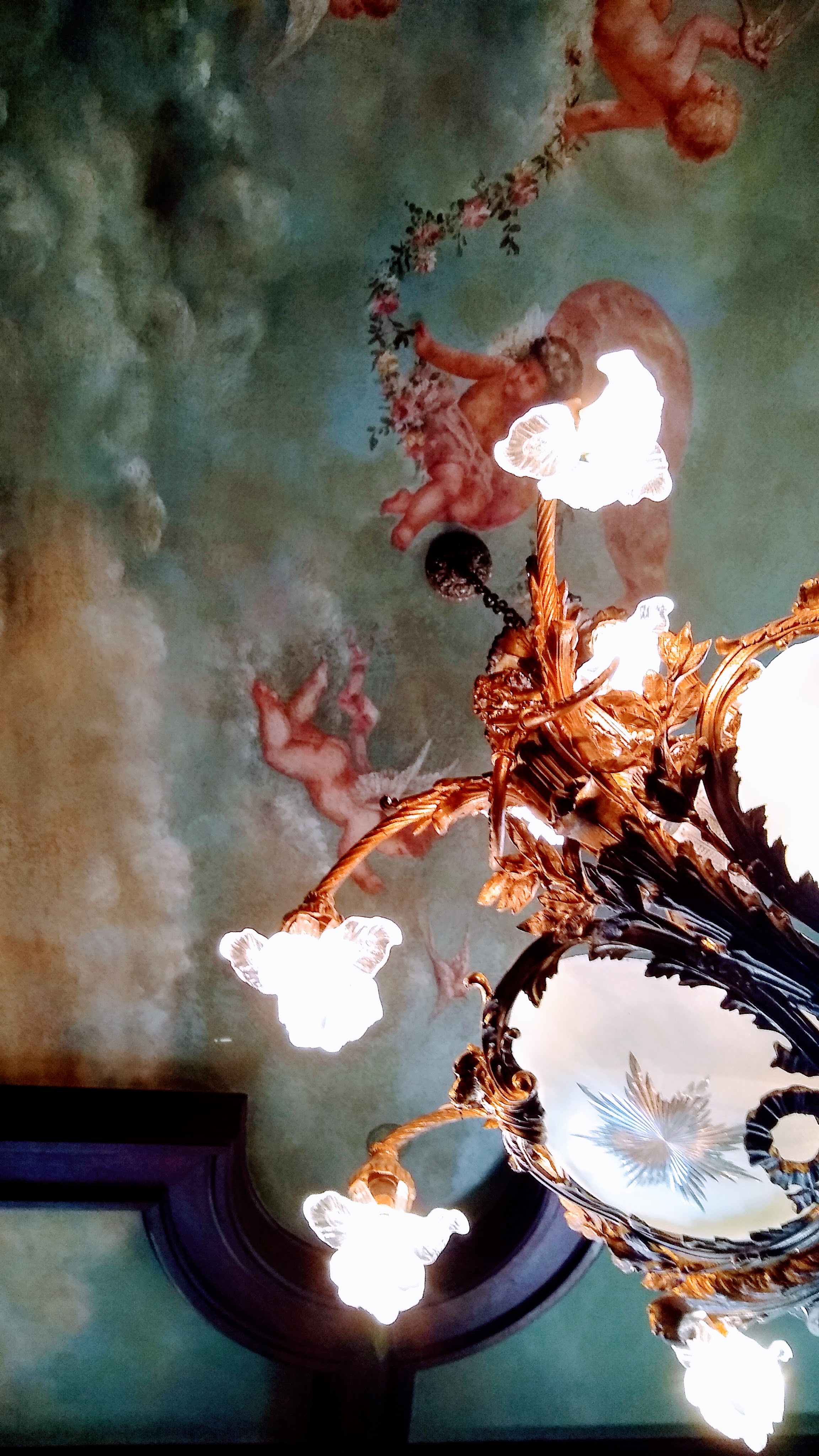
Hotel Galvez, Galveston, Texas – 1911. Image is in the public domain.

With so many diverse threads woven into the cultural fabric of the city, laypersons and history buffs alike will find plenty to pique their interest.

Sign up for more articles. It’s free:

1. CHART A COURSE FOR FUN ABOARD THE TALL SHIP ELISSA

The Elissa, designated “The Official Tall Ship of Texas” by the Texas Legislature, is not a replica like so many of her sisters. She is a true original and one of the world’s oldest, fully-functional tall ships.
(Click on the link to view the video:)

3:26 minute video containing archival footage of an historic trip aboard the Elissa, shot in 1995 in standard definition

Launched in Aberdeen, Scotland during the final glory days of the Age of Sail, she sailed under various flags and names. Records show that Elissa carried cotton from the Port of Galveston in 1883 and 1886.  She ended up in the hands of smugglers, who tried to have her scrapped in Greece. Abandoned and altered almost beyond recognition, that should have been the end.

Photo by Mass Communication Specialist 2nd Class Roadell Hickman; courtesy U.S. Navy

But through an accident of good fortune and the tireless efforts of many individuals, she was eventually rescued and restored by the Galveston Historical Foundation. Today, the square-rigged barque joins the Galveston Historic Seaport as a floating exhibit. Tourists can walk her gangway and stroll her decks to better imagine the spray on their faces and the wind snapping the canvas!

For directions and information on hours and admissions, go to www.galvestonhistory.org.


2. GET IN THE SPIRIT OF A GHOST TOUR
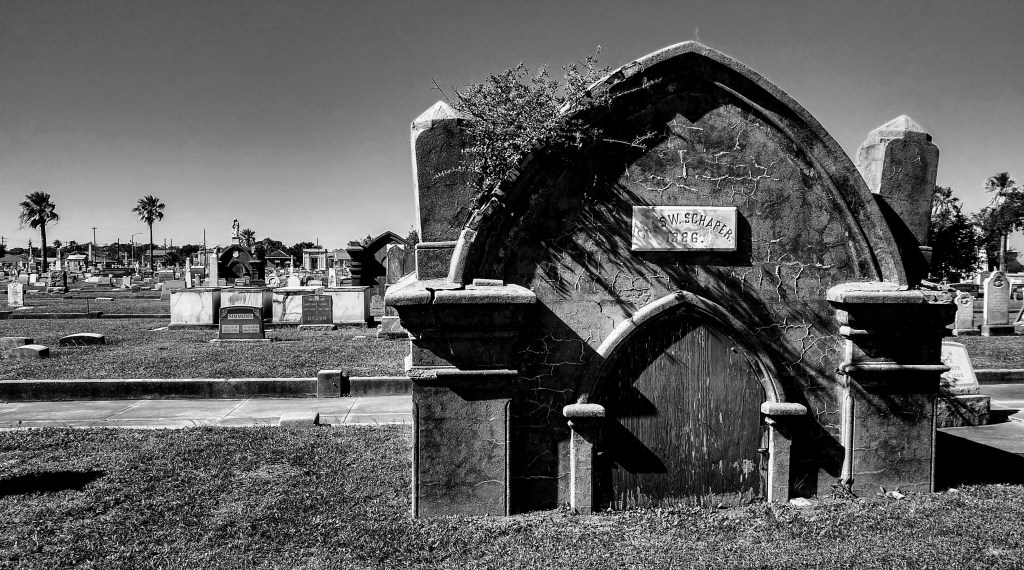
Sinking mausoleum.
Macabre fact: The grave markers in the cemetery on Broadway in Galveston actually represent only about 1/4 of the departed population buried there. As the graves slowly sink into the sand, more bodies are buried on top.

Galveston has taken center stage in the hurly burly of countless human dramas, both social and personal.  Through the centuries, nuns and prostitutes, entrepreneurs and felons have crossed her broad avenues and seedy wharves, and more than one bride, pale with anxiety, has paced the widow’s walk*. Is it any wonder that some folks consider Galveston a hot spot for paranormal activity?  Fun, even for skeptics, ghost tours offer an alternative to the traditional.  Several companies provide walking tours of noted Galveston haunts: the historic Strand, the scandalous ‘red light district’, and the weathered markers and above-ground mausoleums of old cemeteries.  Along with hunting for apparitions, guides relate fascinating historical detail and local lore.  Tag along to catch some eerie vibes.
The setting for this video is the second floor of Riondo’s Ristorante in the Hutchings-Sealy building at the corner of Strand and 24th Street. The building was designed by Nicholas Clayton (who also designed Bishop’s Palace, below) and built in 1896 to replace a previous bank building. It represents an early example of steel frame construction.

(Click on the link to view the video:)

4:03 minute video including an interview with Dash Beardsley of Ghost Tours of Galveston Island

Among the stories floated in the wake of the Great Storm of 1900 is that of a young schoolteacher who took refuge on the second floor of the building. According to legend, as the storm surge inundated the island, she stepped out onto the window ledge, pulling victims to safety. She sorted the living from the dead and cared for them for several days, until she succumbed to a fever and died. She is among numerous spirits reputed to haunt various parts of the building.

For information on scheduling and pricing, visit https://GhostToursofGalvestonIsland.com.

* A widow’s walk is a railed platform on the roof of a house in a seaport town, where wives could watch for the return of their seafaring husbands. Since many never returned, it was, as often as not, a widow’s walk.

3. MEANDER THROUGH MENARD HOUSE
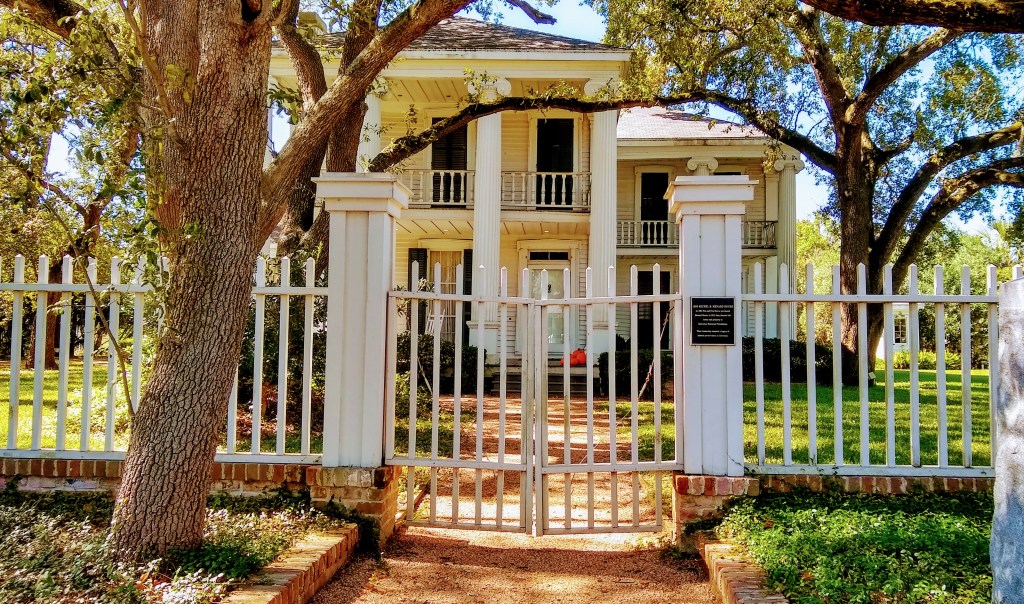
Menard House – photo by Ria Nicholas

Houston founders, John and Augustus Allen, built this Greek-revival-style mansion in 1838 and sold it to Michael (Fr. Michel) B. Menard upon completion. Menard, who was a founder of Galveston and a signatory to the Texas Declaration of Independence, bought the home, probably for his second wife, who died within a year of the purchase. Surprisingly, it serves as an interesting example of an early pre-fab house. Constructed in Maine, it was shipped to Texas in pieces and reassembled at its current location.  The home passed from the Menard family to the Ketchum family in 1879, but fell into disrepair 100 years later.  It was slated for demolition until Pat and Fred Burns, in partnership with the Galveston Historical Foundation, restored Menard House to its original 19th century charm and opened it as a museum in 1994. The home was gifted to the Galveston Historical Foundation in 2018 and remains the oldest surviving structure on the island.

For directions, hours of operation and admission visit www.galvestonhistory.org.

(Click on the link to view the video:)

4:36 minute video tour of Menard House, historic neighborhoods, Bishop’s Palace and Moody Mansion

4. RELAX AT AN HISTORIC BED & BREAKFAST

Several historical neighborhoods dot the eastern end of Galveston Island. The Silk Stocking District, so called because its wealthy residents could afford silk stockings, nestles south of Broadway, along Rosenberg, between 26th and 23rd Streets. Once home to the Texas Cotton Press, it is one of the most intact residential areas in the city, with houses dating from the late 1800s.

Slightly to the east, between 21st and 16th Streets, the Lost Bayou District was originally contemporaneous with the Silk Stocking District, but on a slightly smaller scale. It features homes rebuilt immediately after the destruction of the Great Storm of 1900. Its name derives from Hitchcock’s Bayou, which was filled in during the 1880s and thus ‘lost.’

Photo courtesy the Coppersmith Inn

Moving just north of Broadway, between 19th and 10th Streets, we find the East End Historical District, with homes dating from the 1850s. Here, the pattern of progressive decay has been reversed, and rotting wood, chipping paint, and rusting metal give way to gingerbread and corbels, vibrant pallets, and wrought iron filigree.

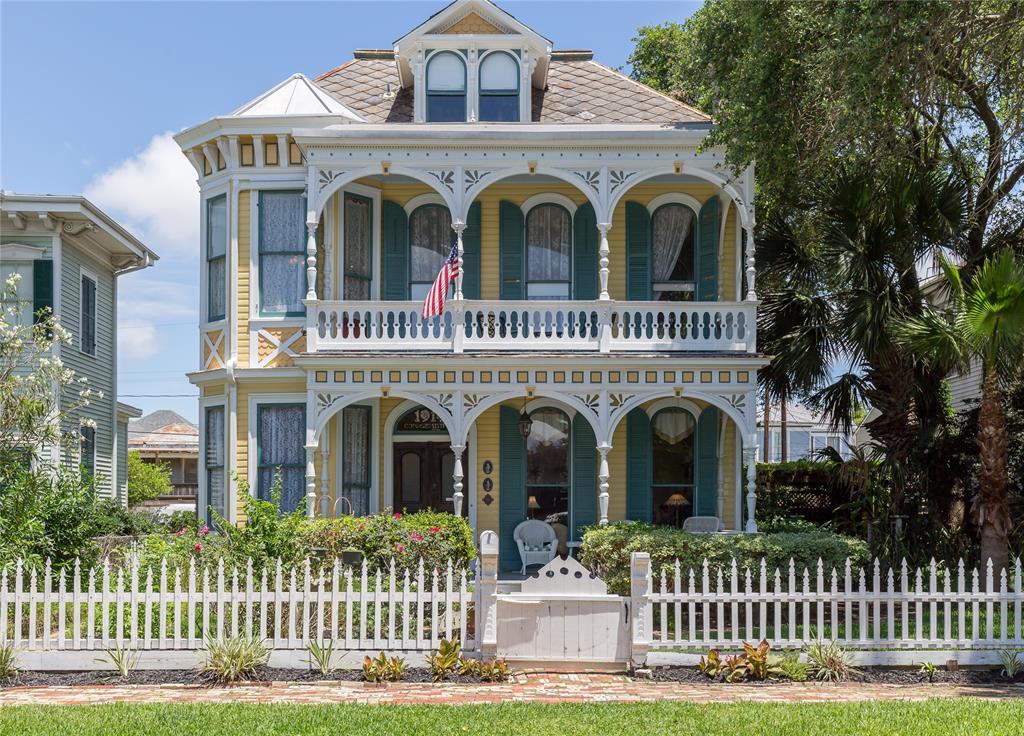
We can experience the genteel ambiance and diverse architectural styles of century homes while strolling through these neighborhoods or by staying at one of their bed & breakfast inns. Bougainvillea and oleander blossoms spill over white picket fences. Colorful gardens surround shaded porches, caressed by the ubiquitous Gulf breeze and invite you to sit a spell and unwind. Check out Coppersmith Inn, Lost Bayou Guesthouse, Carr Mansion, or The Villa Bed & Breakfast, among others.

For directions and information on pricing and availability, visit https://CoppersmithInn.com.

5. BROWSE THROUGH BISHOP’S PALACE
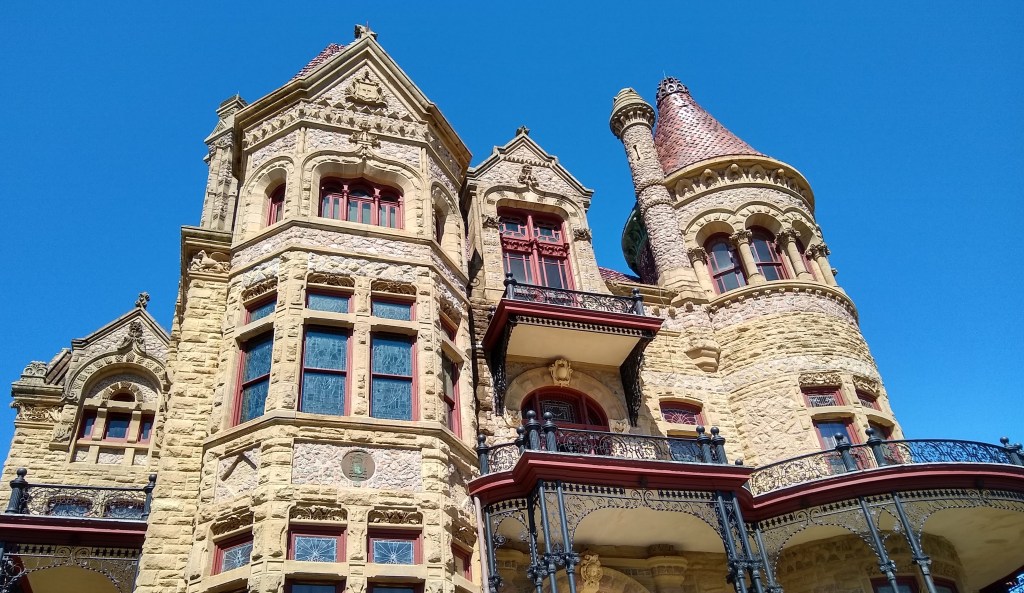
Bishop’s Palace, a/k/a Walter Gresham House – photo by Ria Nicholas

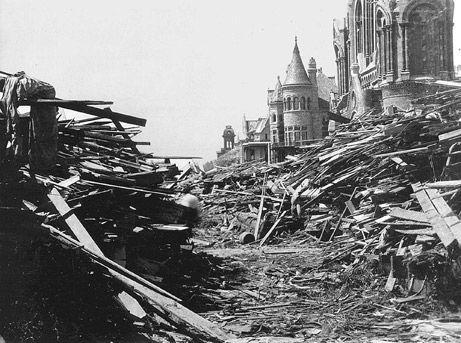
The American Institute of Architects ranks this turreted 1892 residence among the most important buildings in America.  Constructed entirely of stone for Colonel Walter Gresham, the home became refuge to hundreds of hurricane survivors. Vintage photographs of the 1900 Storm show the structure looming, relatively unscathed, above mountains of mangled storm surge debris.

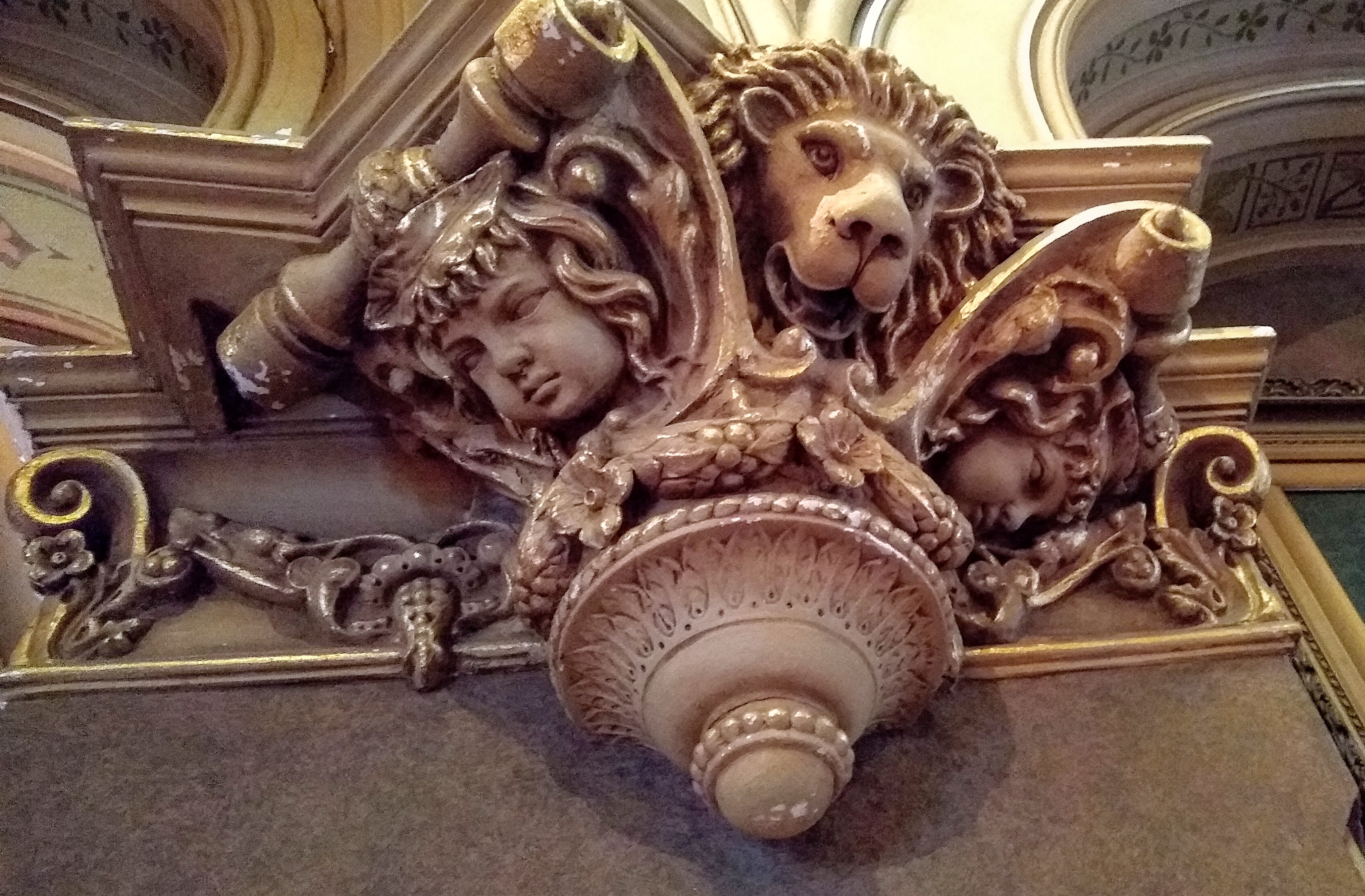
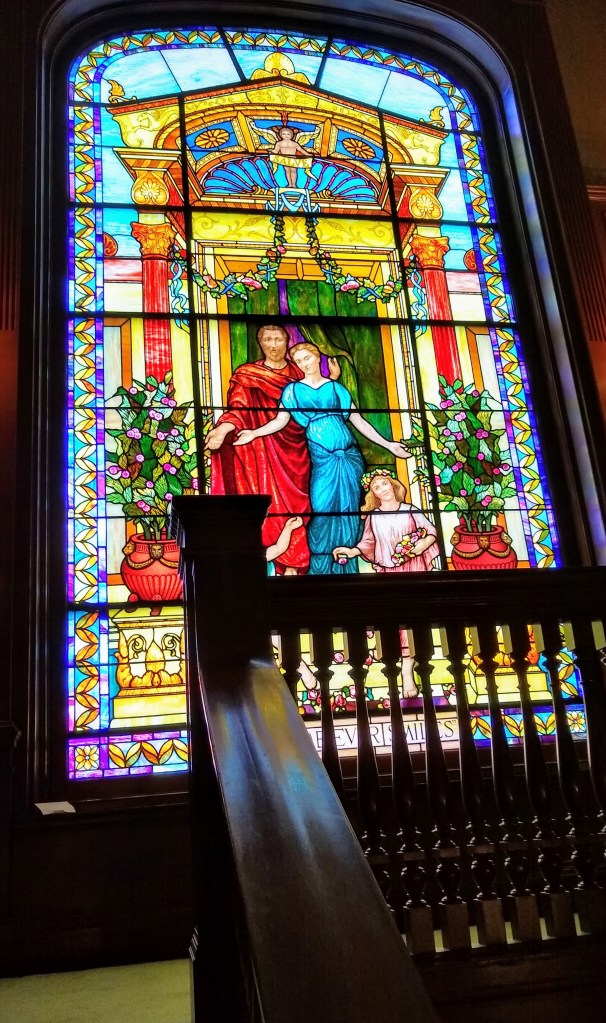
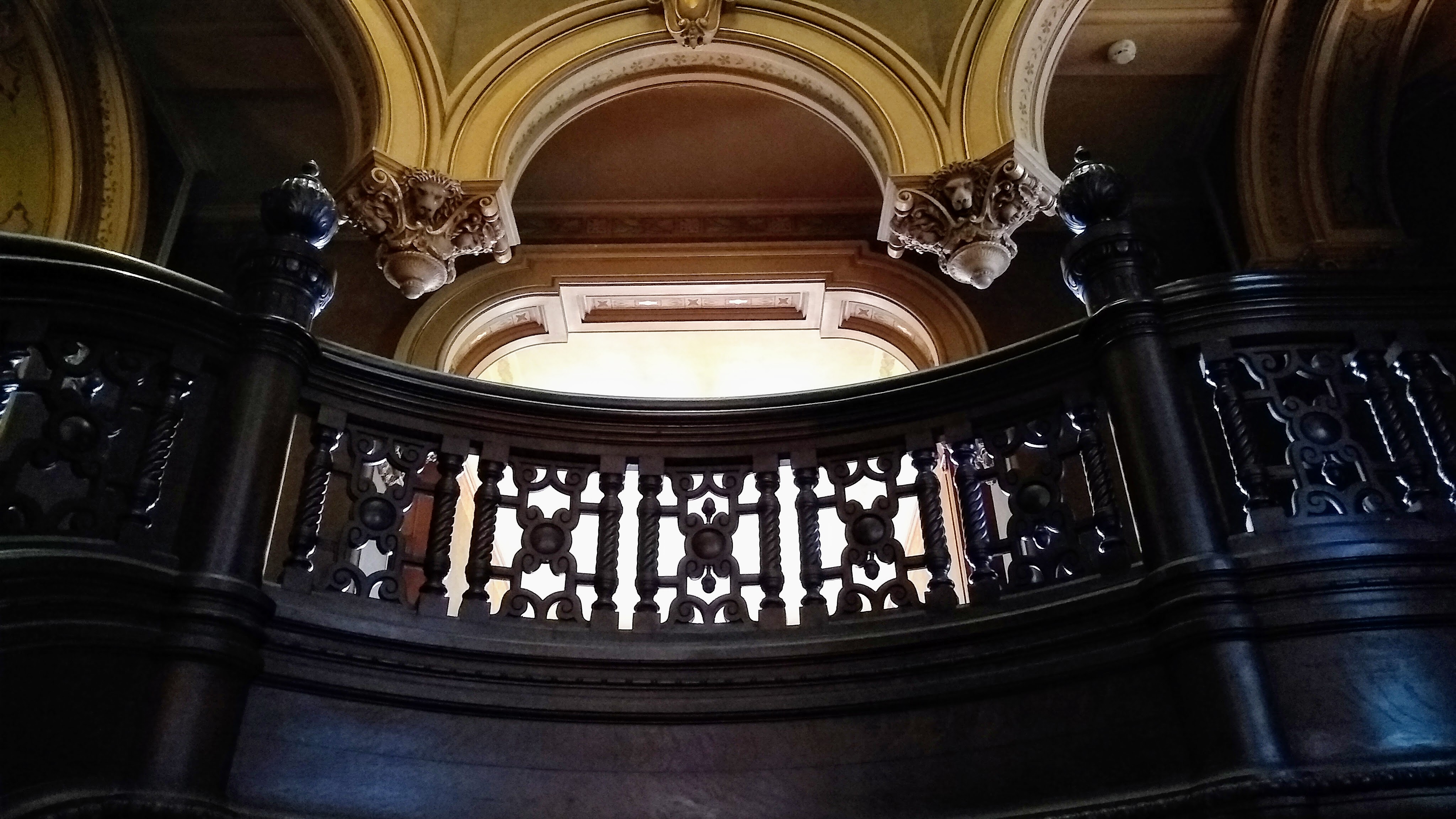
Main stairwell, above; architectural detail, below – photos by Ria Nicholas

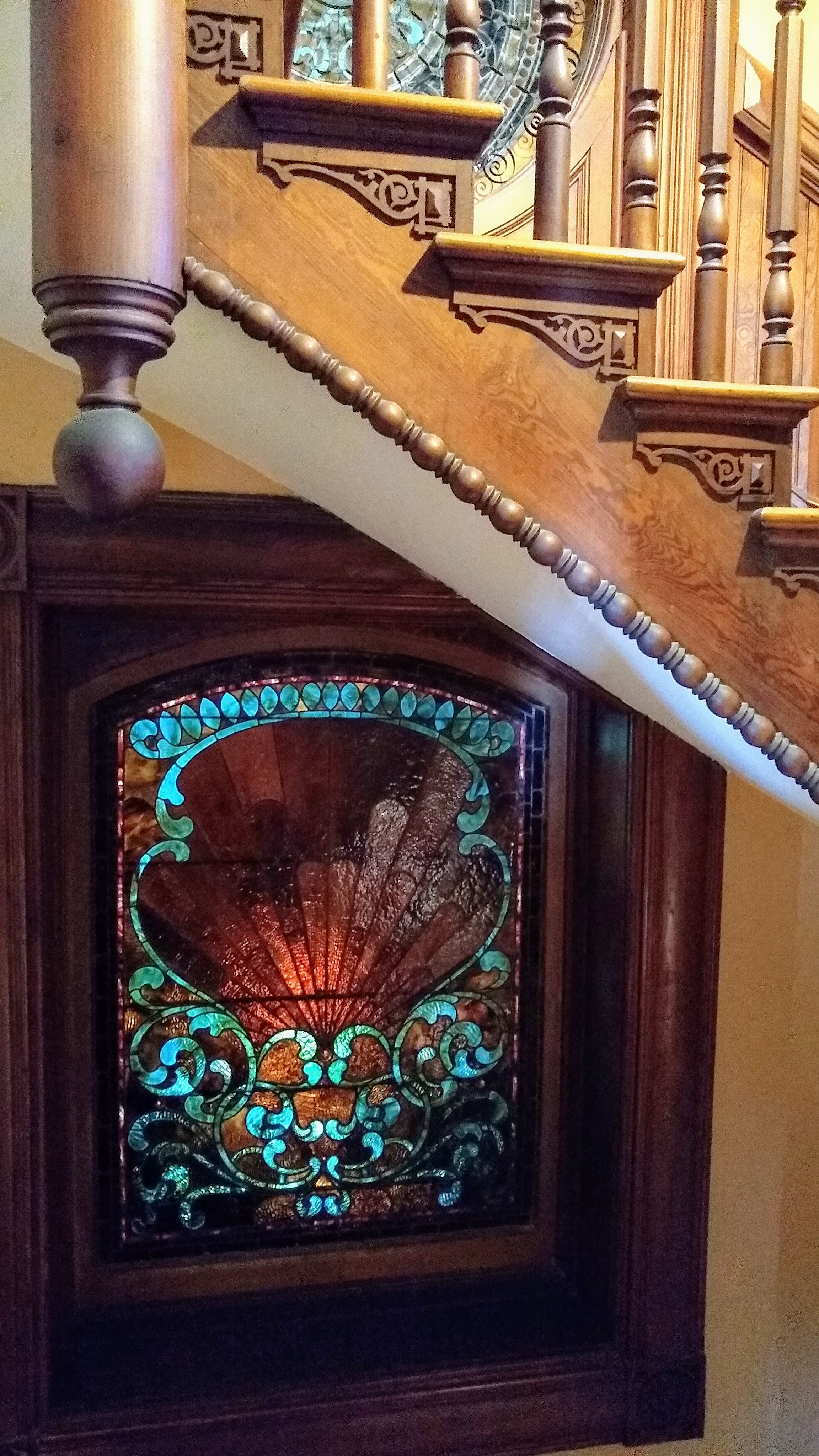
In 1923, the Roman Catholic Diocese of Galveston purchased the home to serve as residence for Bishop C.E. Byrne, earning it its present-day moniker. Today Bishop’s Palace is owned by the Galveston Historical Foundation, and its carved and gilded details, stained glass, and luxury furnishings spark the imagination of tourists, who come to immerse themselves in the glory of her past.

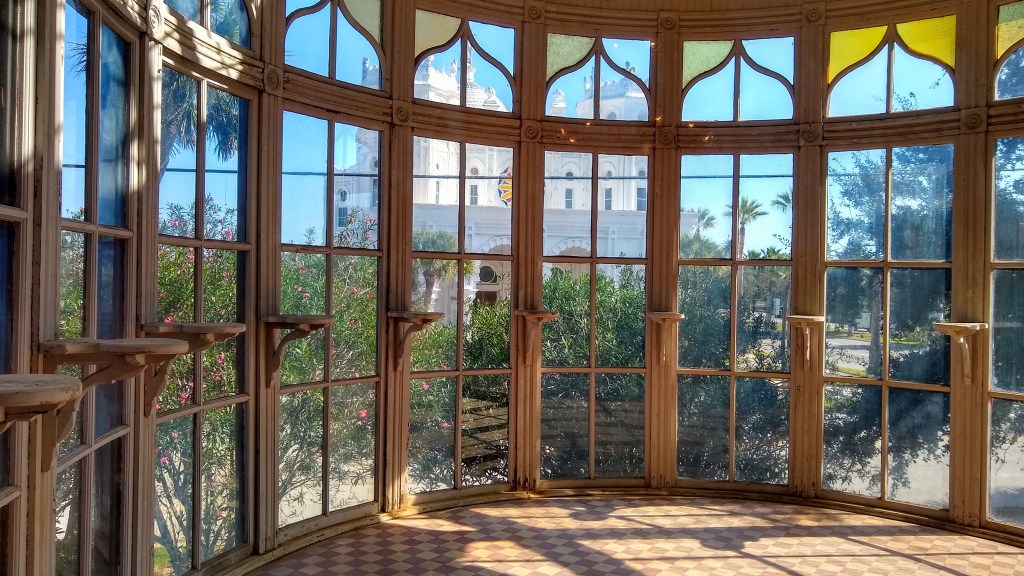
Winter garden – photo by Ria Nicholas
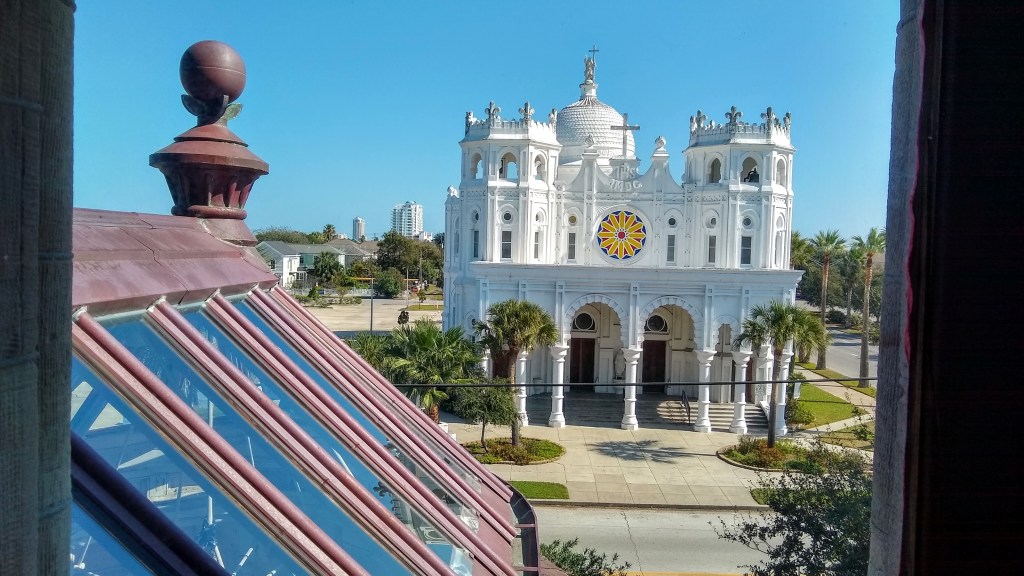
View of Sacred Heart Church from Bishop’s Palace –
photo by Ria Nicholas

(Left: Galveston’s striking Sacred Heart Church, built in 1903-04, sits just across the street.)

For directions, hours of operation and admission to Bishop’s Palace, visit www.galvestonhistory.org.


6. MARVEL AT MOODY MANSION
Moody Mansion – photo by Ria Nicholas
Main staircase – photo by Ria Nicholas

Galveston socialite Narcissa Willis had always longed for a grand home. After her husband’s death in 1893, she indulged in commissioning this impressive four-story Romanesque mansion.  The result?  Her children, now unable to secure a fair share of their father’s inheritance, abandoned her to the rambling thirty-one room residence, where she lived out the balance of her life alone.

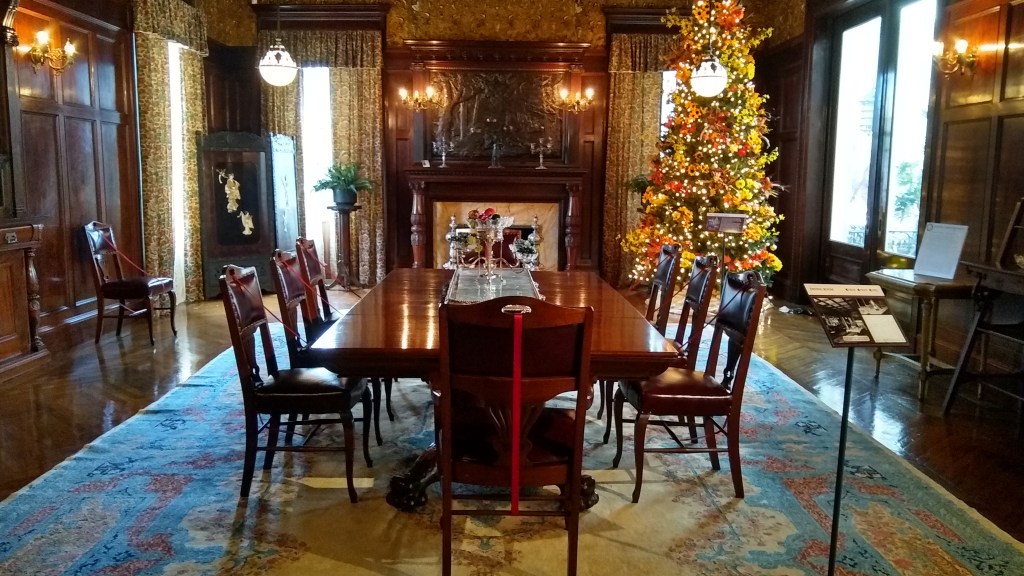
Upon her death in 1899, the home was purchased by cotton magnate W.L. Moody, Jr., whose philanthropic legacy permeates the region to this day. The family celebrated their first Christmas at Moody Mansion a mere three months after the Great Storm leveled much of the island. Tourists lose themselves in the lifestyle of the rich and famous of the turn of the century as they wander the mansion’s 28,000 square feet, filled with the opulent furnishings, personal effects and legacy of this remarkable family.

Dining room – photo by Ria Nicholas

For directions and information on hours and admissions, go to www. moodymansion.org.

7. GO FULL STEAM AHEAD AT THE GALVESTON RAILROAD MUSEUM

Long before a network of paved highways crisscrossed the land, and before passenger airlines took flight, travelers relied on trains to carry them to their destinations.

(Click on the link to view the video:)

7:26 minute video tour of the Galveston Railroad Museum with Executive Director, David Robertson

As passenger and commercial traffic in and out of Galveston picked up steam, so did the need for a railroad.  The Gulf, Colorado & Santa Fe was founded in 1874 to ferry passengers and cargo to points throughout Texas & the United States.  The current terminal building was completed in 1932 and known as Union Station since it was a “union” of multiple railroad lines.  In the late 1970s, Mary Moody Northen and the Moody Foundation purchased the historic art deco building to save it from demolition. 

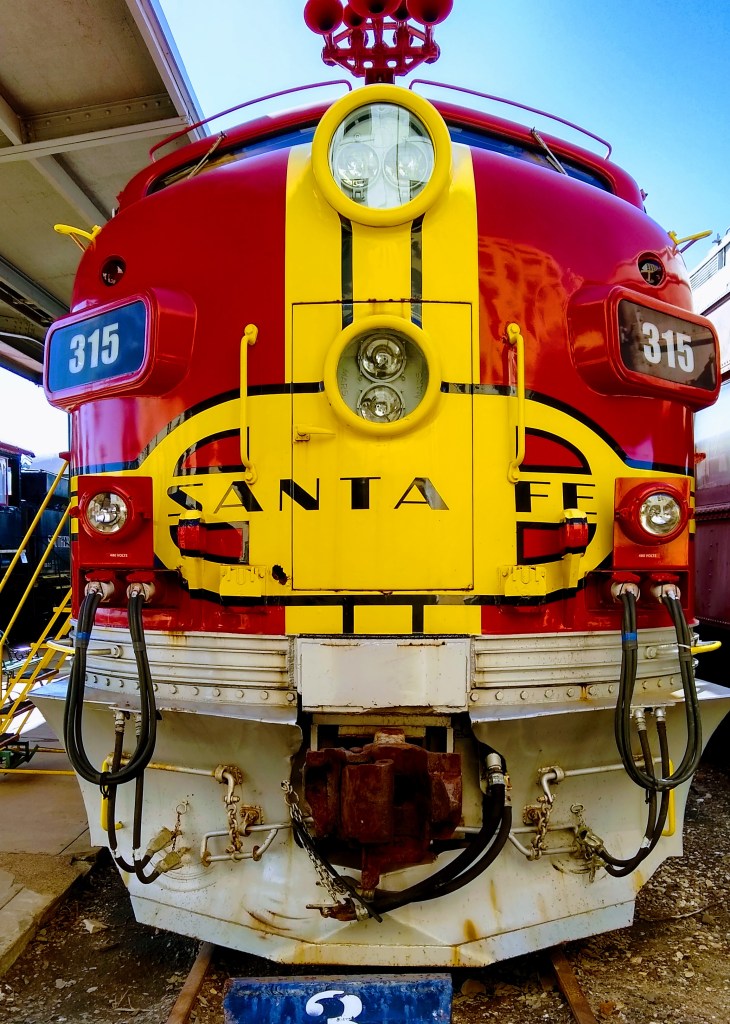
F-7A diesel locomotive in Warbonnet colors –
photo by Ria Nicholas

The Galveston Railroad Museum opened here, at the junction of 25th and Strand Streets, in 1983 to preserve Galveston’s railroading history. Sadly, Hurricane Ike flooded the museum with more than 10 feet of saltwater in 2008, destroying much of the museum’s collection. After three years of clean up, however, the museum reopened with forty pieces of rolling stock, including two F-7A diesel locomotives in Santa Fe Warbonnet colors.

The museum continues to add to its collection. A recently acquired mid-century modern private train car, formerly used by movie and television star Jackie Gleason, is available to rent for meetings*. Various other areas of the museum complex are also available for events, gatherings, and wedding venues. On Saturdays, in addition to admission, the museum offers short rides – weather permitting – aboard an open-air caboose. Remember those?

*UPDATE: The “Bonnie Brook” private car, formerly owned by Jackie Gleason, is now available for overnight rental! Book here!

For directions and information on hours and admissions, visit www.GalvestonRRMuseum.org.

8.  STROLL ALONG THE HISTORIC STRAND

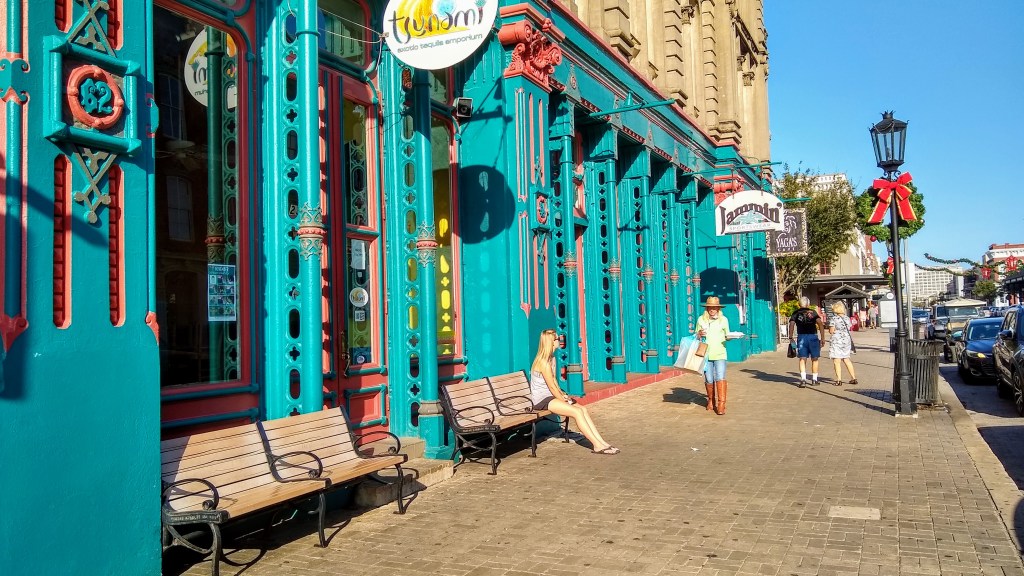
The Strand, more than any other location, represents the heart and soul of historic Galveston. Located a stone’s throw from the waterfront, the eclectic shops and busy bistros of Strand Street reside in the cast iron-fronted, turn-of-the-century buildings that were the nerve center of Galveston’s economic heyday. 

The Strand, Galveston, Texas – photo by Ria Nicholas

Throughout each year, The Strand hosts numerous arts and entertainment events, including – most famously – Dickens on The Strand. This weekend-long holiday-themed Victorian frolic occurs in early December and is marked by plays, roaming vendors, costumed carolers, parades, feasts, and . . . of course, Victorian bed races. Shop or dine here any time of year, but if you attend Dickens on The Strand, be sure to sport your best Victorian finery and enter the costume contest!

(Click on the link to view the video:)

3:37 video tour of The Strand, The Grand 1894 Opera House and The Colonel Paddlewheel Boat

For more information on how to attend Dickens on The Strand, go to https://www.GalvestonHistory.org/events/dickens-on-the-strand.

9. CELEBRATE A LEGACY OF LIBERTY
Image courtesy Reginald C. Adams
Artist Reginald Adams; image courtesy Reginald C. Adams

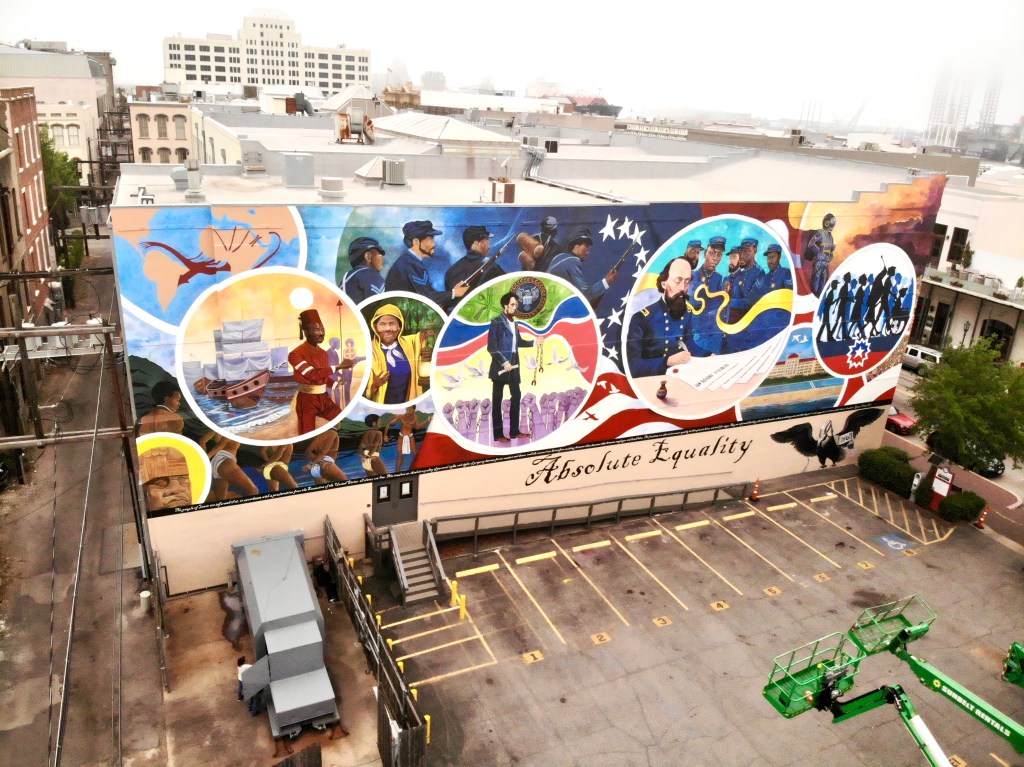
The newest destination on the Strand, a 5,000 square foot mural by Houston-based artist Reginald Adams, finally provides a physical destination where tourists can reflect upon a decisive moment in Galveston’s and the nation’s history. The mural is the centerpiece of the Juneteenth Legacy Project, a platform for telling the Juneteenth story and promoting its celebration of freedom and opportunity. It depicts a pivotal chapter in the American narrative, through several graphic “portals.” The story, which begins with the African slave trade, moves on to the Underground Railroad and Lincoln’s Emancipation Proclamation. It culminates with the eventual announcement of “Absolute Equality” by Union Army General Gordon Granger, in the presence of several Union regiments of the U.S. Colored Troops. The June 19, 1865 announcement of the Emancipation Proclamation in Galveston, two and a half years after it was first issued, freed some 250,000 Texas slaves and inspired the Juneteenth holiday. The mural is located at 22nd Street and the Strand, across the street from the former slave market and overlooking the location at which Granger is said to have made the announcement.

Learn additional details about this interesting episode in American history in this New York Times article or at the Juneteenth Legacy Project.

“Juneteenth is not about enslavement and suffering. Juneteenth is about a spirit of renewal that celebrates freedom and opportunity. Absolute equality is not about equal results but about creating a society that supports all to become their very best selves to benefit the collective community.”

–Sam Collins, historian and co-chair of the Juneteenth Legacy Project
Image courtesy Reginald C. Adams
10. DELIGHT IN A PERFORMANCE AT THE GRAND 1894 OPERA HOUSE
Photo by John Glow; courtesy The Grand 1894 Opera House

The Grand 1894 Opera House, the official opera house of the State of Texas, recently celebrated its 125th anniversary. It survived not only the Great Storm of 1900 and several subsequent hurricanes, but many years of neglect at various times throughout its history. While Henry Greenwall raised $100,000 for the original construction, thousands of residents from Galveston, Houston, and across Texas poured $8 million dollars into its restoration between 1974 and 1990. The Grand passed through several iterations, including a Vaudeville venue and movie theater, before returning to its original glory.  Today, international stars of stage and screen, Broadway hits, music, dance, comedy and more grace its stage.  Immerse yourself in the opulence of the Gilded Age – perhaps in one of the velvet-draped loges – to take in a live performance.

For directions, ticket pricing and schedules, visit www.TheGrand.com.

11. TAKE A ROMANTIC DINNER CRUISE ON A PADDLE WHEEL BOAT

During the 1800s, as commerce burgeoned across the frontier, and roads amounted to little more than ruts, flat-bottomed steam boats plied the shallow waters of rivers and bayous upstream from the Texas coast. They ferried cotton and other commodities to and from muddy riverbank landings. What started as a practical solution for commerce, soon evolved into an entertainment option. In 1831, actor William Chapman launched the first showboat. The idea caught on, and soon other family-owned showboats brought entertainment to small towns along inland waterways.

Photo courtesy Moody Gardens

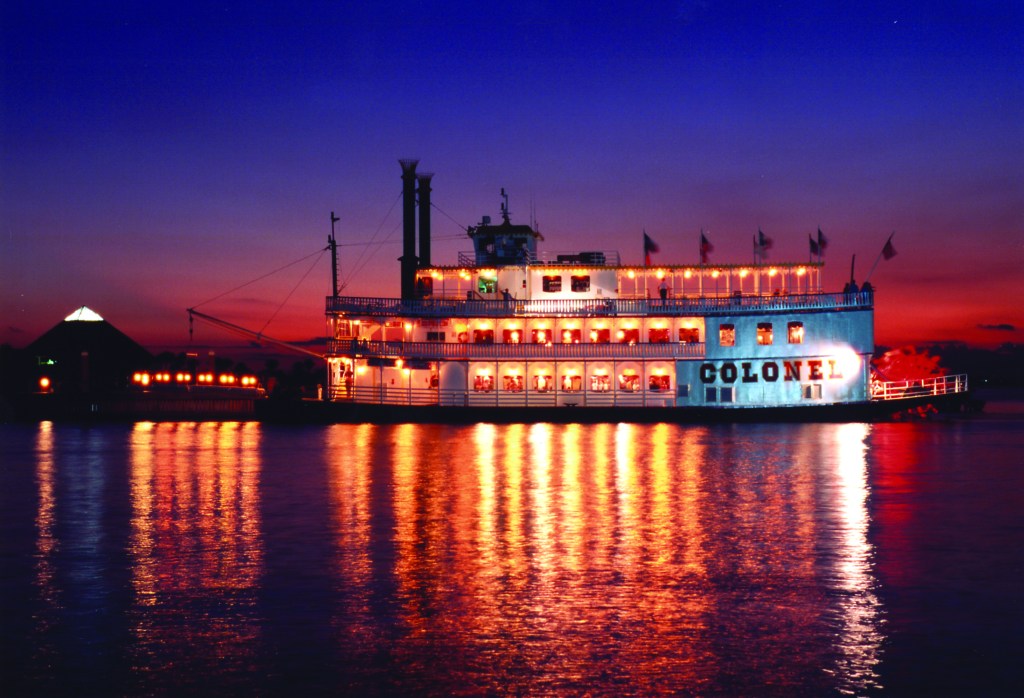
Now we, too, can drift back in time with a dinner and dance cruise aboard the Colonel, a 675-passenger, replica 19th century paddle wheel boat. Note that dinner and dance cruises require advance reservations by the Monday prior to the scheduled departure date. Shorter, hour-long cruises around Offatts Bayou are available without reservations, weather permitting. Be sure to arrive early.

For directions and information on tickets and schedules, go to www.MoodyGardens.com.

Photo by Ria Nicholas

12. HEAD TO GALVESTON’S HISTORIC PLEASURE PIER

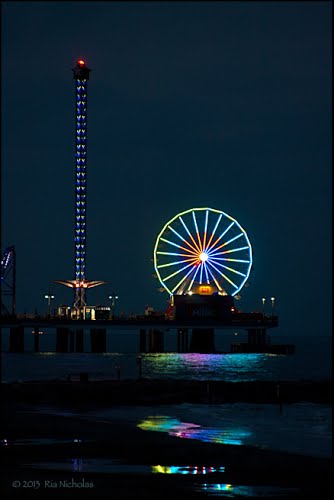
Read the full story in our separate article, “Bright Lights and Cool Nights At Galveston Island Historic Pleasure Pier.”


Galveston, Texas lies on the Gulf of Mexico, just 50 miles southeast of Houston via I-45.

American History Road Trip would like to thank:

  • The Galveston Historical Foundation
  • The Galveston Convention & Visitors Bureau
  • The Galveston Railroad Museum and David Robertson, Executive Director
  • The Grand 1894 Opera House and John Glow, Photographer
  • The Juneteenth Legacy Project
  • Moody Gardens
  • Moody Mansion
  • Ghost Tours of Galveston Island and Dash Beardsley, Owner
  • Riondo’s Ristorante and Don McClaugherty, Owner
  • The Coppersmith Inn

Sign up for more articles. It’s free:


Sponsored by Ria Nicholas Designs – Modern, Rustic Furniture & Decor:


A Photo Essay on Jalopies

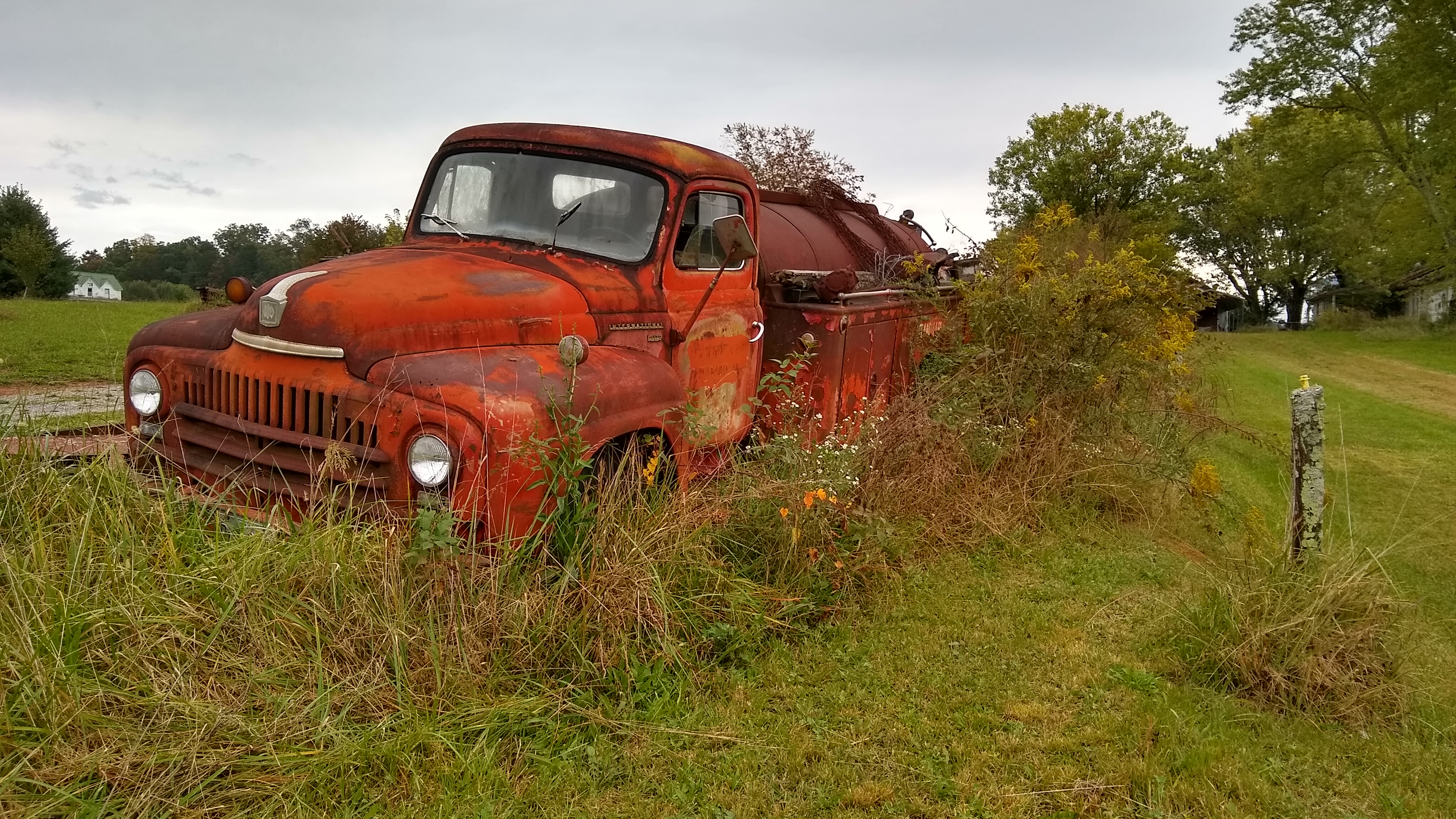
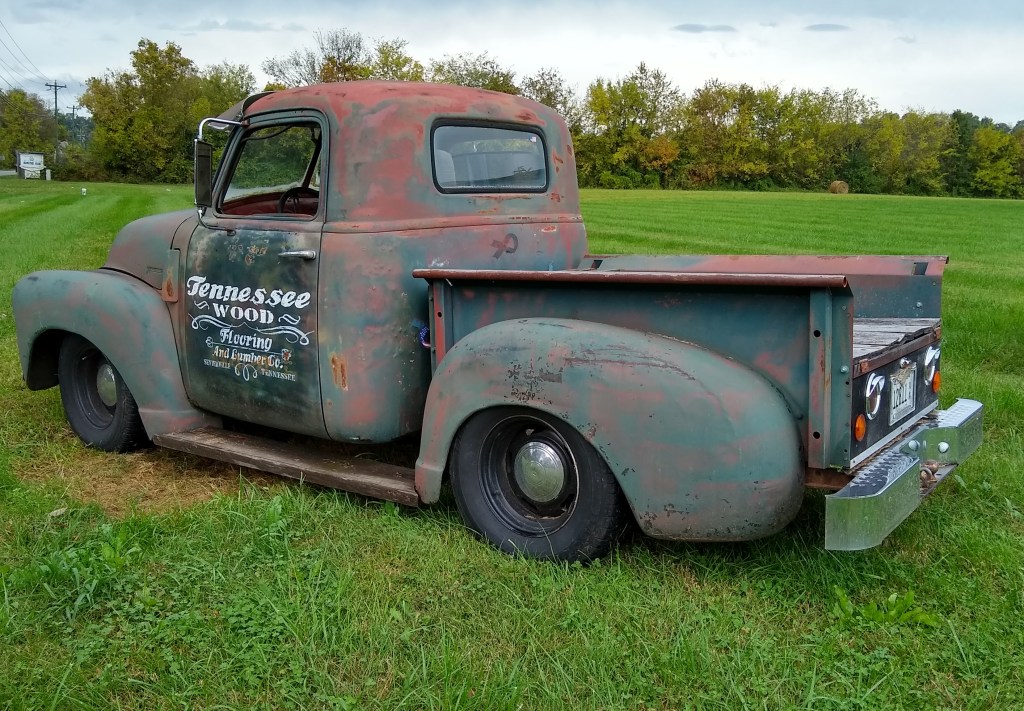
Truck #1 was located at an antique shop on Newport Highway (US 411), between Sevierville and Newport, Tennessee. We think it might be a 1951 or 1952 International Harvester truck. What do you think?

Witnesses to the American Road

by Ria Nicholas

I know, I know! Jalopies are not a destination we can visit. But what could be more iconic of the American experience – or more necessary for a road trip – than the American automobile? Whether you call them “classic cars,” “antique automobiles,” or just plain “vintage,” I have managed to photograph a number of jalopies through the years and find them both beautiful and sad.


Year: ? Make: ? Model: ?

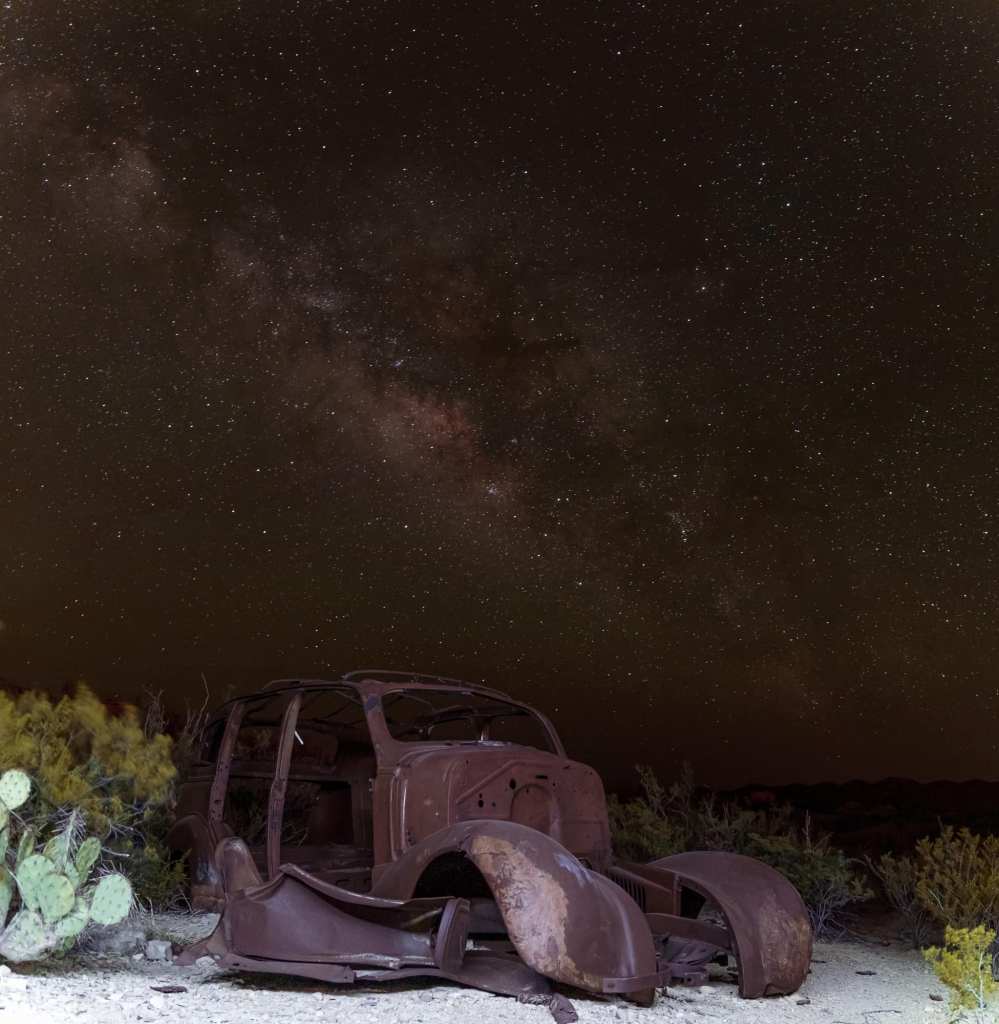
Vehicle #2: This beautifully eerie image of a fossilized car, beneath an overarching Milky Way, is one of several spectacular night photos taken in the Big Bend area of West Texas by photographer Andrew M. Shirey.


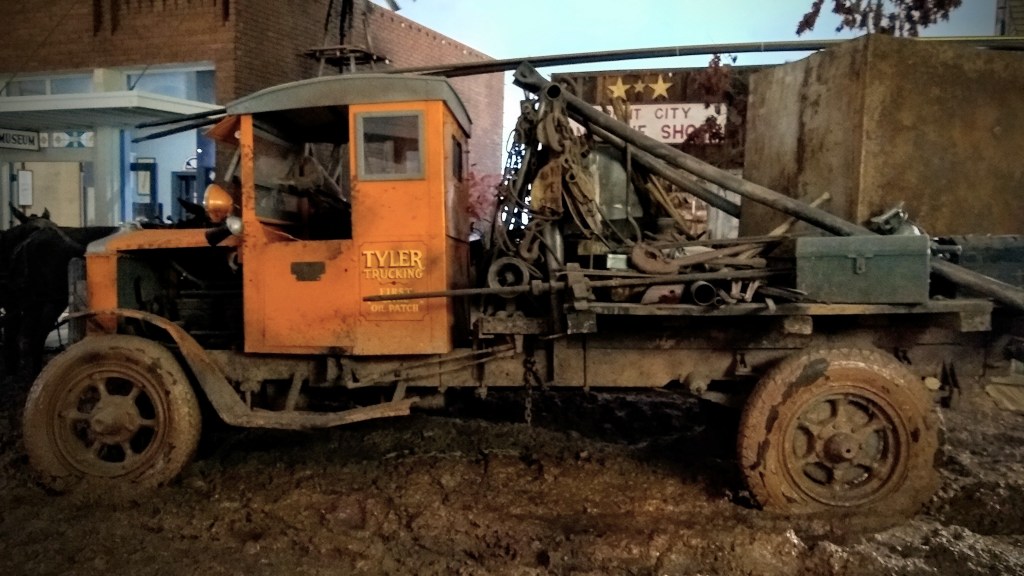
Vehicle #3 is a truck located inside the East Texas Oil Museum in Kilgore, Texas. Can anyone identify it for us?


I invite you to help me identify their years, makes and models and to share your photos of jalopies to add to this post. (I’ve numbered the vehicles, to make it easier for you to refer to them.)

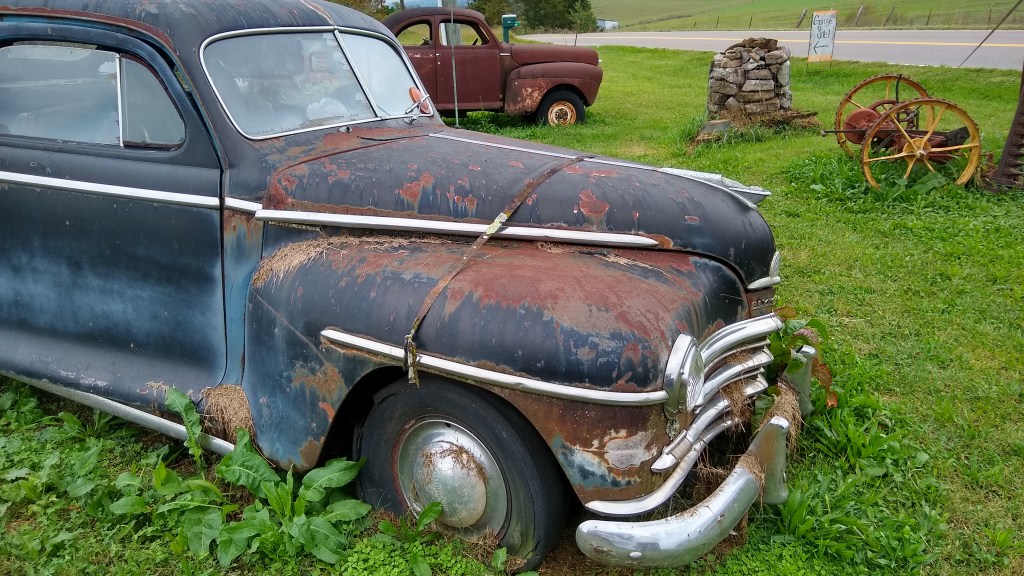
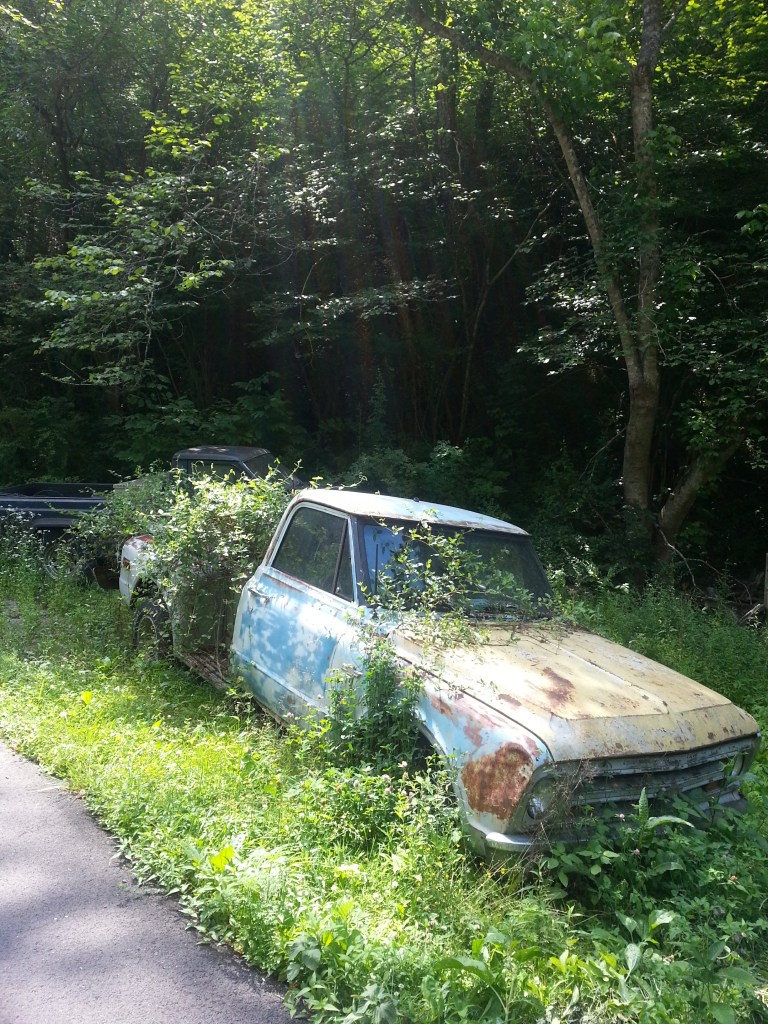
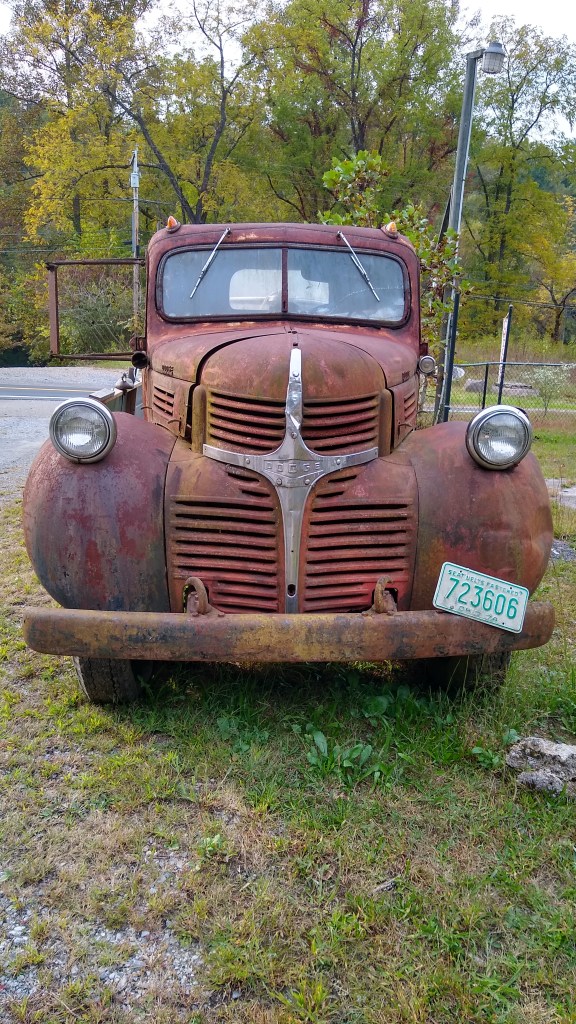
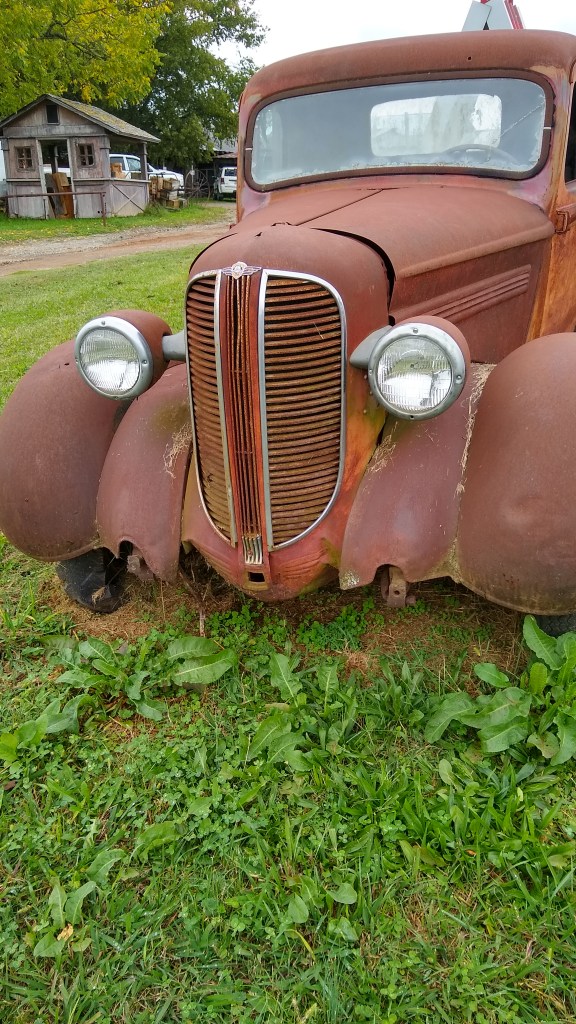
The above three cars were all located in Tennessee. Car #4 was offered for sale at an antique shop on Newport Highway (US 411), between Sevierville and Newport. We believe it is a Plymouth. Pickup #5 was abandoned off Boogertown (yes, you read that right) Road in Gatlinburg. It appears to be a Chevy. And pickup #6, a Dodge, was on display at a school bus diner and gift shop on US 321 near Cosby, TN.

We believe vehicles #7, #8 and #9 are all 1930s or 40s International Harvester trucks. Location: Silverton, Colorado, near the railroad tracks. Can anyone provide more details?

The Tremont area of the Great Smoky Mountains National Park was once a booming logging community known as Stringtown, run by the Little River Lumber Company. It was clustered around a hotel and post office and served by a railroad. Somewhere off the main hiking trail sit the skeletonized remains of a 1930s Cadillac, leaving visitors to ponder how it ended up among boulders and trees. Rumor has it, that it was used to run moonshine from a still during the Prohibition. More likely, it was left behind by the Civilian Conservation Corps, who had a camp in the area at the time.

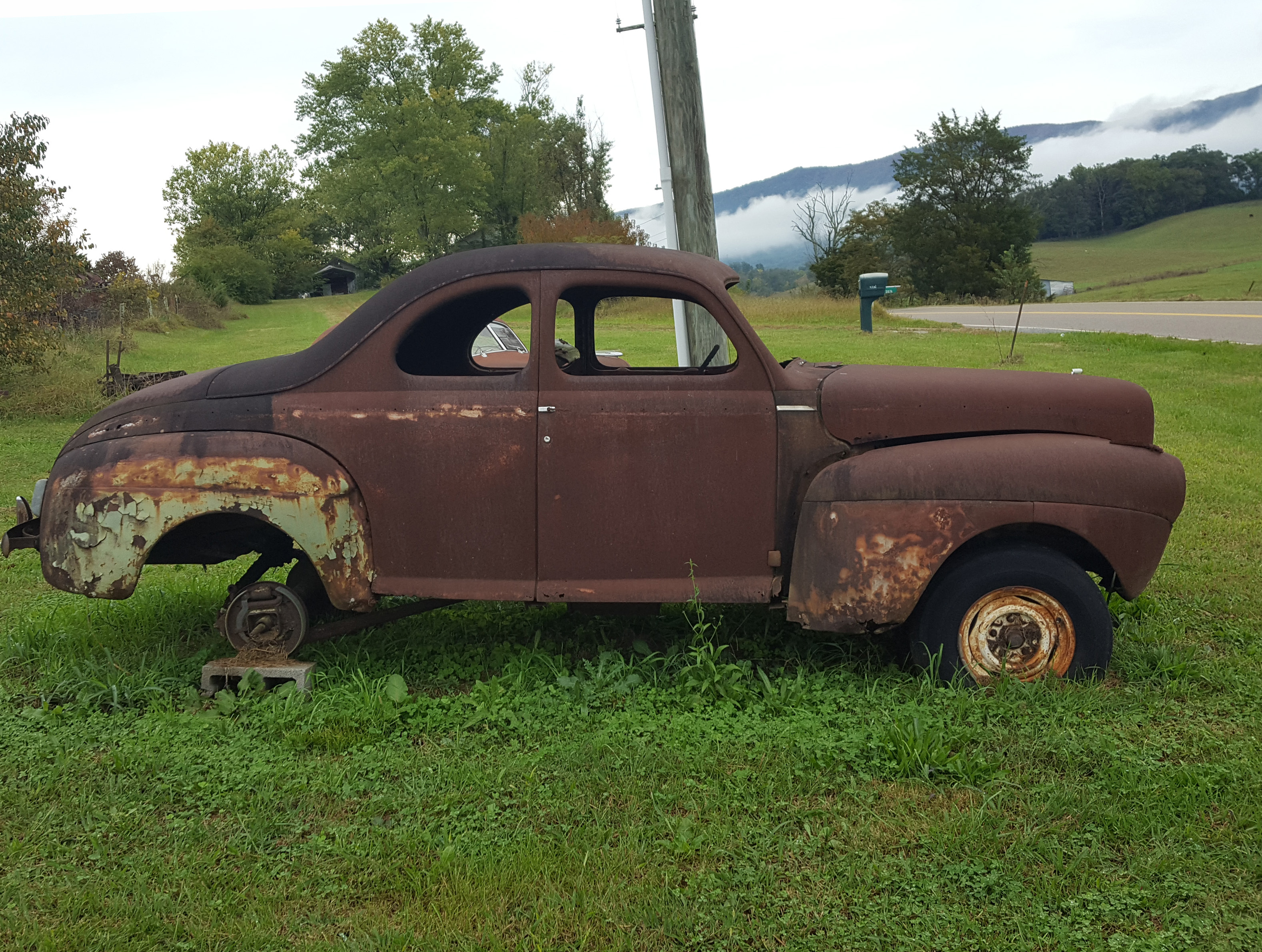
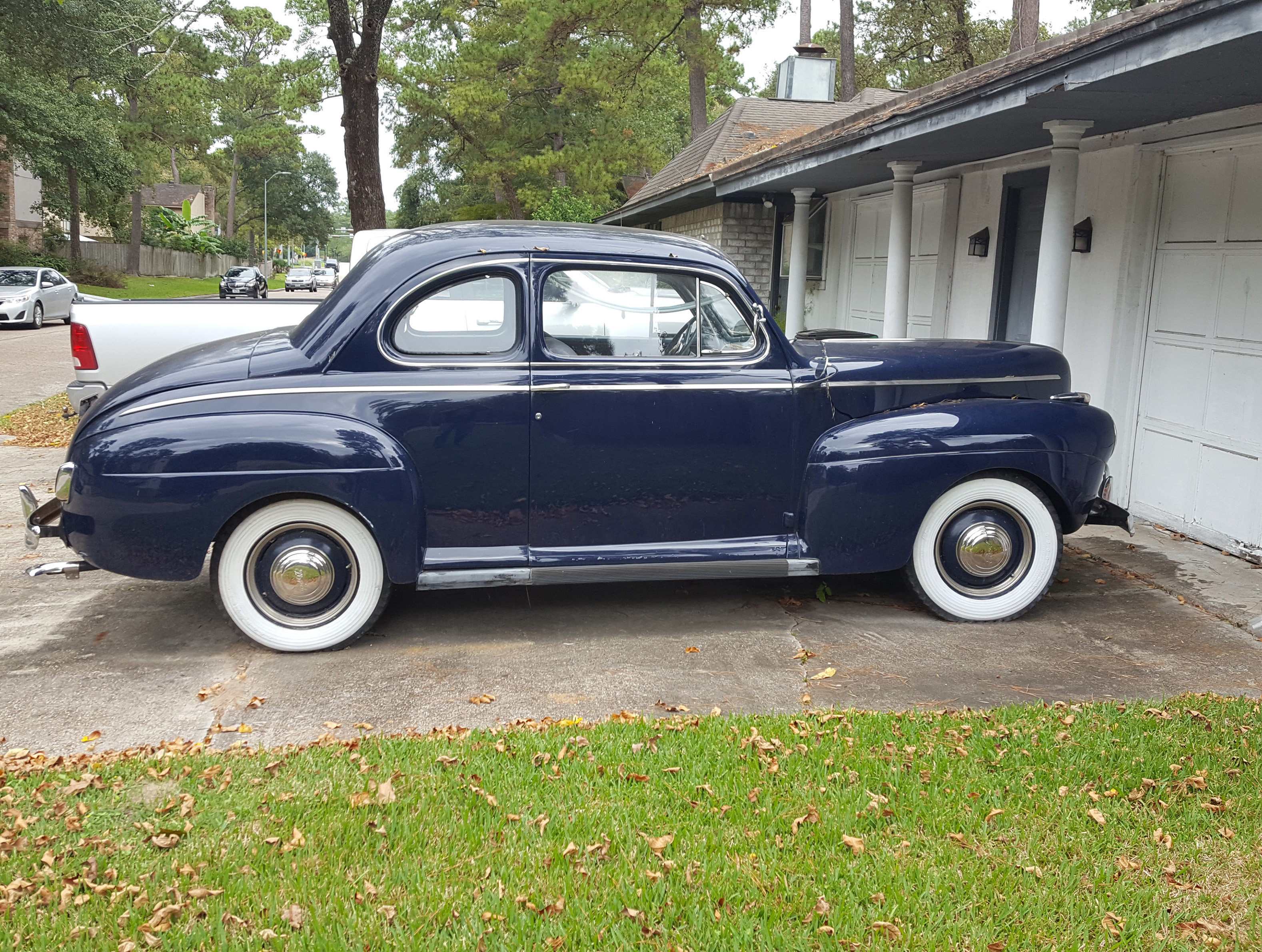
#11. 1941 Ford Coupe; photos by Jim Zura. Use the slider to see its potential.

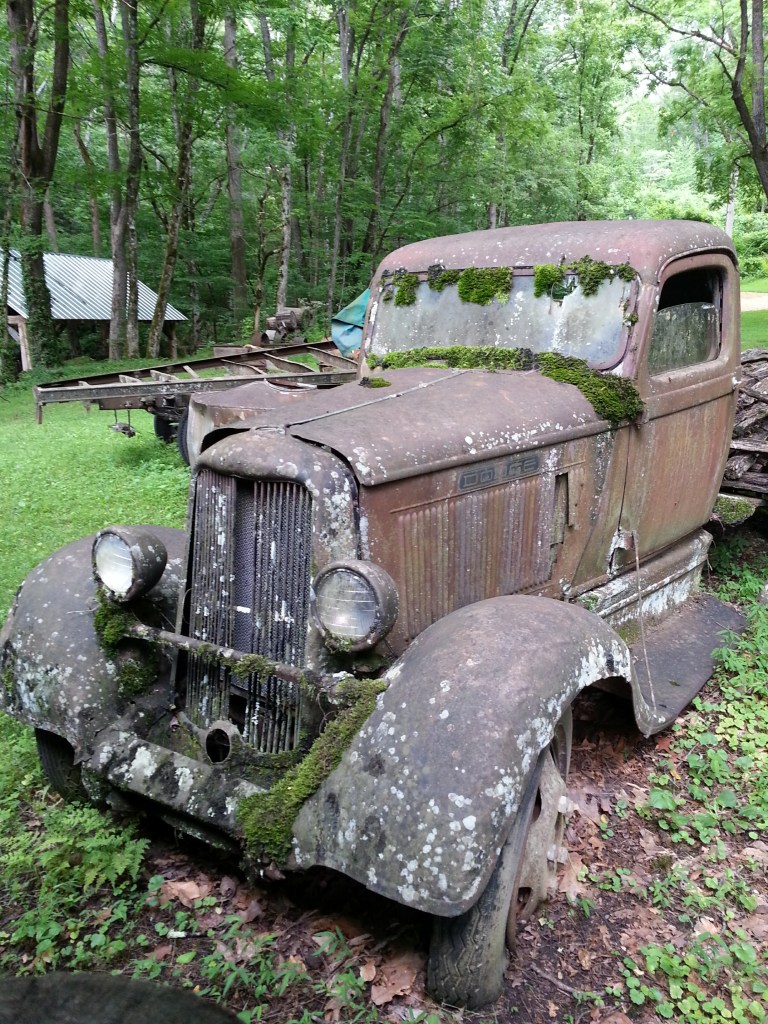
This moss-covered beauty is located at Ely’s Mill, at the end of the Roaring Fork Motor Nature Trail in Gatlinburg, TN. Andrew Jefferson Ely built the mill in 1925 after the death of his wife and to escape urban living. He hired local craft folk to produce items to sell at the mill and used the mill – actually two mills – for wood furniture making and grinding grain.

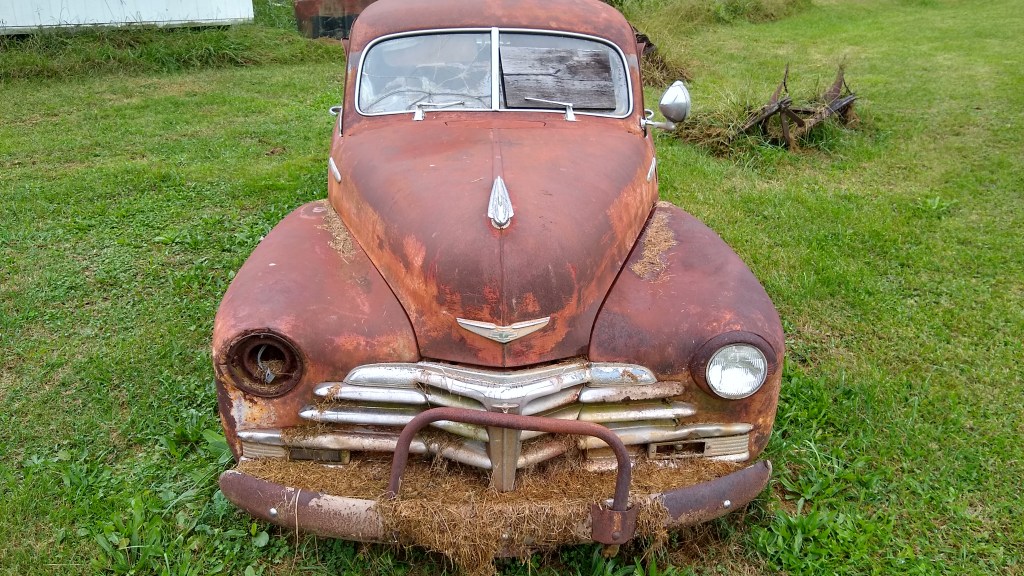
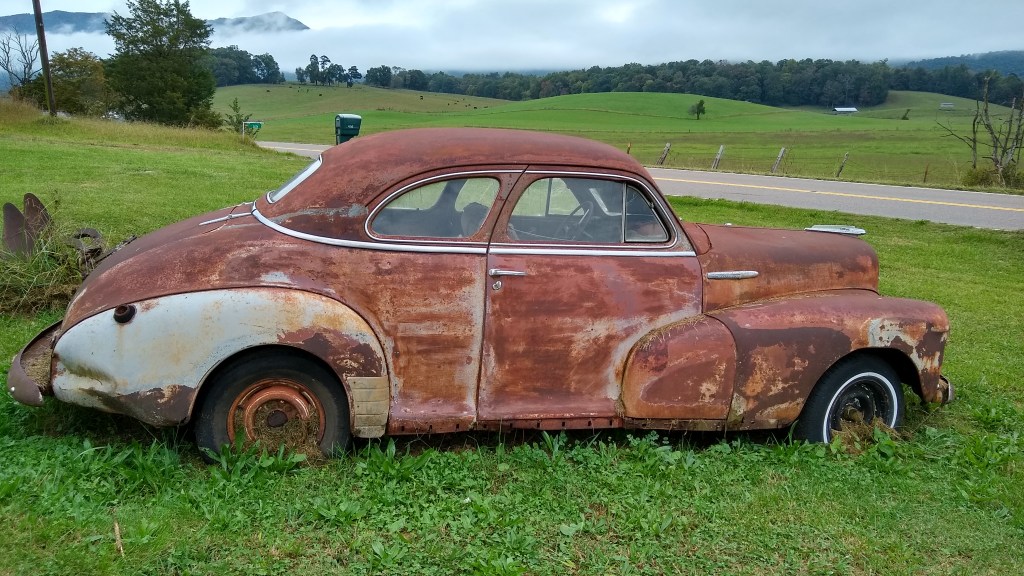
Vehicle #13 serves as an advertising banner on Pittman Center Road in Sevierville, Tennessee. Cars #14 and #15 were located at the antique shop on Newport Highway (US 411) between Sevierville and Newport, TN. We believe car #15 is a 1947 Chevy Stylemaster.

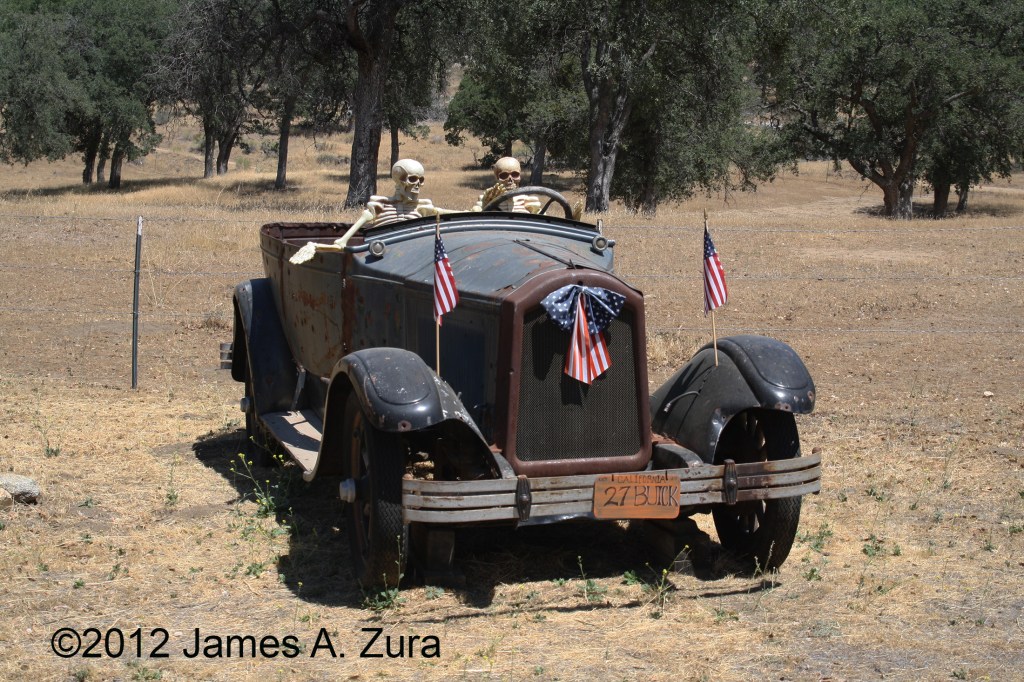
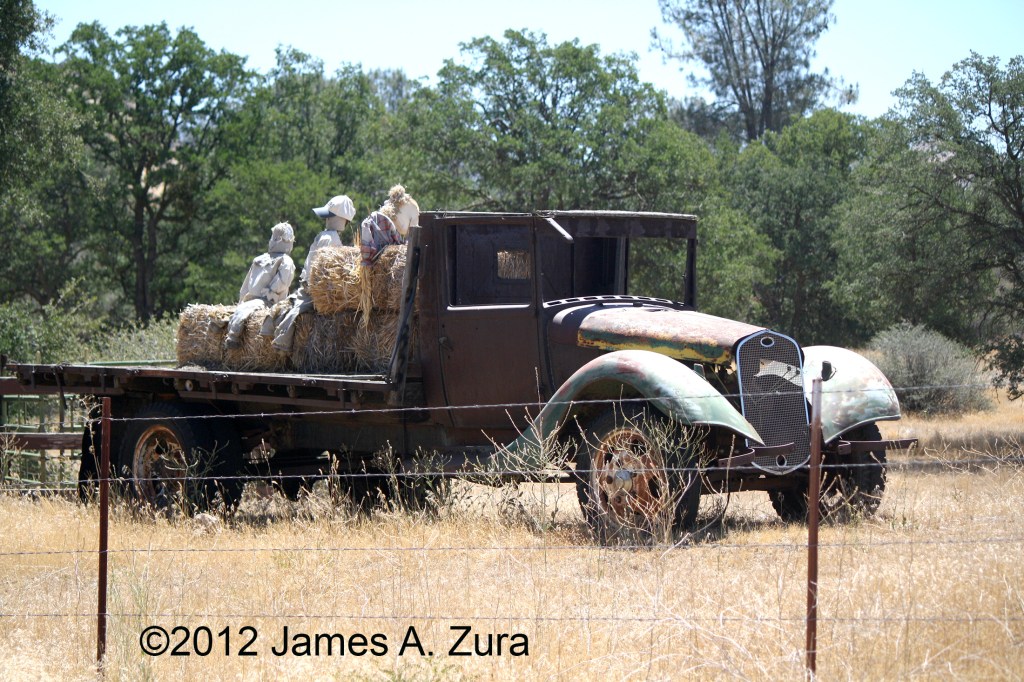
The two images of jalopies below, #16, labeled as a 1927 Buick, and #17, an unidentified truck, were taken on the Caliente-Bodfish Road, east of Bakersfield, California in 2012. Both photos are by Jim Zura. Happy Halloween!

So what’s the difference between a vintage car and a classic car? (I had to look it up.) According to West Coast Shipping, a company that deals in cars from around the globe, a classic car is at least 20 years old. Vintage cars were built between 1919 and 1930. A car must be at least 45 years old to be considered an antique car. And if a car was manufactured after 1922 and is at least 25 years old, then it is an Historical Vehicle.

Sign up for more articles. It’s free:


Battle of Vicksburg, MS: Civil War Victory Wasn’t Ironclad

The Sinking of the USS Cairo

by Ria Nicholas

Courtesy Missouri History Museum

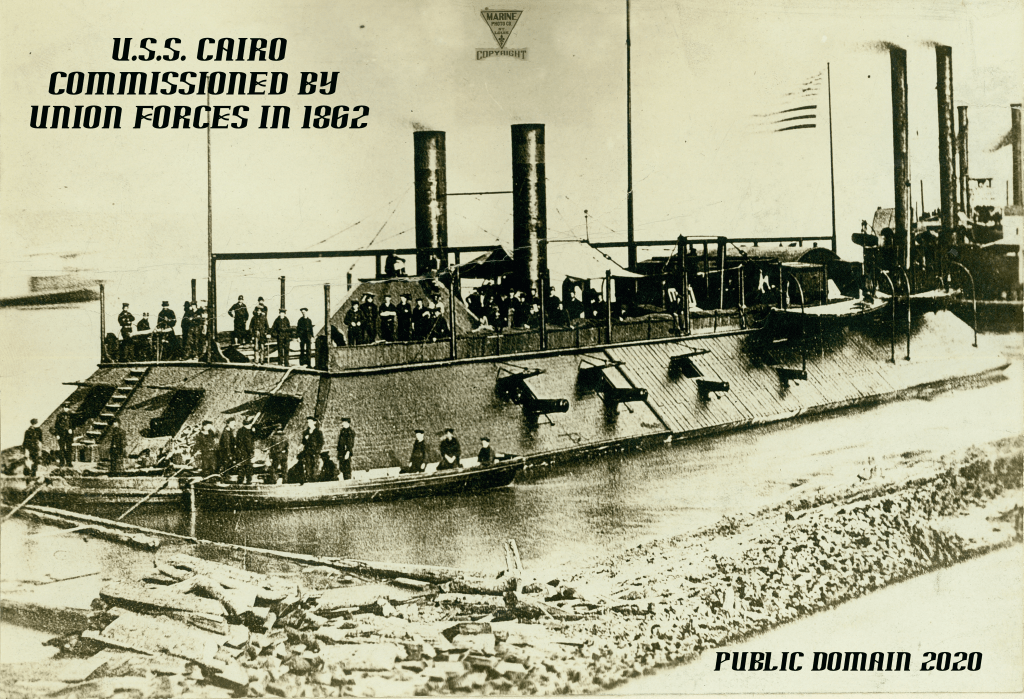
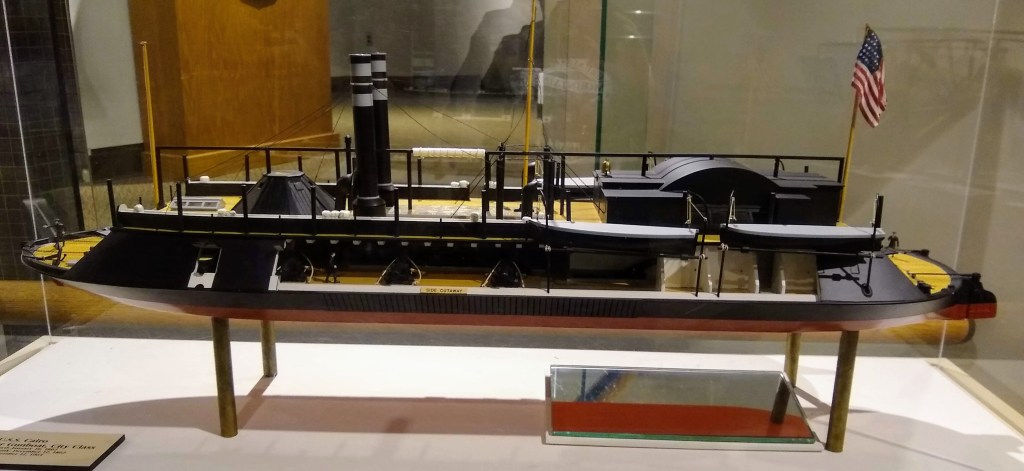
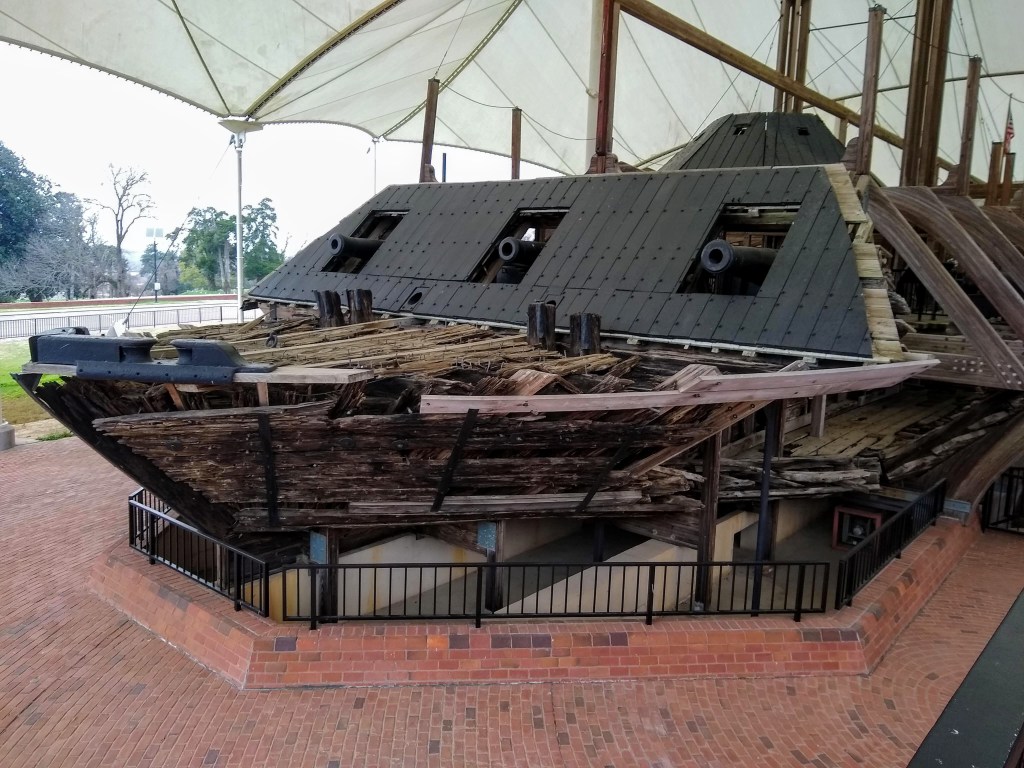
Were they awestruck as they boarded her? Or skeptical perhaps, those Union soldiers? Did they brim over with excess pride, like the kid riding a brand new motor scooter on Christmas day, when everyone else just has a bike? Impossible to tell now. But all those feelings and more must have been tossed aboard alongside the artillery. After all, the USS Cairo [KAY row] was, for her time, an example of cutting-edge technology: an ironclad steam-powered paddlewheeler!

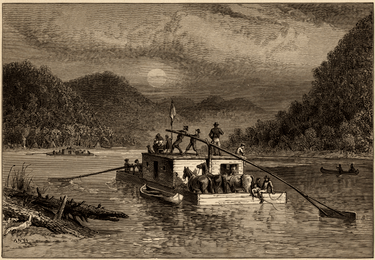
Flatboat; engraving by Alfred R. Waud

Imagine, if you can, a time before cars, trucks, trains, or airplanes, a time when roads amounted to little more than rough dirt trails. Transporting crops and other commodities was largely achieved using river boats. The efficiency of the trip depended on the speed of the current and the weight of the cargo. And the upstream leg of the journey, accomplished entirely by manpower, was arduous, to say the least. A round trip could take eight or nine months, and boat owners often found it easier to dismantle their boat, sell the timber, and walk home – along the Natchez Trace, perhaps – than to try to propel it back upstream.

Sign up for our free newsletter to receive more travel tips and ideas:

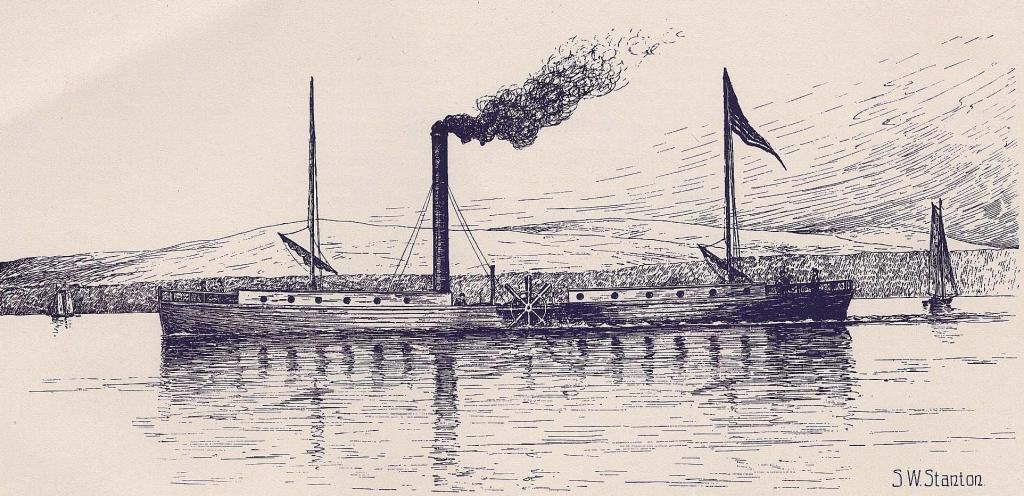
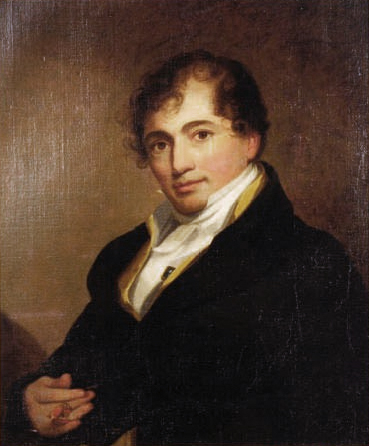
All that changed with the power of steam.  In 1769, James Watt invented the steam engine, but it wasn’t successfully applied to shipping until Robert Fulton designed his steam paddleboat, the Clermont, in 1807. The invention transformed commerce.

Simple steam power diagram; courtesy Σ64;
image altered to show ‘Paddlewheel’ instead of ‘Generator.

The power of steam essentially works as follows: When water is heated, it turns to steam and expands. If the water is held in a boiler – a metal tank – and prevented from expanding, it will build up tremendous pressure. A pipe and valve at one end of the boiler can be opened to release that steam pressure with great force. Harness that force through pipes and gears to turn paddlewheels, in the case of a ship, or driving wheels, in the case of a locomotive.

During the first half of the 19th century, steam paddlewheelers – either sidewheelers or sternwheelers – performed a variety of tasks.

Towboats moved barges up and down rivers, ferries carried passengers, and snagboats removed tree stumps and other submerged hazards from the water. The most common steam paddle wheeler, the packet boat, carried both crops and passengers.

Turret of the USS Monitor after battle – 1862;
photo in public domain, courtesy US Navy Online Library

By the time of the Civil War, the concept of armored ships had been floating around for some time, but the need hadn’t arisen until the 1820s, with the development of explosive shell-firing guns capable of penetrating a wooden hull. Iron plating didn’t become practical, however, until the power of steam evolved to handle the additional weight.


In 1862, hard on the heels of the legendary ironclad USS Monitor, the Cairo was pressed into service to support Union troops in their capture of Memphis. Later the same year, she took part in the Yazoo Pass Expedition, a joint operation led by Grant’s Army of the Tennessee and Porter’s Mississippi River Squadron, during the Vicksburg Campaign. 

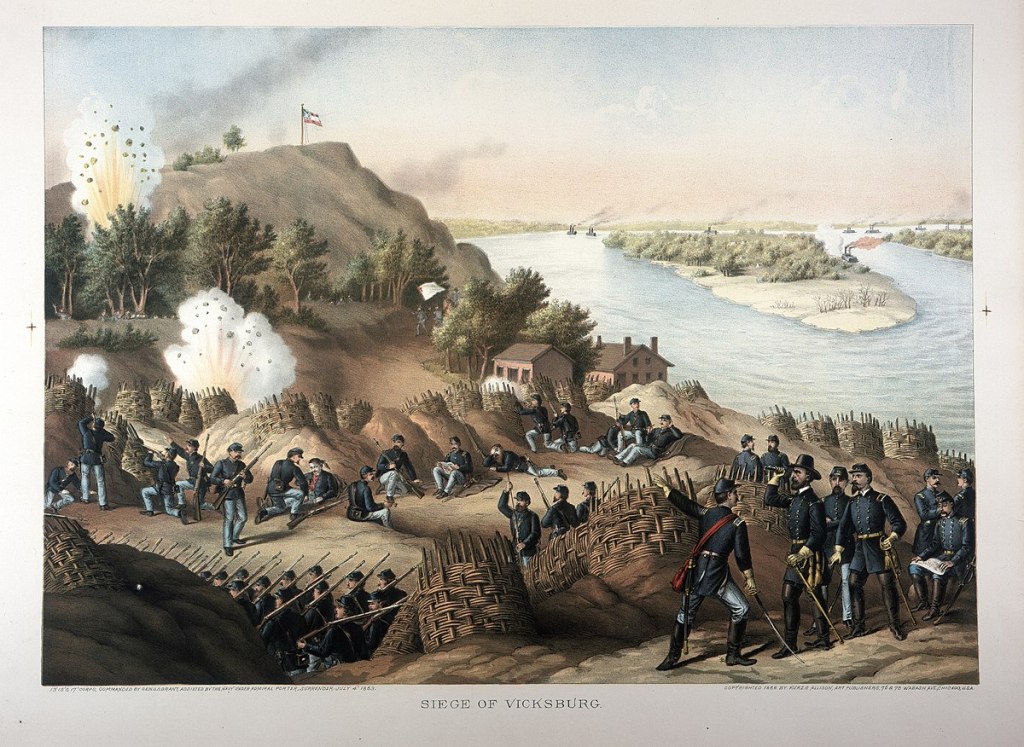
Due to its position on a bluff overlooking the Mississippi River, the Confederate stronghold at Vicksburg enjoyed a geographical advantage. The Union-led Yazoo Pass Expedition intended to bypass this bluff, snaking its way through the murky backwaters of the Mississippi Delta. Here it would enter the Yazoo River and approach unopposed. However, obstacles presented by having to breach levees and navigate a maze of channels and lakes, slowed the expedition, allowing Confederate forces time to construct a fort to block and repel the Federal fleet.


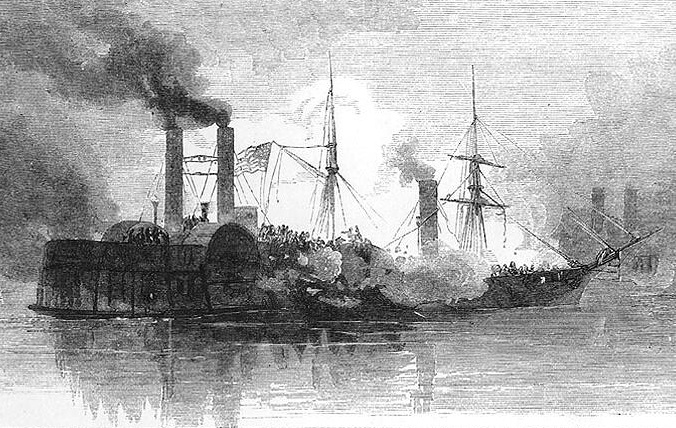
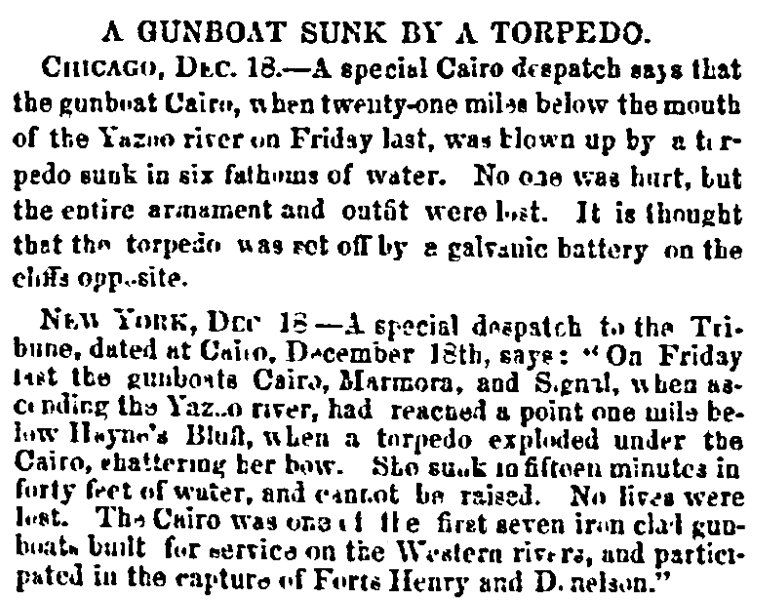
During the expedition, the Cairo earned the less-happy distinction of being the first ship ever sunk by a remotely detonated mine.  While attempting to clear mines, or ‘torpedoes,’ from the river in preparation for the attack, Cairo struck a mine. A group of Confederate volunteers, concealed along the riverbank, exploded the mine. In less than 15 minutes Cairo sank to the bottom of the Yazoo River. There the ironclad remained for the next 100 years, covered by a protective blanket of silt.

Sign up for our free newsletter to receive more travel tips and ideas:


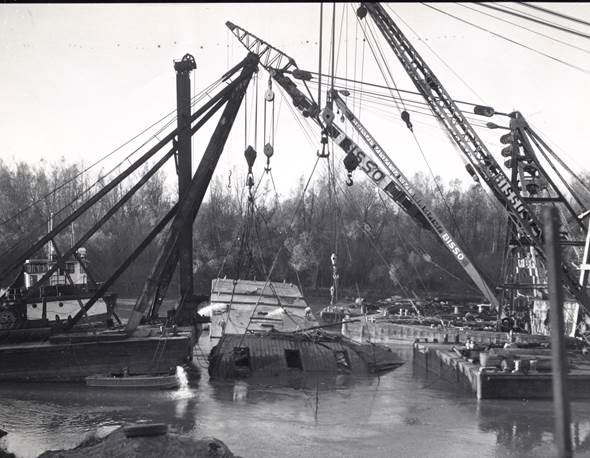
Cairo was located in 1956, and efforts to raise the ship finally succeeded in 1964. The thick Mississippi mud in which she had lain encased, had slowed the natural processes of corrosion and decomposition, which allowed for the recovery of numerous historical artifacts and for the restoration of Cairo herself.  Today, you can visit the final resting place of this ironclad paddle steamer at the Vicksburg National Military Park.

Travel Tips:

The Military Park, located at 3201 Clay Street in Vicksburg, Mississippi, preserves the site of the Battle of Vicksburg, a 47-day siege ending in the surrender of the city to Union forces – despite the Union’s loss of the Cairo and the failure of the Yazoo Pass Expedition.  It also commemorates the greater Vicksburg Campaign leading up to the Battle.

To visit, park your car at the Visitor Center, and purchase your entrance pass. The fee is about $20 per passenger vehicle. Various annual passes and passes for pedestrians and commercial vehicles are also available. While at the Visitor Center, we greatly enhanced our overall experience by watching the introductory video, which tells the stories of Union and Confederate troops, African American combatants, and local civilians.

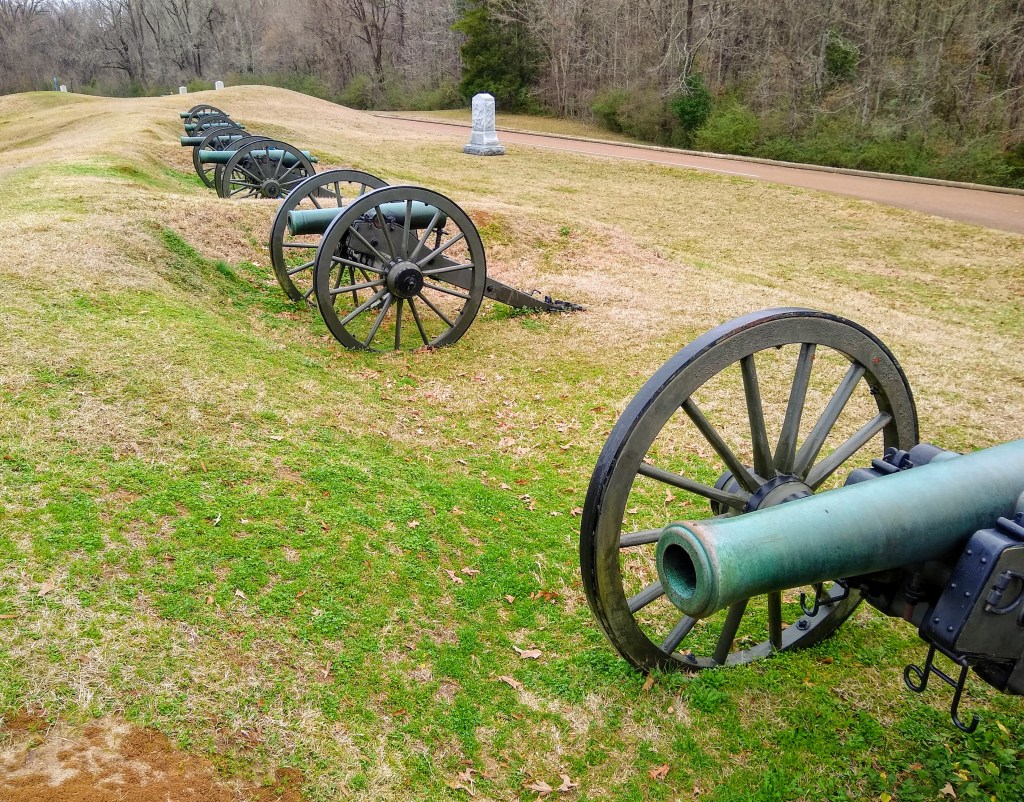
From there, we started our 16-mile, self-guided driving tour of the battlefield, including 1,325 historic monuments and markers, 144 cannons, the Shirley House (the only wartime structure remaining inside the Park), the Vicksburg National Cemetery, and the USS Cairo.

KID’S CORNER:

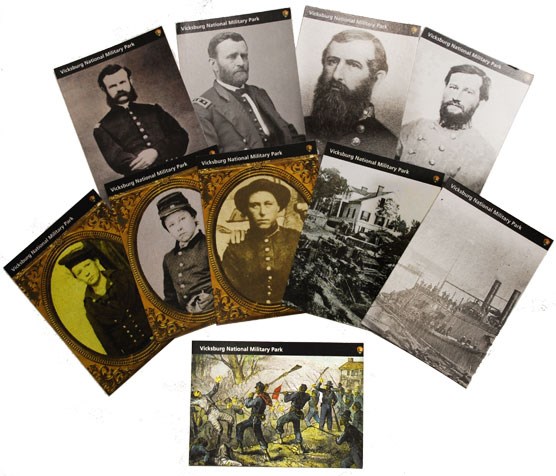
I can’t end this blog post without mentioning the Vicksburg National Military Park Trading Card Program. VNMP teamed up with 145 other parks to create the Civil War to Civil Rights trading card program. The National Park Service offers more than 500 trading cards commemorating the 150th anniversary of the Civil War and the 50th anniversary of the Civil Rights Movement of the 1960s. You can only earn the cards by visiting the national parks in person, but you can preview them here.  

Vicksburg National Military Park presents ten cards, honoring the contributions of women, children, African Americans, and commanding officers – with unique and sometimes surprising stories. Collect the card for artillery commander John Wesley Powell, who went on to explore the Grand Canyon with only one arm, or the card for soldier Albert Cashier, who was actually a woman!

Sign up for our free newsletter to receive more travel tips and ideas:


Asheville, NC: A Little Castle for Three

Luxury and Excess at the Biltmore

By Ria Nicholas

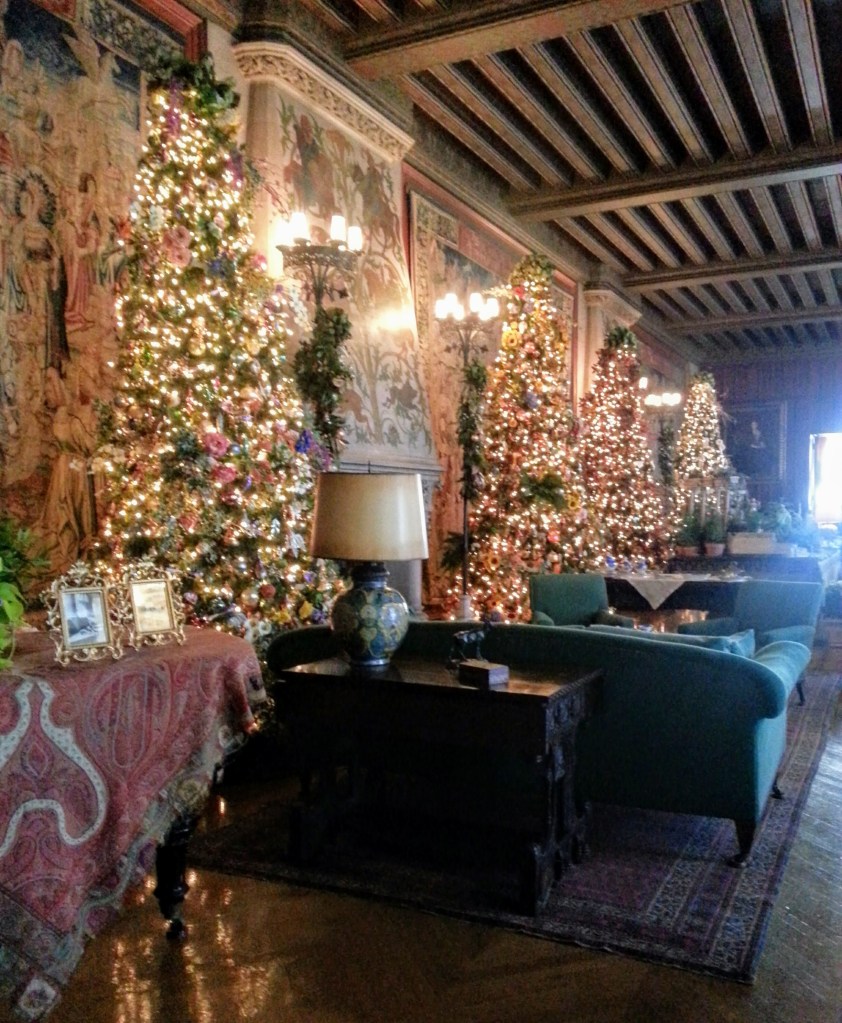
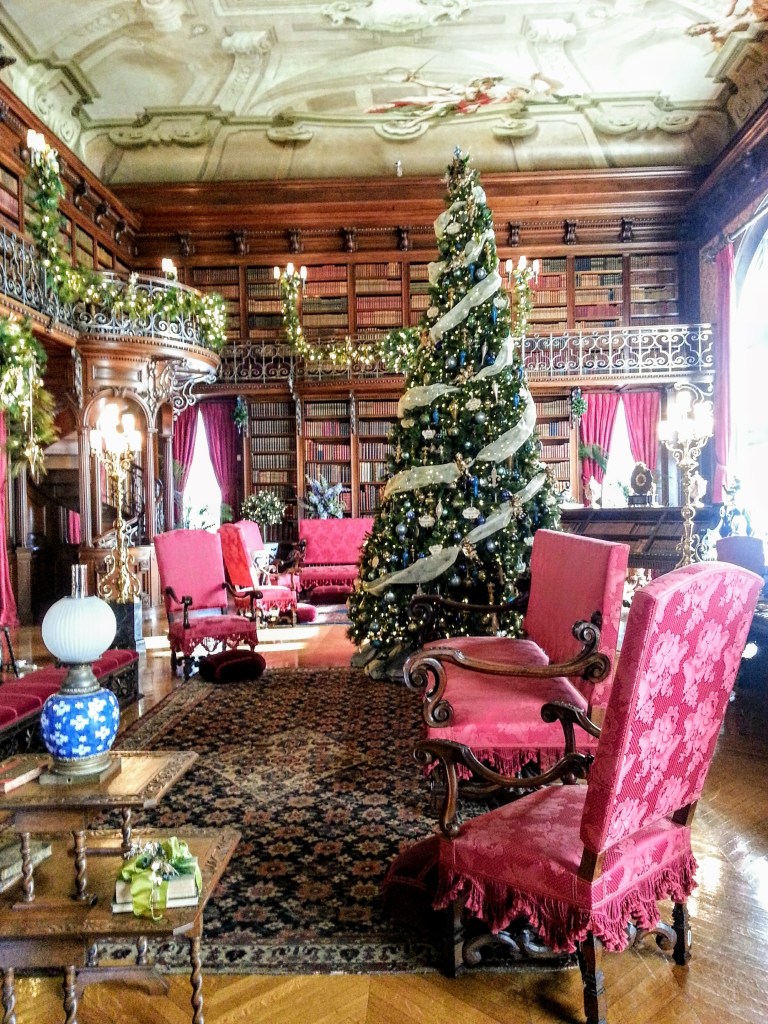
The road trip from Knoxville, Tennessee to Asheville, North Carolina snakes its way down I-40 through the verdant Smoky Mountains.  We made the trip in winter, when gossamer shrouds of mist, prompted by the crisp December air, billow up from among the dips and hollows and dissipate in the early morning sunlight. This is the time of year when Biltmore Estate dons its best holiday finery. 

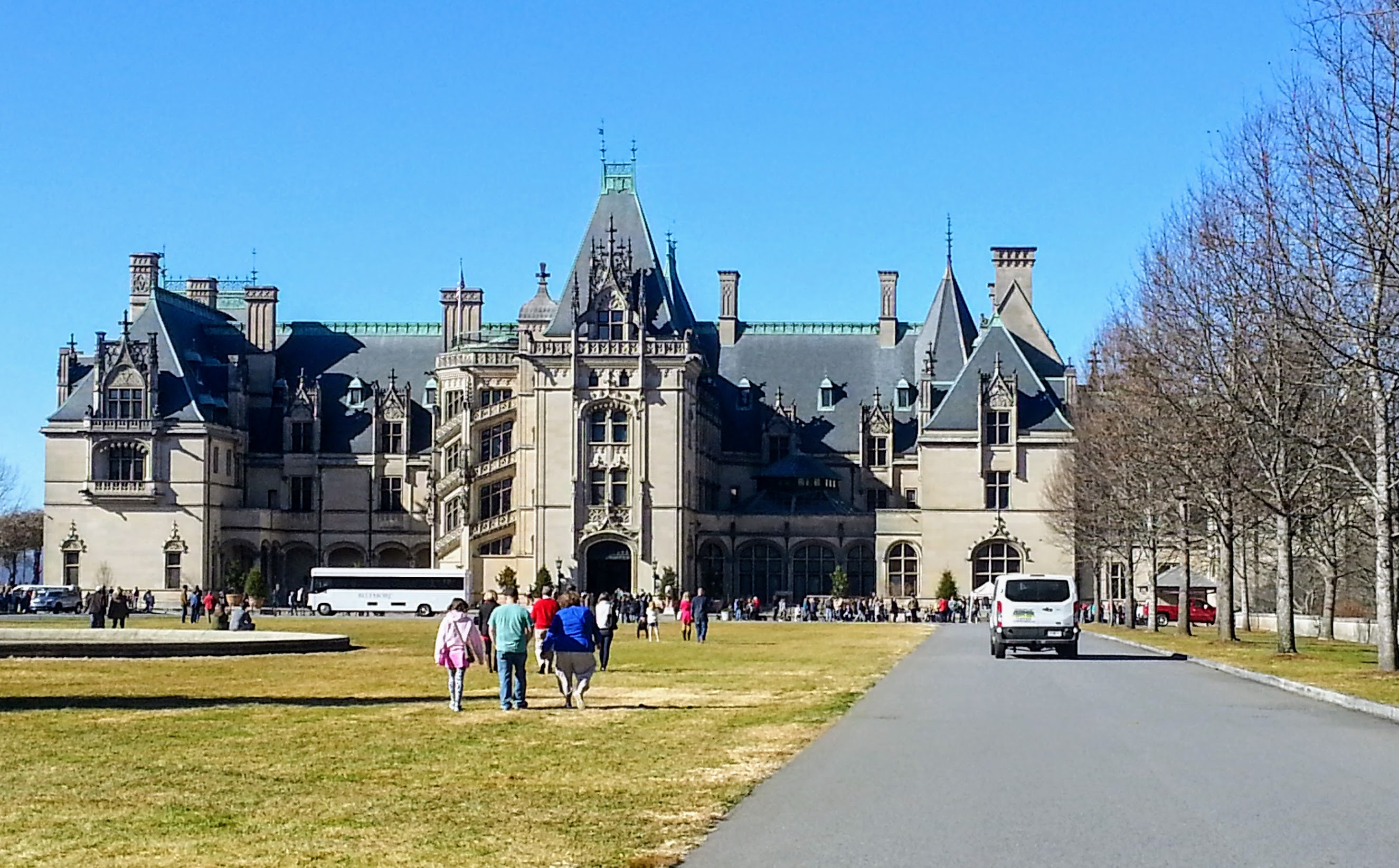
The 8,000-acre grounds of the estate sprawl out impressively, and at the distant end of an expansive lawn, the chateau anchors the horizon, resplendent as a crown jewel of the Gilded Age. Her spires and pinnacles held us spellbound; her 10 million pounds of polished limestone dominated both the landscape and our imaginations. 

Sign up for our free newsletter to receive more travel tips and ideas:


This is Biltmore House, America’s castle, the largest single-family home ever built in the United States! It was the project of George W. Vanderbilt, grandson of railroad magnate Cornelius “Commodore” Vanderbilt.

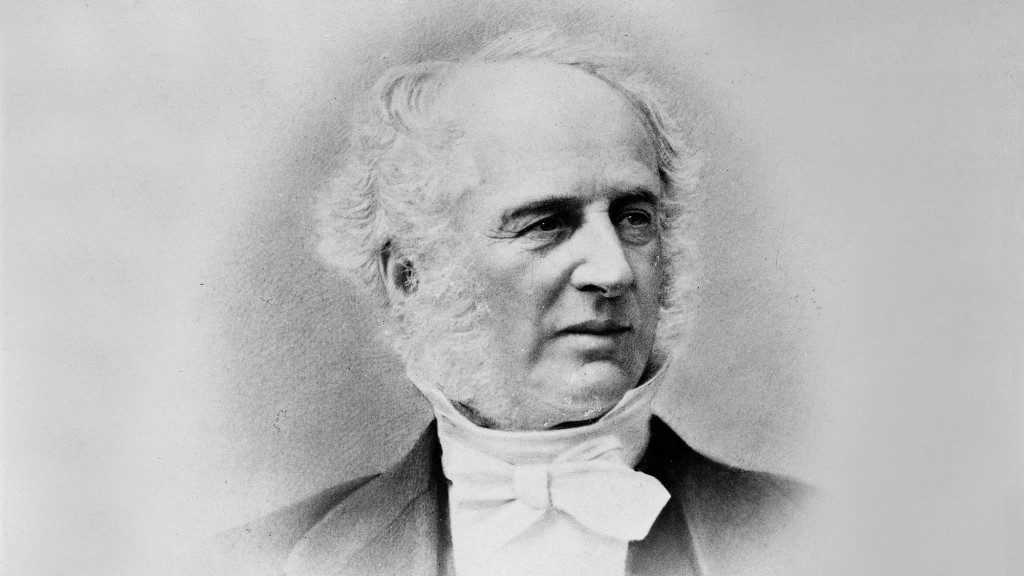
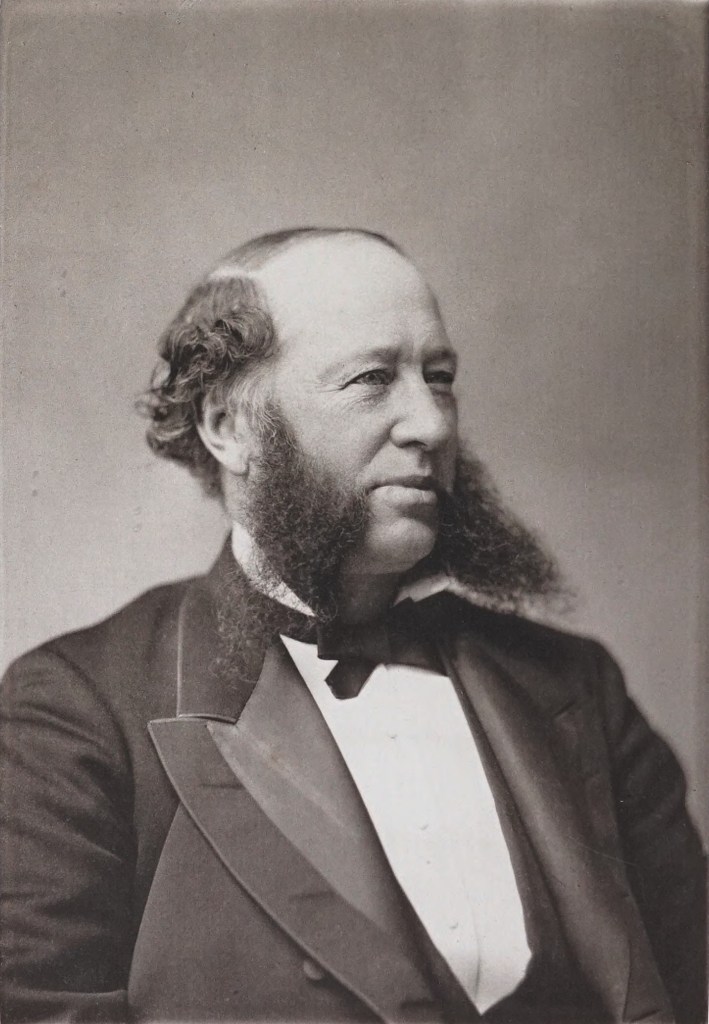
Three generations of Vanderbilt – left to right: Cornelius, William, and George

Born into poverty on Staten Island, Cornelius Vanderbilt quit school at the age of 11 to work on the waterfront. By the age of 16, he purchased his first boat and used it to ferry passengers from Staten Island to New York and back. From these simple beginnings, he grew, first a steamship company, and later a railroad and shipping enterprise. At the time of his death in 1877, his estate had ballooned to $100 million – a staggering sum at the time.

In his inequitable will, Cornelius Vanderbilt bequeathed $90 million to his son William Henry, $7.5 million to William’s four sons, and the residue of his estate to his second wife and his eight daughters.

William Henry Vanderbilt, a business mogul in his own right, nearly doubled the family fortune. Unlike his father before him, he was a generous philanthropist but still left a fortune of nearly $200 million at the time of his death. The bulk of William’s estate was split between his two oldest sons, and, although George received far less money, his inheritance still amounted to several million dollars.

George W. Vanderbilt used his inheritance to design Biltmore in collaboration with architect Richard Morris Hunt and landscape architect Frederick Law Olmsted (of Central Park fame).  The ‘House’ takes its cues from the châteaux of the Loire Valley of France, including Blois, Chenonceau, and, of course, Chambord.  As mind boggling as the other statistics attributed to Biltmore, is the $6 million dollar price tag ($1.6 billion in today’s money) on this extravagant country retreat for three: George, his wife Edith, and their daughter Cornelia.

Sign up for our free newsletter to receive more travel tips and ideas:

Beginning in 1889, one thousand men toiled for six years to complete the ‘House’.  George Vanderbilt finally opened Biltmore Estate to family and friends on Christmas Eve, 1895.

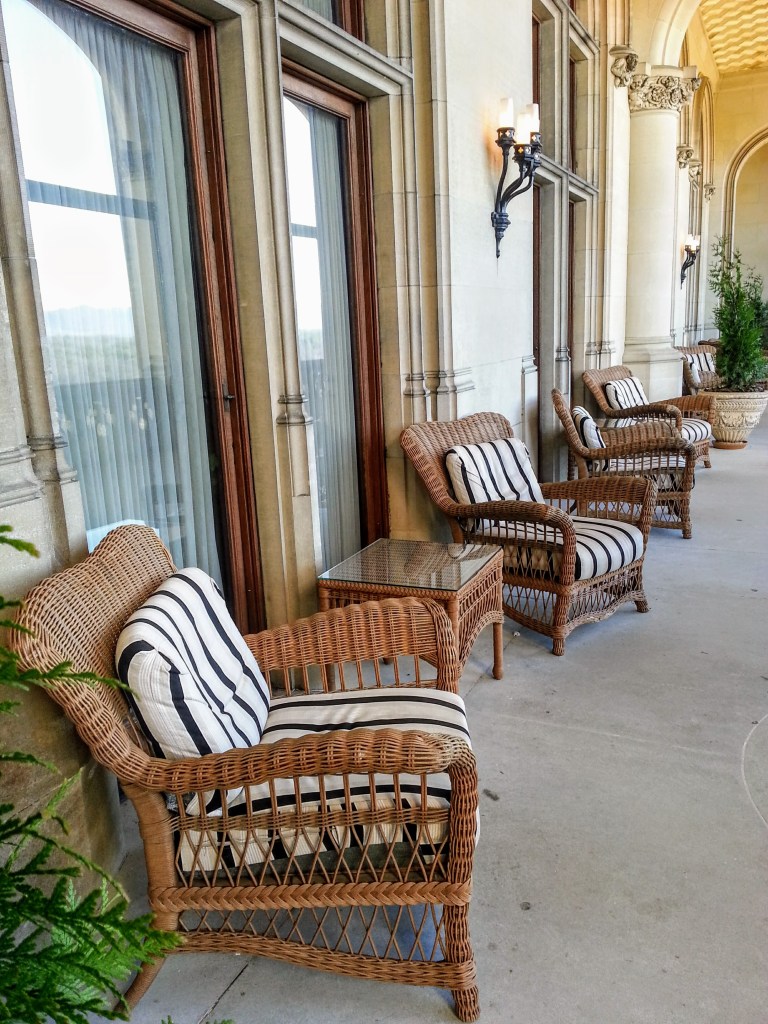
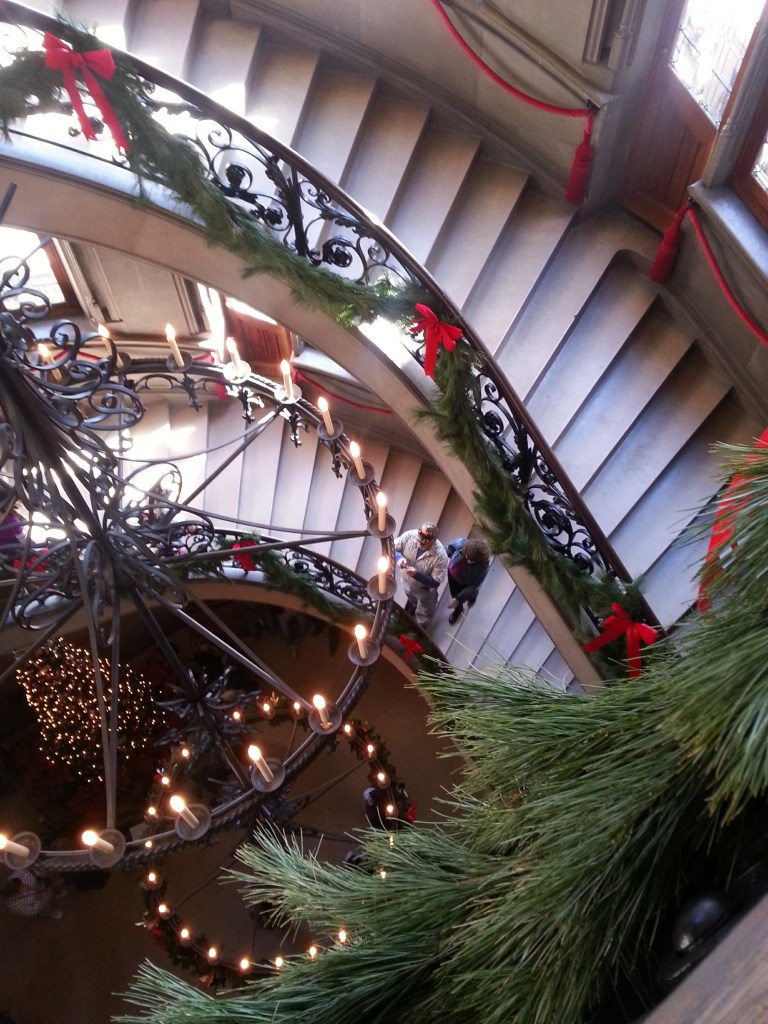
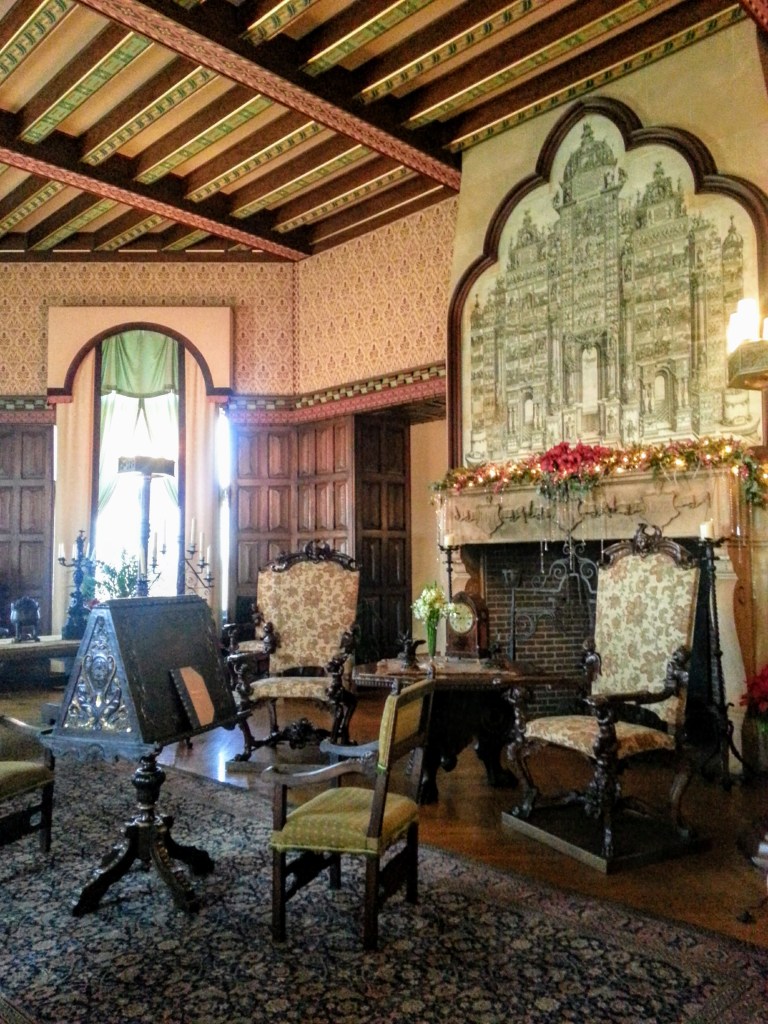
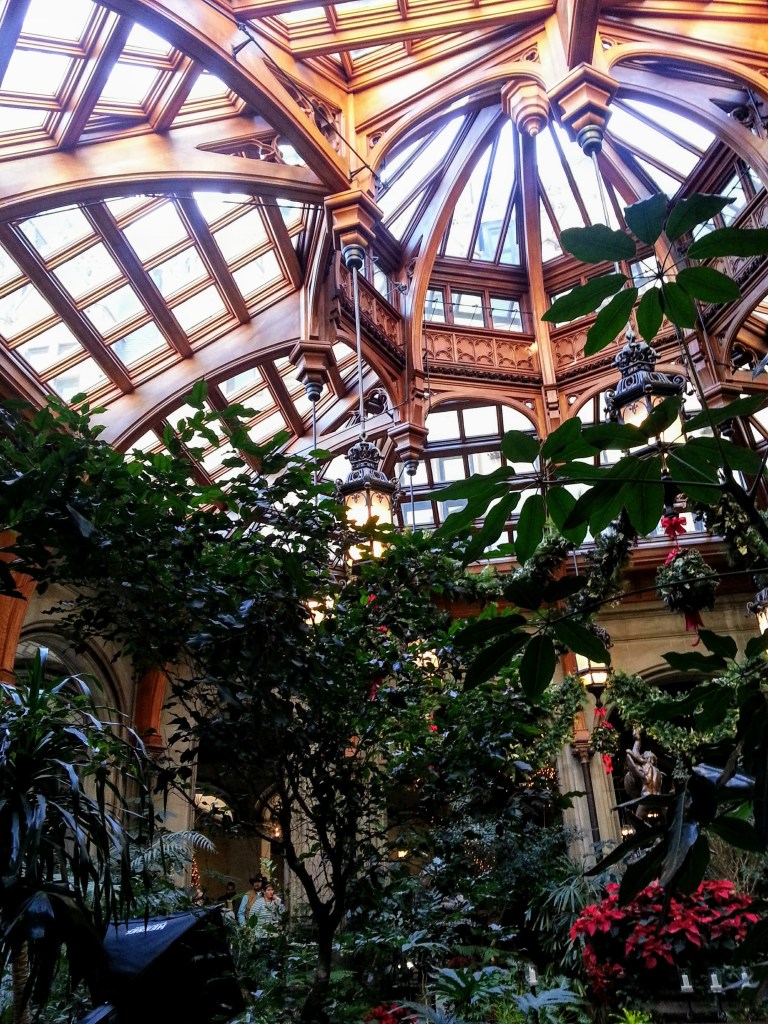
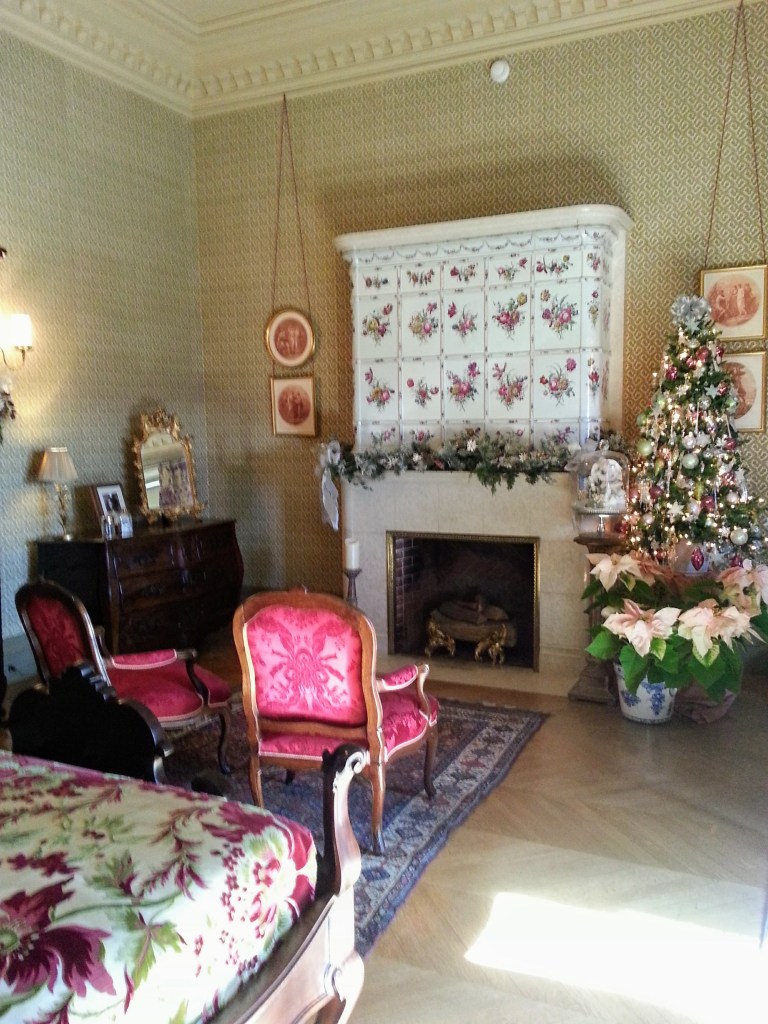
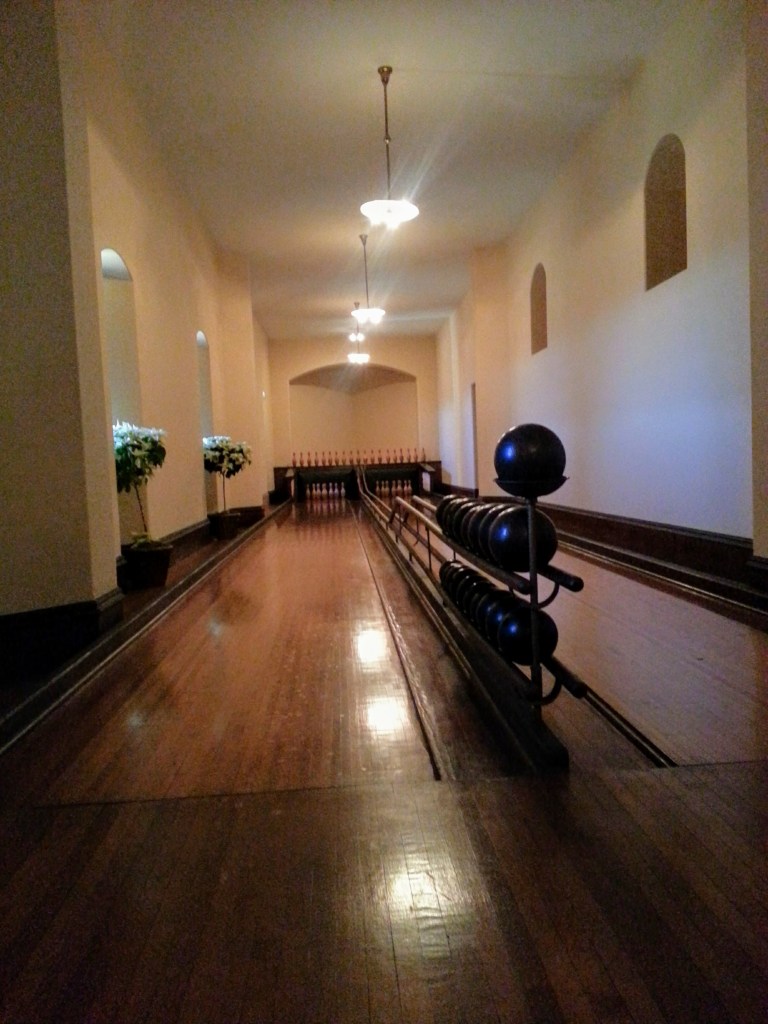
The home boasts some 250 rooms, including 35 bedrooms, a glass-domed winter garden, a banquet hall, library, music room, loggia, tapestry gallery, and massive four-story spiral staircase. In the basement, the family enjoyed their own bowling alley, gymnasium, and 70,000 gallon heated and lighted swimming pool.

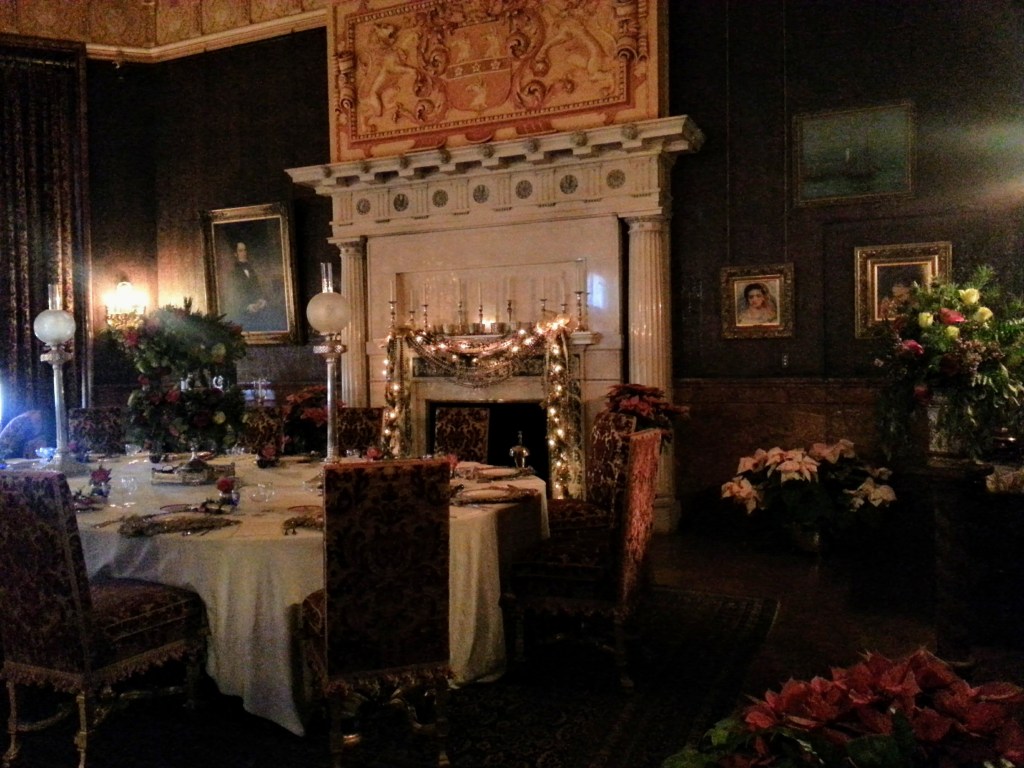
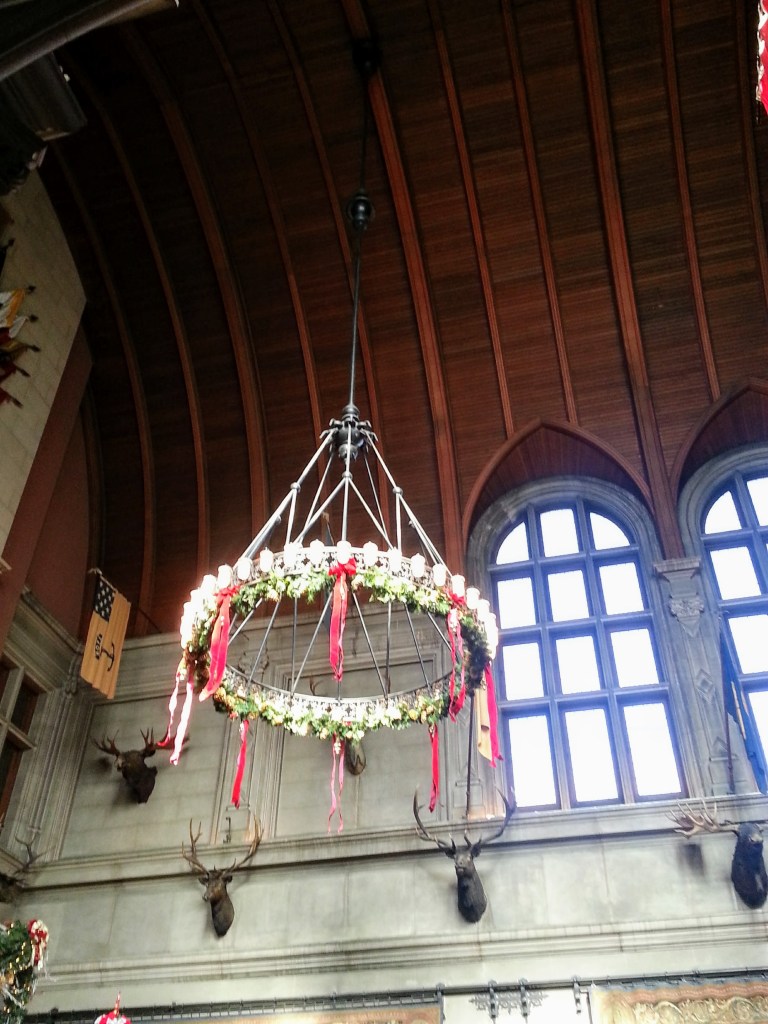
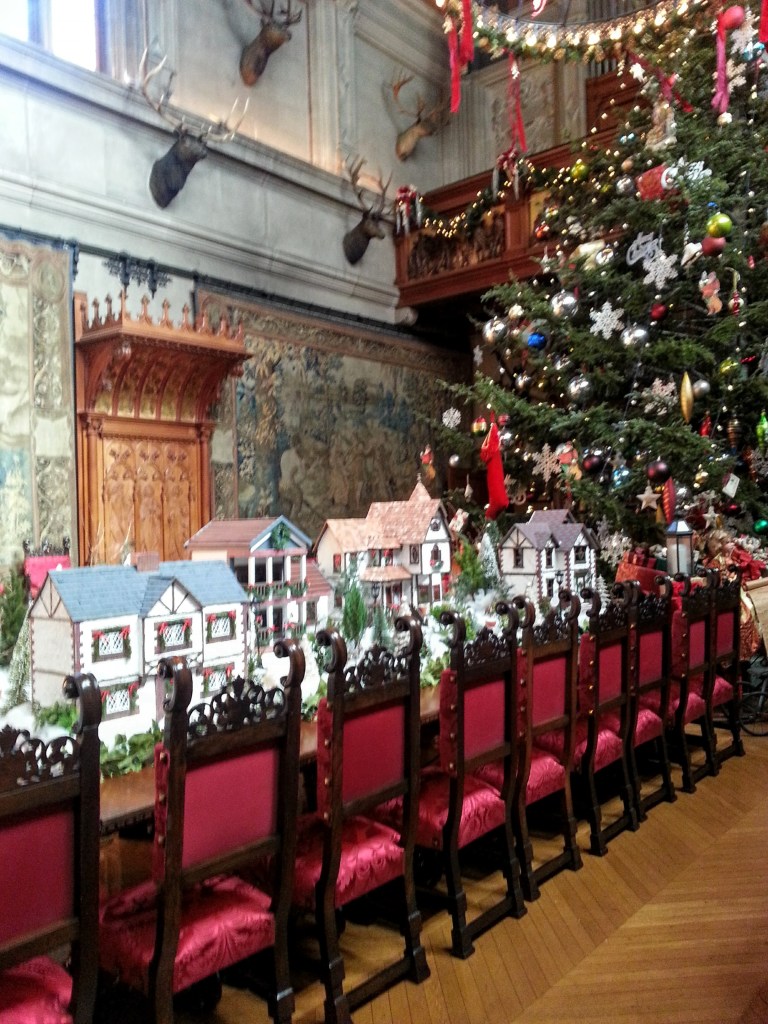
The medieval banquet hall, with its arched ceiling towering 70 feet overhead, hosted guests at a 40-foot table, opposite a massive fireplace – one of 65 throughout the home.  In this banquet hall, the Vanderbilts entertained a variety of luminaries, including artists, politicians, and authors.

“Yesterday we had a big Xmas fete for the 350 people on the estate – a tree 30 ft. high, Punch & Judy, conjuror, presents & ‘refreshments.’ It would have interested you, it was done so well & sympathetically, each person’s wants being thought of, from mother to last baby.”

From the letters of edith wharton

Those with a penchant for the Downton Abbey television series will be tempted to draw comparisons to Highclere Castle, ancestral home of Lord Carnarvon, who financed the excavation of Tutankhamun’s tomb. The lifestyle at Biltmore did, in fact, resemble that portrayed in Downton Abbey.


Sign up for our free newsletter to receive more travel tips and ideas:

All that changed in 1930, when Cornelia Vanderbilt Cecil opened Biltmore to the public, in an effort to draw tourists and stimulate the local economy during the Depression. Today, Biltmore welcomes 1.4 million visitors each year and provides employment for more than 2,000 people.  The Estate’s present 8,000 acres include several restaurants, extensive gardens, the nation’s most visited winery, luxury hotels, and a variety of shops.

SIDE NOTE:

Fashion maven, Gloria Vanderbilt, and her son, journalist Anderson Cooper, are direct descendants of Cornelius “Commodore” Vanderbilt.  However, they are not direct descendants of George W. Vanderbilt, who commissioned Biltmore House. George Vanderbilt was Gloria Vanderbilt’s great uncle, and therefore neither she, nor her son Anderson Cooper, inherited an interest in the Biltmore Estate.

Travel Tips:

No visit to Asheville would be complete without a pilgrimage to the Biltmore. We recommend pre-purchasing tickets, which range in price upward from $54, depending on the date of your visit and the amenities selected. Plan to arrive early and spend a good five hours or more traveling back in time and imagining yourself a Vanderbilt, as you wander the magnificent rooms and gardens.

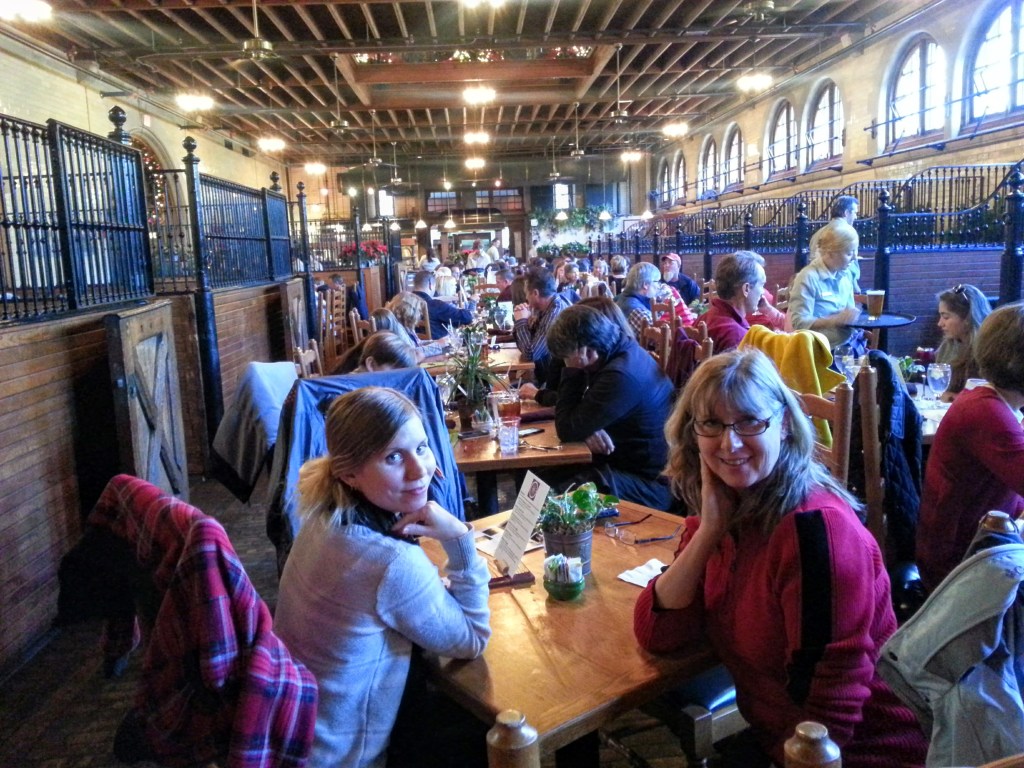
Here I am with my daughter as we stopped for lunch at Biltmore’s Stable Café.

Stop for down-home Appalachian comfort food at the Stable Café, so named because it is located in the former carriage house and horse stable. You can’t beat the ambiance at this casual dining restaurant, winner of a 2020 Open Table Diners’ Choice Award. We thoroughly enjoyed it!

If you are over 21, take advantage of the complimentary wine tasting at Biltmore’s very own world-class winery, included with your daytime admission.

And if you’ve traveled from afar, or if you just want to extend your stay, you can reserve a room at one of several of hotels right on the Estate.

Biltmore Estate is located at 1 Lodge St, Asheville, NC 28803.

Sign up for our free newsletter to receive more travel tips and ideas: